
My first Apple computer was an iBook G3 in Blueberry. Debuting in 1999 it was nicknamed the Clamshell, although my dad always called it the toilet seat, and I thought it was marvellous. Curvy and colourful, it had an integrated handle, and as I swung it through cafés and airports, it made me feel like I was Someone. It also made sitting down to work seem like fun. Before Apple’s dream team of chief executive Steve Jobs and chief design officer Jony Ive came together, computers were beige and boxy. After the pair took charge, Apple unrolled a series of revelations: the iPod made my once sexy Walkman suddenly defunct. The iPhone wiped out Blackberry. Releases were events: what would become our next collective vital desire?
Objects have always conferred status in the eyes of those who care about such things, and design undoubtedly inflects how we feel about ourselves, but Apple were the first to realise this could also apply to technology. In the early years of personal computers, designers had relied on the acronym, MAYA, coined by Raymond Lowey back in the 1920s. Lowney’s MAYA stood for “Most Advanced Yet Acceptable”, a design and marketing axiom that nudged progress along, but always within conventional bounds. With their multi-coloured Macs, never mind the systems within, Apple ditched the idea of incremental innovation and so broke the mould.
This extended to architecture, so much so that when the Apple Store opened on New York’s Fifth Avenue in 2006, its glass box stood out as a gleaming icon of pared back beauty, as if in rebuke to the surrounding skyscrapers for their obvious efforts. People flocked to experience it. The construction, initially by Bohlin Cywinski Jackson, and later redesigned by Foster + Partners with input from Ive, is, like IM Pei’s 1989 Louvre Pyramid, essentially a street-level access point for a basement space, but the design turns it into an occasion.
In 1989, when Jobs launched Ive’s iMac, he unveiled it like an artwork, saying “it looks like it’s from another planet, a good planet with better designers”. No wonder, perhaps, that Apple Park, the company’s circular $5 billion Cupertino campus has all the appearance of a spaceship come to earth. Designed by Foster + Partners in collaboration with Jobs and Ive, Apple Park opened in 2017. Jobs wouldn’t live to see it. He died in 2011, and Ive left in 2019 to start his LoveFrom firm, whose clients include Ferrari, AirBnB and OpenAI.
And so to Cork: Apple opened its first site in Europe at Cork’s Hollyhill in 1980, employing just 60 people. Jobs came to visit. Interviewed for RTÉ by Pat Kenny, he said, “We started off building a computer because we couldn’t afford to buy one…”
Driving up the hill now, you can still see the original factory, inherited from the IDA. One of the five buildings that now makes up Apple’s European headquarters, it has been retrofitted, but still bears the old multi-coloured Apple logo. Today, this reads as a charming connection to a relatively recent past. In terms of progress, however, it is almost unimaginably distant.
Now the campus facilitates around 6,000 people and, given that our design choices reflect how we like to imagine ourselves, and to be seen, what does the new building say about Apple?
At the corporation’s London HQ and Store in the former Battersea Power Station, the choice of location, as well as the design speak of leveraging industrial tradition, building on the legacies of old technologies to create a new future. In Cork, the first impression is of commitment to both Ireland and Europe, which has an added significance given current turbulent US policies. The opening of Apple’s first permanent Dublin office at Park Place further underlines this.
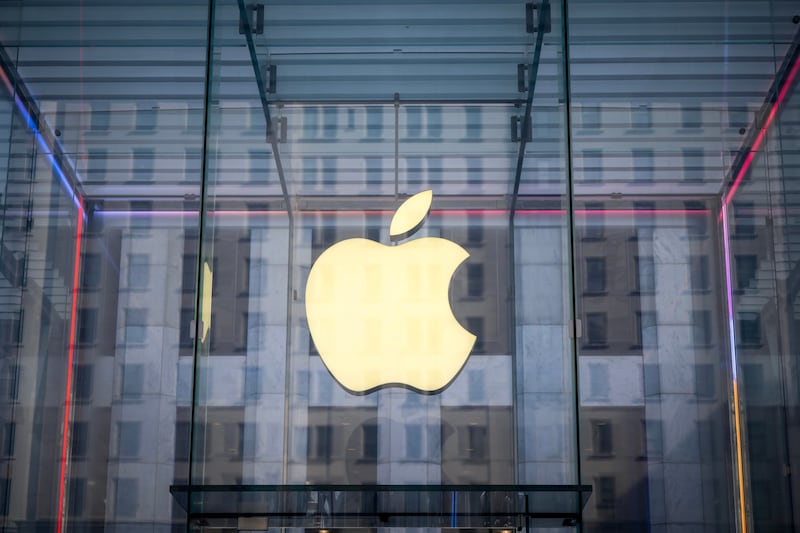 The Apple Fifth Avenue store in New York. Photographer: Michael Nagle/Bloomberg
 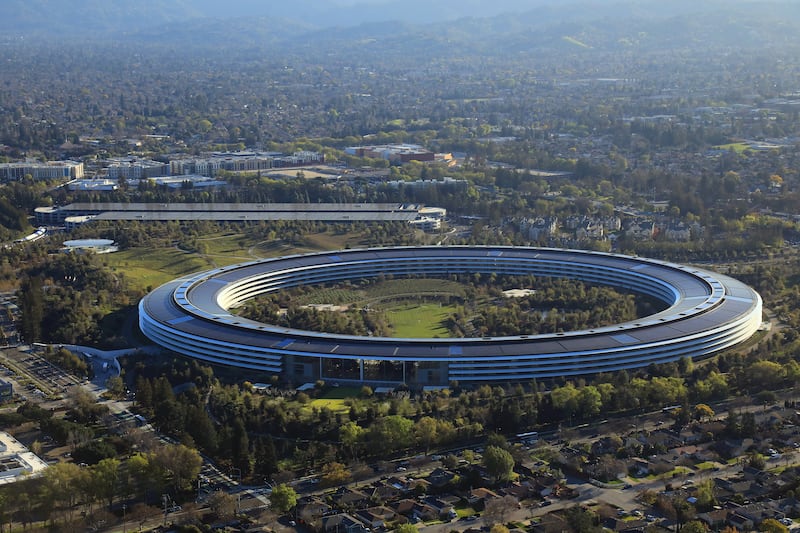 Apple’s headquarters in Cupertino, California. Photograph: Jim Wilson/New York Times
In Cork, the expansion necessitated an entire masterplan, including moving a road that cut across the site, creating on-site walkways and building a new public ring road in the process. On a walk through the recently opened fifth building at Hollyhill, Kristina Raspe, vice president of places with Apple, stresses the local: “We believe our buildings are the physical embodiment of our culture, our values and our commitment to the environment,” she says, and she communicates such belief and exceptional professionalism, that she makes this sound like something one might naturally say in conversation.
“We always try and find an exceptional local architect that we can work with to bring that local feeling,” she continues, before stressing that “the most important thing in the design of all our buildings is how they make our people feel […] and when there are flavours of the local immersed with our culture, it makes people really have that belonging.”
[ Challenge of AI is to bridge the culture gap between its creators and custodiansOpens in new window ]
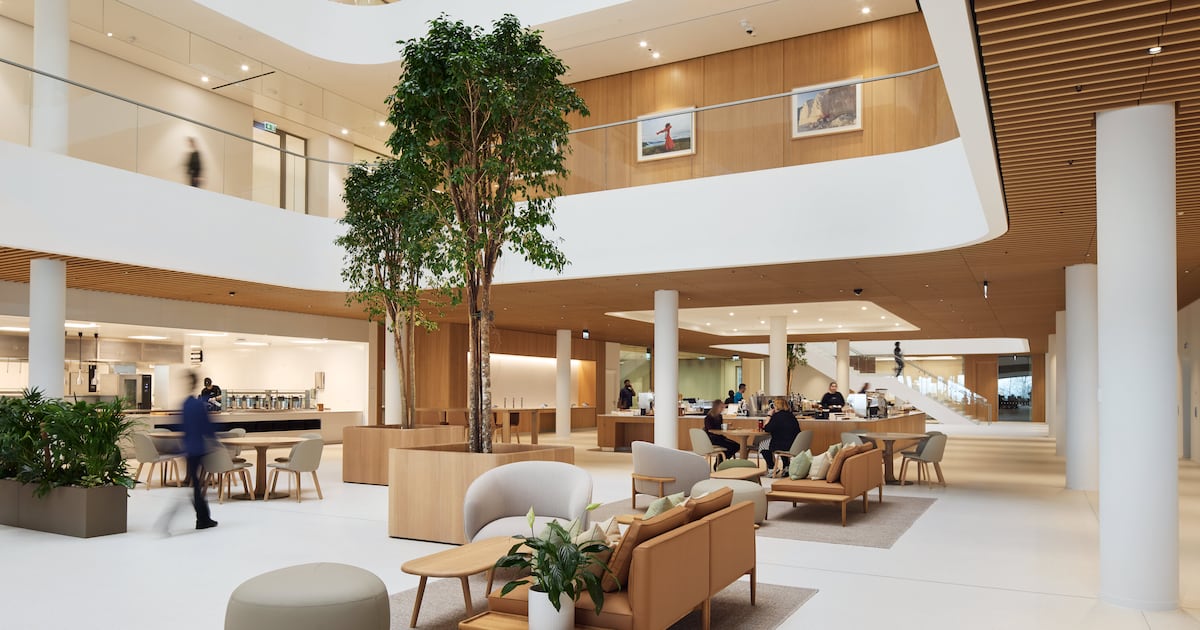
At what the team calls Hollyhill Five, the local is, essentially, elements of Kilkenny limestone, and the views from the huge atrium window across the rolling green valley, all the way to Blarney.
The local architects were Scott Tallon Walker, who were also responsible for retrofitting the original buildings, creating Hollyhill Four, and for the masterplan. Lead architect David Flannery is proud of the project, saying that the most recent building was his firm’s closest collaboration with Raspe and her team to date. Anyone expecting spaceships, multi-coloured or otherwise, will be disappointed. Apple these days is much more about the sleek, the smooth, the seamless. It is also about the more intangible products such as services, apps and content. And, as Raspe points out, the Hollyhill campus is primarily a place of work, facilitating everything from software engineers to marketing teams.
[ From confusion to paranoia: firms struggle with Trump’s trade agendaOpens in new window ]
“We spend a lot of time really focused on understanding the unique needs of each of our groups that we’re in service to, and really try and empathise with them, to understand what is going to make them feel most inspired to do their life’s best work with Apple,” she says.
As, in practice, their life’s best work is for a corporation that reached a $4 trillion market value in October 2025, and corporate espionage must be an omnipresent risk, I don’t actually get beyond the admittedly marvellous communal areas of café, restaurant and series of atrium breakout spaces.
The building is corporately beautiful, exceptionally so, and it is also highly sustainable. Constructed with zero waste to landfill, it is fully electric, running on one hundred per cent renewable energy, has more than 200 solar PV panels, and can harvest 1.2 million litres of rainwater, which goodness knows, we’re getting these days. Designed to be certified BREEAM Excellent, the nuances of its environmental credentials go right down into certifying the treatment of the timbers on site. Flannery also points out the louvers on the dramatic atrium window, which deals with issues known to everyone who opted for a glass box, whether at home or at work, including overheating in summer, and low-sun glare in winter.
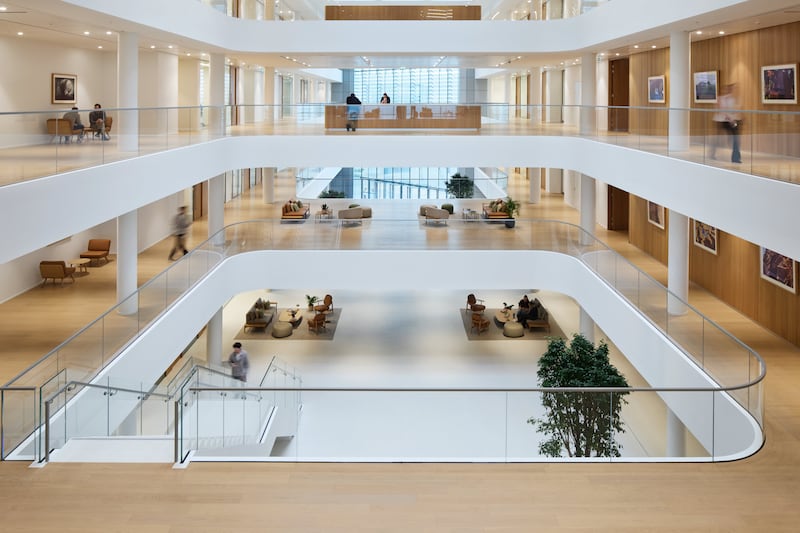 The building is corporately beautiful, exceptionally so, and it is also highly sustainable.
 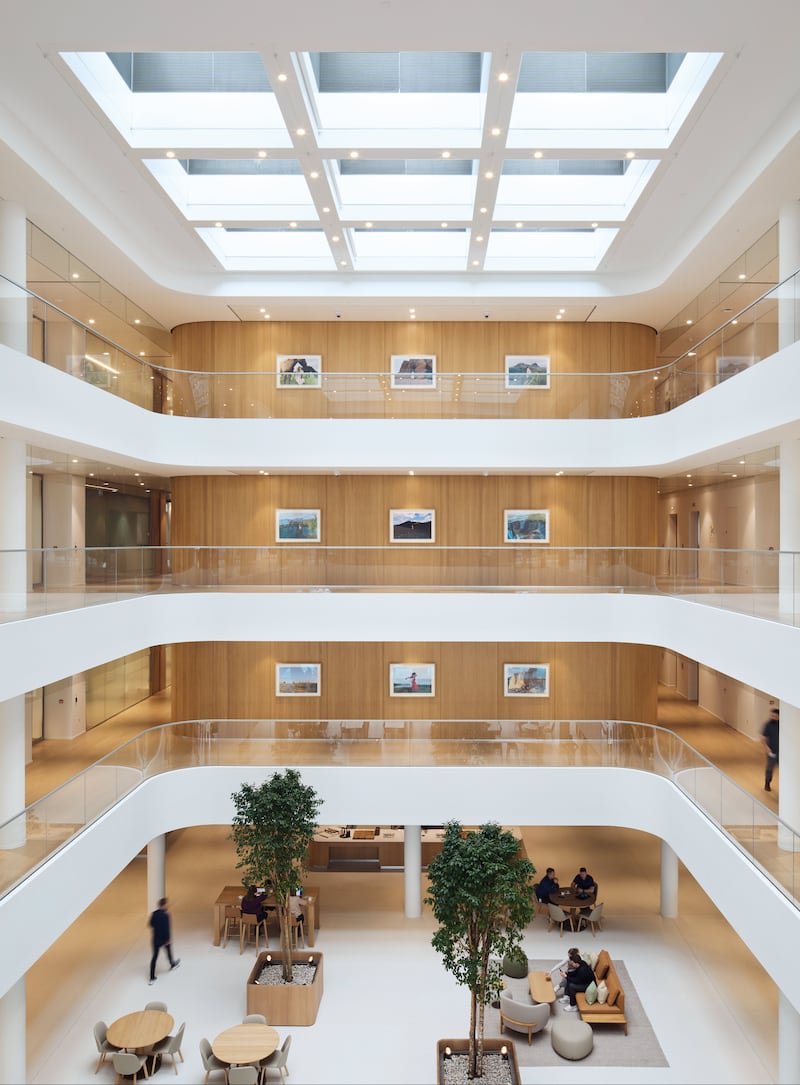 Anyone expecting spaceships, multi-coloured or otherwise, will be disappointed. Apple these days is much more about the sleek, the smooth, the seamless. Pictured: Apple Hollyhill Five Cork, images courtesy of Apple.
There are only so many ways you can design a pair of trousers, and ultimately the same goes for offices. In Cork, Flannery and the teams at Scott Tallon Walker and Apple have created subtle curves, and used quality materials with a muted palette.
“We have designed it,” says Flannery, “to speak to the products of Apple. You can see it in the curves in the atria. The interior very much feels that you’re in a beautiful Apple product. It speaks to the Apple production and concept of excellence and innovation.”
The art works are a variety of scenes, all shot on iPhone.
[ Why is Ireland so lacking in architectural ambition?Opens in new window ]
What? No brash primary colours and ping pong tables? These, beloved of companies such as Facebook-owner Meta, when they moved into Dublin’s Silicon Docks, were never an Apple pursuit. “Our old design aesthetic had a lot more simplicity,” says Raspe, which seems quite a statement given the sort of Scandi-minimalist feel around us. “It was very white and light greys because we really felt like the people brought the colour and the energy, and we wanted to almost create a whiteboard for the mind.”
Over time, she says, giving more warmth made people feel more comfortable: “Starting about seven or eight years ago, we transitioned to this design aesthetic.” With current conversations about returning to the office, versus working from home and hybrid working, is Apple’s commitment to a new space, capable of accommodating 1,300, out of step? According to Flannery, Raspe brought a strong sense of hospitality to the project. “The way people work is changing,” he says. “The building is designed to encourage people to move away from their individual workspace, which is the individual typology of working, and sit around and work in groups.”
From Raspe’s perspective, that collaborative ethos means the working from home debate is not an issue.
“We have a culture of meeting together and rock tumbling,” she says. “Tim [Cook] has a saying that I think really sets Apple apart, it’s that we truly believe, all our employees truly believe that one plus one equals three.”
Around us, those improbable mathematics are being added up by small groups on chairs and sofas in natural earth tones. The furniture isn’t Irish made. Probably, given the approximately 90 nationalities that make up the Cork workforce, the local must be balanced with something more consistently international. Maybe, aesthetically at least, it is all about MAYA after all.