
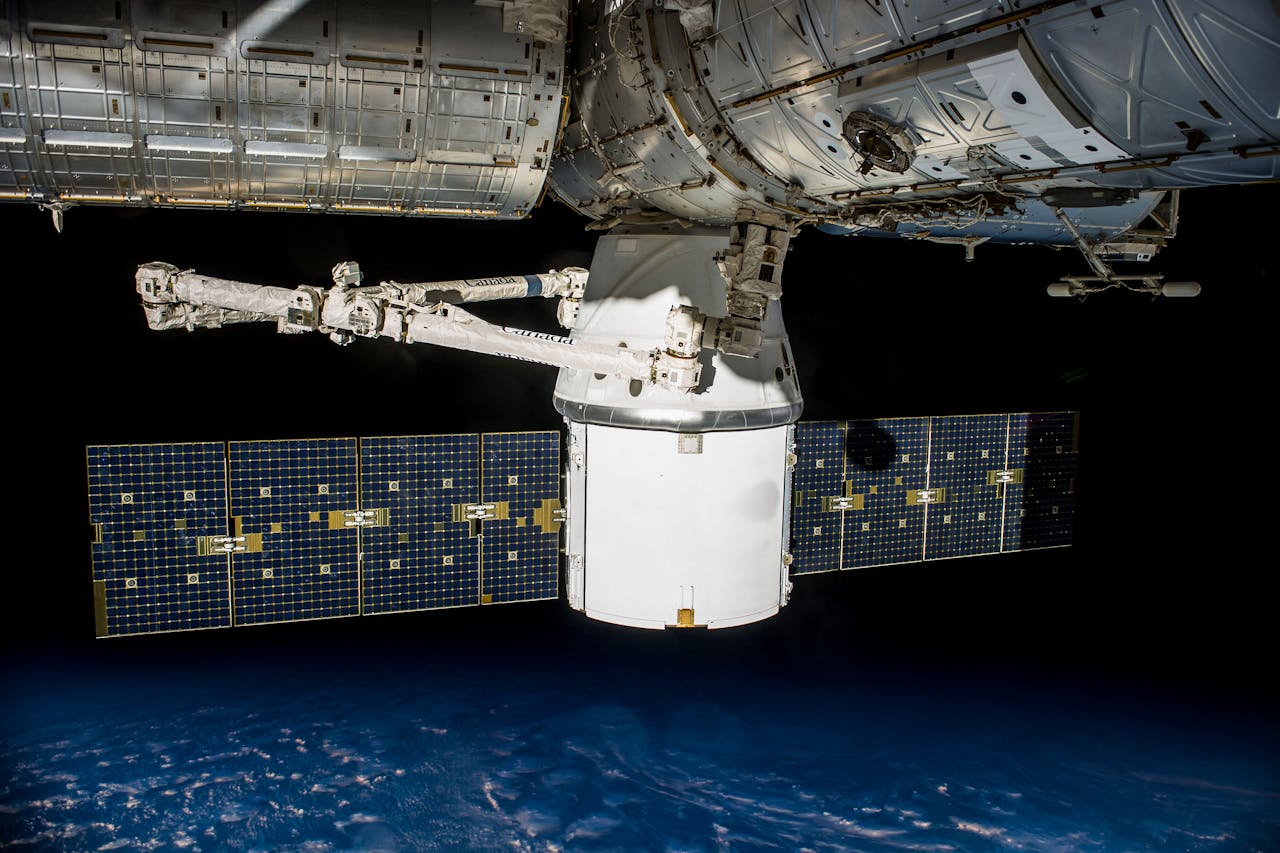
A strain of common fungus has extracted palladium from crushed meteorite while growing aboard the International Space Station, marking a significant step toward biological resource use in space.
Inside sealed containers, scientists placed powdered meteorite into liquid cultures and left them in microgravity for several weeks. When the samples returned to Earth, analysis showed measurable amounts of palladium dissolved into the liquid. The fungal cultures released more of the metal than a bacterial species tested alongside them.
The result strengthens the case for using microbes to process raw materials beyond Earth, reducing the need to launch every critical component from the ground.
Microgravity Changes The Chemistry
On Earth, fluids circulate through convection. In orbit, that movement largely disappears. Metal ions drift slowly instead of mixing freely, raising doubts about whether biological extraction systems would function reliably.
The experiment indicates they can. Even without added chemicals, the fungus drove extraction in near weightlessness. Researchers also observed that purely chemical leaching behaved differently in orbit, in some cases releasing certain elements faster than expected.
Across 44 elements measured in the samples, 18 were drawn into solution with microbial help. The fungal cultures accounted for a substantial share of that release.
Fungi Outperform Bacteria
The species Penicillium simplicissimum proved more effective than the bacterium Sphingomonas desiccabilis under the same orbital conditions. Palladium concentrations rose most sharply when the fungus grew directly on the meteorite grains.
The findings underline the importance of organism selection in biomining. Different microbes interact with minerals in distinct ways, and performance in space does not simply mirror laboratory behaviour on Earth.
How The Fungus Does It
Fungi alter their surroundings chemically rather than mechanically. Many release carboxylic acids that bind to minerals and free metal ions. Once these compounds accumulate in a closed system, dissolution can continue even without constant contact between cells and rock.
Chemical analysis revealed another shift. In microgravity, the fungus increased production of some organic acids and other small molecules. That suggests spaceflight conditions influence microbial metabolism, with implications for designing future bioreactors.
From Small Chambers To Space Industry
Identical hardware operated on Earth allowed researchers to isolate gravity’s role in the process. Despite promising results, the experiment was conducted on a small scale. Scaling up would require tighter control of microbial growth, fluid dynamics and metal recovery systems.
Engineers would also need efficient methods to capture and refine dissolved metals within closed loops.
The work builds on earlier orbital biomining trials and adds a new data point using genuine meteorite material. It signals that living systems remain active partners in chemistry even in orbit, reshaping thinking about how future crews might obtain critical materials during long missions.
 Published by Kerry Harrison
Kerry’s been writing professionally for over 14 years, after graduating with a First Class Honours Degree in Multimedia Journalism from Canterbury Christ Church University. She joined Orbital Today in 2022. She covers everything from UK launch updates to how the wider space ecosystem is evolving. She enjoys digging into the detail and explaining complex topics in a way that feels straightforward. Before writing about space, Kerry spent years working with cybersecurity companies. She’s written a lot about threat intelligence, data protection, and how cyber and space are increasingly overlapping, whether that’s satellite security or national defence. With a strong background in tech writing, she’s used to making tricky, technical subjects more approachable. That mix of innovation, complexity, and real-world impact is what keeps her interested in the space sector.