
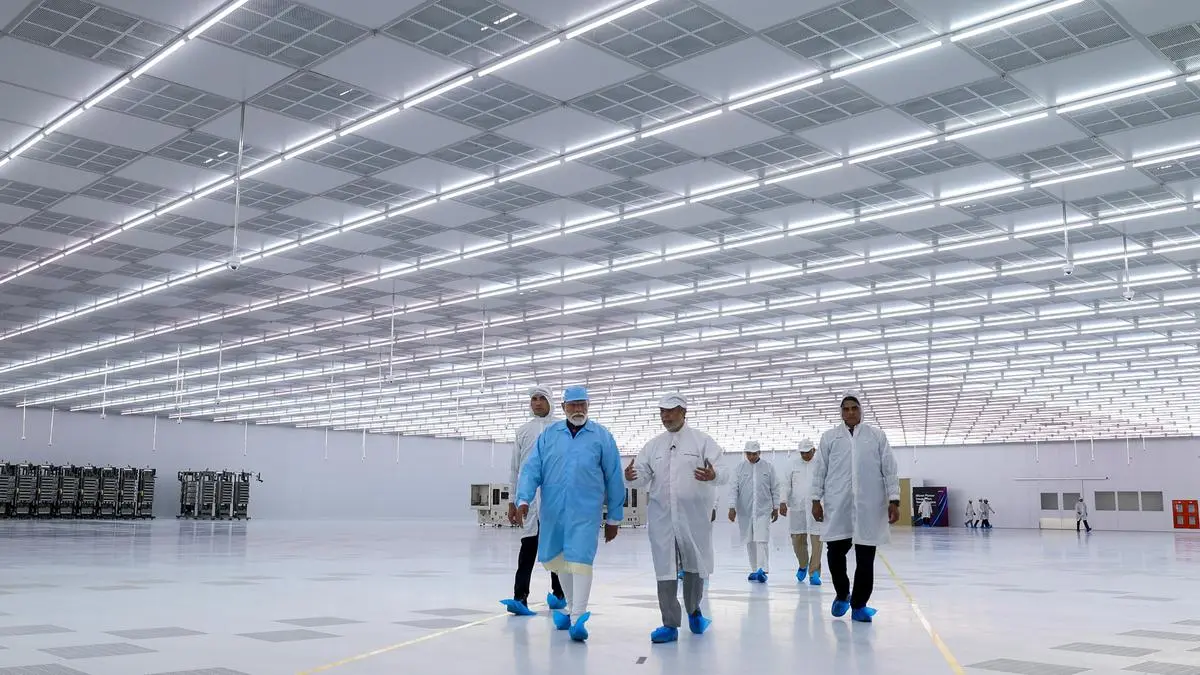

Prime Minister Narendra Modi with Micron CEO Sanjay Mehrotra and others at the Micron Technology’s semiconductor facility, in Sanand, Gujarat. PM Modi inaugurated the company’s ATMP (Assembly, Testing, Marking and Packaging) plant. (PMO via PTI Photo)(PTI02_28_2026_000351B)
| Photo Credit:
–
India marked a historic moment in its semiconductor journey on Saturday, as Micron Technology began operations at its Sanand ATMP facility in Gujarat and shipped out its first DRAM module to Dell Technologies from a 500,000 square feet (sq ft) raised-floor clean room, the largest of its kind in the world.
“This is India’s first advanced memory ATMP site. It houses a 500,000 sq ft clean room — the largest single raised-floor clean room for semiconductor assembly anywhere in the world,” Manish Bhatia, Executive VP, Global Operations, Micron Technology told businessline in an exclusive interaction.

Manish Bhatia, Executive VP, Global Operations, Micron Technology
“The raised-floor clean room has been engineered specifically for Sanand’s soil and climate conditions to prevent moisture-related risks. The clean room is Class 1000 — meaning no more than 1,000 particles per cubic meter. We turn over the air twice per minute, or 120 times per hour. That is significantly higher airflow than pharmaceutical clean rooms because our focus is on eliminating particles that can damage electronics. The ICs and the gold bonding wires we handle are thinner than fractions of a human hair. Even a single particle can impact yield or reliability,” he added.
The facility will assemble and test DRAM (Dynamic Random Access Memory) — the main working memory for PCs, smartphones, and data centres — and NAND flash memory, the non-volatile storage used in SSDs and computing devices. On Saturday, Prime Minister Narendra Modi inaugurated the plant, which represents India’s first advanced memory ATMP facility. The total planned investment across Phase-1 and Phase-2 is $2.7 billion, with Phase-2 expected to expand the cluster further.
“Today, we are making our first revenue shipment — a finished DRAM module for personal computing — to Dell. We will also supply global customers, including Asus and Qualcomm, among others,” Bhatia said adding that nearly half of the plant’s 1,300-strong workforce are fresh engineering graduates from Gujarat and neighbouring States, trained in semiconductor-focused curricula and 3–6 months of hands-on experience at Micron facilities in Malaysia and Singapore.
“Around 700 of the 1,300 employees are fresh engineering graduates from Gujarat and neighbouring States. We worked with universities to develop semiconductor-focused curricula. These graduates — from electronics, mechanical, chemical, industrial engineering and materials science — were trained for 3–6 months at our facilities in Malaysia and Singapore before returning,” he said.
Describing operations, he explained, “This is wafer-in to finished-product-out. DRAM and NAND wafers come in from our global fabrication sites. Here, we thin the wafers, dice them into individual chips, assemble the components, test them, mount them onto memory modules or SSDs, conduct final testing and ship them out. All these steps are done in Sanand.” Production targets are ambitious. Tens of millions of integrated circuit chips are expected this year, scaling to close to one billion ICs annually by 2027. While a significant portion of output will serve exports, the plant will also cater to India’s domestic market.
“We are deploying the same automation systems, AI-driven factory intelligence, yield engineering tools, and productivity systems used across our global network. As we ramp up this year, we expect to match the quality and productivity benchmarks of our other plants worldwide,” Bhatia added.
Published on February 28, 2026