

In an era when the very craft of writing looks in danger of either appeasing the lowest common denominator or appealing to preset tastes determined by algorithms, Tim MacGabhann’s debut poetry collection Found in a Context of Destruction comes as a welcome corrective to easy platitudes and formulaic naval gazing.
Taking their cue from the petrol-scented polemic of Sean Bonney’s late poetics and the often difficult terrain of addiction, recovery, economic migration and epigenetic trauma, MacGabhann’s poems are like museum labels for artefacts recovered from a dead planet.
Even the book’s title poem has clear echoes of Rilke’s ‘Archaic Torso of Apollo’; an aesthetic as much beholden to the beauty of blasted, post-human abandonment as to the importance of situating oneself within a particular lineage.
But there is reverence here too. MacGabhann is only too aware of the Irish poetic lineage in whose shadow most of us find ourselves writing, often luxuriating in wry inversions of the classic Heaney-ism; where the empirical world speaks not only to natural beauty, but to violence, degradation, urban squalor:
the flicked comet of a cigarette butt
lit me up: soft luff and rev, pure ignition,
and what to do then but stutter homewards
through the old Metro’s odour of loam…
Perhaps the collection’s closest analogue is Seamus Heaney’s North, only instead of the collapsing body politic, MacGabhann’s subject is the imperfection of the body physical; one in which the ‘inner fold of [an] elbow’ is ‘pink with scarring’ and a nose ‘has the glow of a tabernacle lamp’.
The real star of the show, however, is the book’s middle sequence, ‘Rory Gallagher—Live!—from the Hotel of the Dead’; a kind of Station Island via Hotel California ouija board, in which MacGabhann conjures the Irish bluesman from the twisted bedsheets and dirty bathroom tiles of the Afterlife.
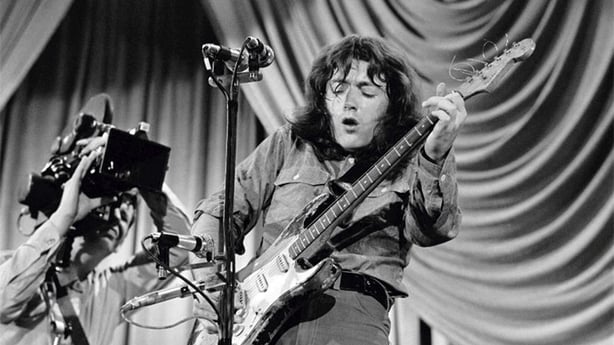
Rory Gallagher
Gallagher speaks for 17 pages on everything from music and drugs to film noir and the Troubles, without ever coming across as anything other than utterly convincing.
The achievement of this cannot be overstated. Poets have been trying for decades—perhaps centuries—to incorporate pop culture into their practice, and too often their efforts can come across as either gauche, patronising, or laughably out of touch.
What makes MacGabhann’s treatment so different is his willingness to plunge wholeheartedly into the shattered psyche of his subject. Quite apart from the sensationalist lore and trivial biographical details of Gallagher’s troubled life, here is something approaching genuine empathy; an empathy born out of the addiction and violence alluded to elsewhere in MacGabhann’s masterful collection:
My poor guitar is nearly finished
each ding and dunt and scar and dent
the illegible scribble of every disaster
the fretboard stain-whorled with fingerprints
the dark pucks of pulled off skin chunks
The word polymath is thrown around a lot, but reading MacGabhann—who also happens to be an accomplished novelist, short-story writer, essayist and journalist—one can’t help but grope around for synonyms. He has mastered almost every literary medium he has turned his hand to, and has done so with palpable sincerity.
He exposes his inner life with a fearlessness which feels as risky as it is rare, and isn’t afraid to allow his work the redemptive arc of a more old-fashioned writer. In lesser hands, this could come across as sentimental. In MacGabhann’s capable grasp, it feels as though we are accessing the thoughts of a particularly erudite friend.
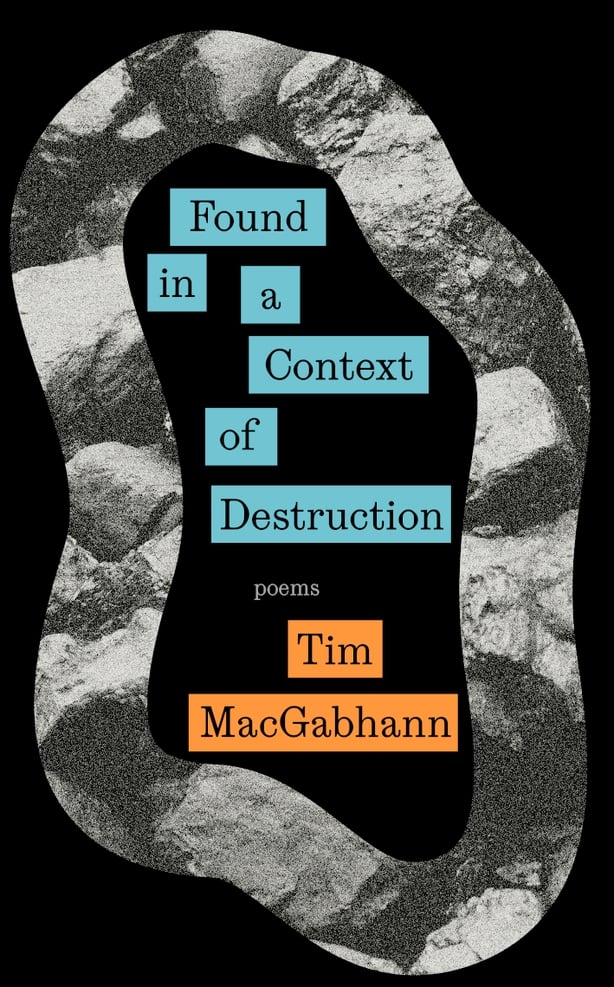
Found in a Context of Destruction is published by the Banshee Press