
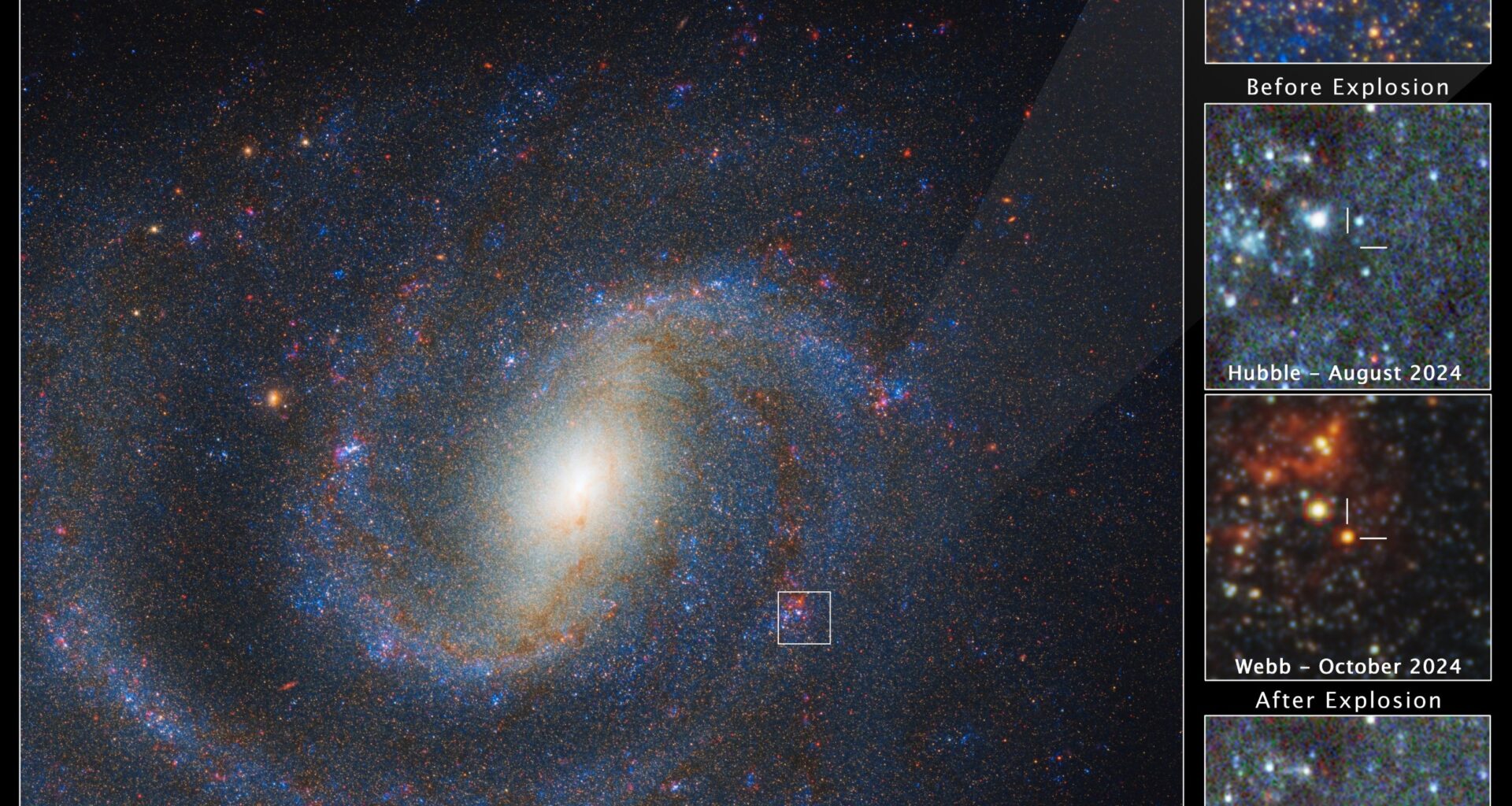
A star can burn for millions of years and still manage one final surprise. In this case, that surprise arrived as a sudden flash of light from a nearby galaxy, even though the blast itself happened millions of years ago.
Space is huge, and light takes its time getting anywhere. That delay is the whole trick. The star blew up roughly 40 million years ago, but the light only reached Earth on June 29, 2025.

When the light arrived, sky surveys caught it fast, and astronomers jumped in to figure out what, exactly, had just ended.
A supernova with a paper trail
The event was designated supernova 2025pht after it was detected by the All-Sky Automated Survey for Supernovae.
Once a star explodes, experts typically work backward with evidence that can be collected after the fact – including light curves, spectra, and follow-up images.
Here, a team took a different route. Instead of starting with the blast, they started with old pictures.
The scientists searched telescope archives to find the exact star that used to sit where the supernova now shines, surrounded by countless other stars in the same galaxy.
Discovery of a red supergiant
The archive images were captured by NASA’s James Webb Space Telescope while it was observing the galaxy NGC 1637. In those data, astronomers identified a red supergiant positioned exactly where the supernova would later erupt.
That match is why this result matters: it’s the first published time Webb has been used to identify a supernova’s progenitor star before the explosion.
“We’ve been waiting for this to happen – for a supernova to explode in a galaxy that Webb had already observed. We combined Hubble and Webb data sets to completely characterize this star for the first time,” said study lead author Charlie Kilpatrick of Northwestern University.
Dust that hides big stars
To nail down the identification, the team carefully lined up images from Hubble and Webb and then looked at Webb observations taken in 2024. The star showed up in Webb’s MIRI (Mid-Infrared Instrument) and NIRCam (Near-Infrared Camera).
What they saw was odd: the star looked unusually red, which is often what happens when dust blocks more of the shorter, bluer light.
“It’s the reddest, most dusty red supergiant that we’ve seen explode as a supernova,” said graduate student and co-author Aswin Suresh of Northwestern University.
That kind of dust matters because it connects to a long-running puzzle sometimes framed as “missing” red supergiants.
Astronomers expect the most massive stars that explode as supernovas to be bright enough to spot in older images, yet many don’t show up. One leading idea is that the biggest, oldest stars may also be wrapped in dust thick enough to dim them until they’re hard to detect at all, and this star fits that picture.
“I’ve been arguing in favor of that interpretation, but even I didn’t expect to see it as extreme as it was for supernova 2025pht. It would explain why these more massive supergiants are missing because they tend to be more dusty,” said Kilpatrick.
What comes next
The team also took a close look at what the dust seems to be made of. Using computer models with Webb’s data, they found signs the dust is likely carbon-rich, even though astronomers would have expected more silicate-rich dust around a red supergiant.
The team thinks that carbon may have been pulled up from inside the star not long before it exploded.
“Having observations in the mid-infrared was key to constraining what kind of dust we were seeing,” said Suresh.
Now the team is looking for more red supergiants like this one, with the idea that catching them before they explode could help explain how massive stars shed material near the end.
NASA’s upcoming Nancy Grace Roman Space Telescope may help, since it should be able to spot these stars in infrared light and track changes as they “burp” out large amounts of dust late in life.
The full study was published in the journal Astrophysical Journal Letters.
—–
Like what you read? Subscribe to our newsletter for engaging articles, exclusive content, and the latest updates.
Check us out on EarthSnap, a free app brought to you by Eric Ralls and Earth.com.
—–