
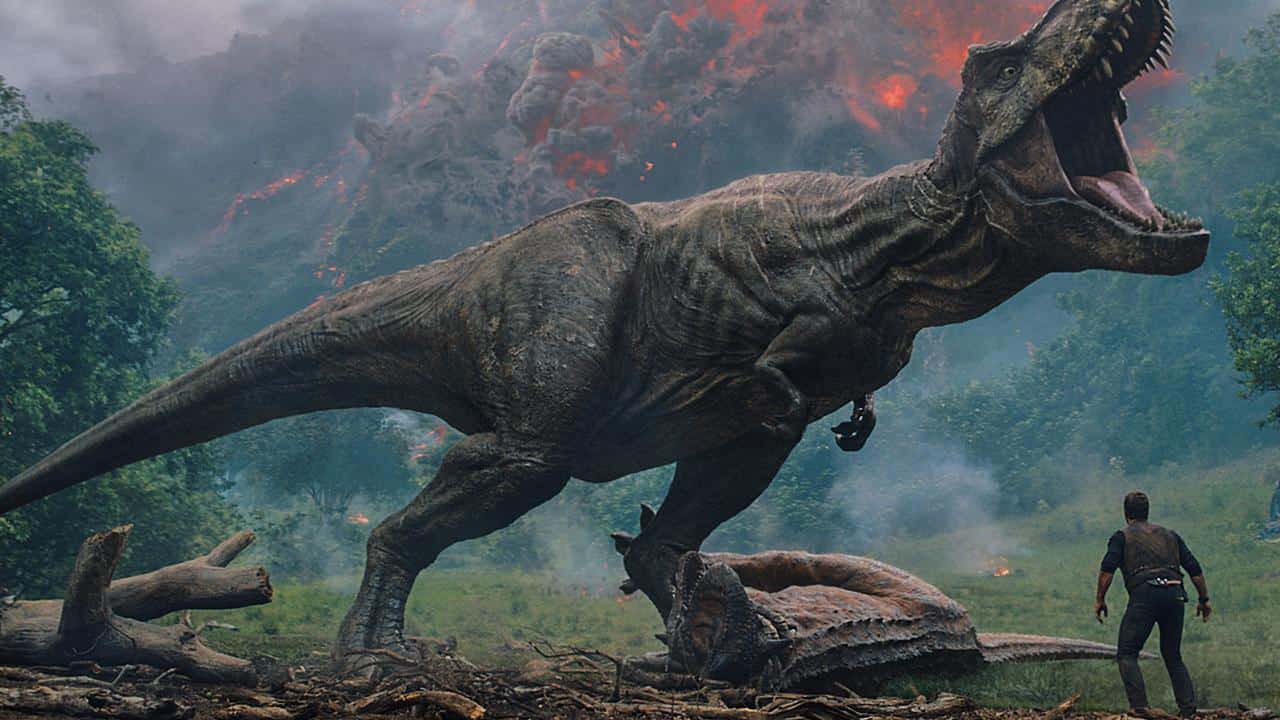
 A rampaging T-rex dinosaur in a scene from the film Jurassic World: Fallen Kingdom.
Pop culture has conditioned us to imagine a terrifying encounter with Tyrannosaurus rex first starts with the rhythmic, earth-shattering boom of heavy, flat-footed stomps. But if you were actually standing in a Cretaceous forest, you might not feel those tremors at all.
Evolutionary biologists and biomechanics experts are giving the apex predator a serious makeover. It turns out the T. rex was remarkably dainty on its feet. Instead of slamming its heels into the dirt, the ten-ton carnivore may have walked and sprinted on its tiptoes.
Not incidentally, most birds are digitigrade, meaning they walk on their toes rather than their entire foot. Birds are scientifically classified as living dinosaurs, specifically the only surviving lineage of the Theropoda group that thrived during the Mesozoic era. They’re descended from small, feathered, two-legged, meat-eating dinosaurs, and claim Velociraptor as an ancestor.
A Bird-Like King of Dinosaurs
This surprising revelation for many of us comes from a new study published in the journal Royal Society Open Science. A research team led by Adrian Tussel Boeye at the College of the Atlantic in Maine analyzed the foot-strike patterns of four distinct T. rex specimens. The scientists sought to understand how a beast weighing up to 10,000 kilograms actually chased down its meals.
To find the answer, the team turned to math and modern animals. They took precise measurements of the dinosaurs’ leg and foot bones, feeding this data into three separate biomechanical equations. They modeled three hypothetical walking styles: striking the ground with the rear of the foot (the heel), the mid-foot, or the distal part of the foot (the tiptoes).
Finally, they ground-truthed these models by looking at living, striding bipeds, such as humans and ostriches. Humans are plantigrade, meaning we strike the ground with a stiff, spring-like heel-first motion. Birds, however, use a distal-first foot strike, hitting the ground with the front of their feet and using short, rapid strides.
“The feet were treated as these rigid blocks,” Boeye told The New York Times, describing how previous models assumed a heel-first stomp. The new math showed that a heel-first approach just did not make biomechanical sense for the tyrant lizard king.
Shock Absorbers and High Speeds
 Visual representation of some of the key aspects of Tyrannosaurus locomotion, including an oscillating, dynamic tail, alongside a more bird-like foot function and up-to-date muscle distribution. Such a model and its results of how T. rex moved and how fast it moved would be key to understanding how T. rex functioned as an apex predator and acquired prey animals as confirmed by the fossil record. Credit: Original image and credit belong to Dr Mark P. Witton; modified with permission by study authors/Royal Society Open Science, 2026.
Fossilized footprints actually corroborate the math. When the researchers examined tracks left by tyrannosaurs, including a massive three-foot-long track from New Mexico, they found the deepest impressions were located under the toes.
×
Thank you! One more thing…
Please check your inbox and confirm your subscription.
This suggests the dinosaur pressed its weight into the front of its foot. Walking on tiptoes allowed the T. rex to maintain a crouched posture, taking numerous fast steps to stay stable. This distal-first strike turned the animal’s legs into massive shock absorbers, managing the immense stress of its body weight over uneven terrain.
“Our study represents, to our knowledge, the first quantitative biomechanical analysis of the effects of foot-strike patterns on the gait of Tyrannosaurus. We find that the pes [the foot] of T. rex functioned similarly to the foot of a bird,” the study authors wrote in their paper.
This tiptoeing technique dramatically changes our estimates of the dinosaur’s speed. Striking with the toes allowed the dinosaur to take more steps in less time, increasing its estimated top speed by about 20 percent compared to flat-footed models.
“Rather than taking these bigger and bigger steps, like in Jurassic Park, it would move quickly by rapidly swinging its legs,” Boeye told The New York Times. “It would resemble being chased by an oversized bird”.
Outrunning Usain Bolt
Just how fast was this oversized bird? The biomechanical models indicate that a T. rex could reach speeds between 5 and 11.4 meters per second, or roughly 11 to 25 miles per hour.
But not all tyrannosaurs were created equal. The study evaluated specimens of varying ages and sizes, from a lanky juvenile at the Natural History Museum of Los Angeles County to the massive adult known as “Sue” at the Field Museum.
 Estimated speeds of T. rex specimens in the dataset. Credit: Royal Society Open Science, 2026.
The models confirmed that an immature, 1.4-tonne T. rex was an absolute speed demon. This youngster could hit a top speed of 11.4 meters per second. That means a teenage T. rex could run 100 meters in a blistering 8.77 seconds. For perspective, human world record holder Usain Bolt ran the 100-meter dash in 9.58 seconds.
The massive adults were slower, but still terrifying. An adult weighing around 6.5 tonnes could move at 9.5 meters per second. The largest adults, like the 9.5-tonne Sue, topped out at a more leisurely 6.3 meters per second, or about 20 feet per second. This is roughly the sprinting speed of a modern Komodo dragon.
The Circle of Life (and Hunting)
Because T. rex young were significantly faster than adults, they almost certainly hunted different prey.
This phenomenon is known in biology as ontogenetic niche partitioning. Separate fossil studies show that it took these dinosaurs up to 40 years to reach their full eight-ton size. As the predators grew over those decades, their diets and hunting strategies had to evolve alongside their changing biomechanics.
The research beautifully bridges the gap between extinct giants and modern avians. Steve Brusatte, a paleontologist at the University of Edinburgh who was not involved in the study, said “this study shows that even the iconic T. rex was quite birdlike in the way that it walked. It would have been something like an eight-ton chicken clucking about in the barnyard”.
If the researchers are right, the filmmakers and museum curators of the world will need to rethink their terrifying monsters. The ground may not have shaken when the tyrant king approached, but the blur of its bird-like stride was far more lethal.