
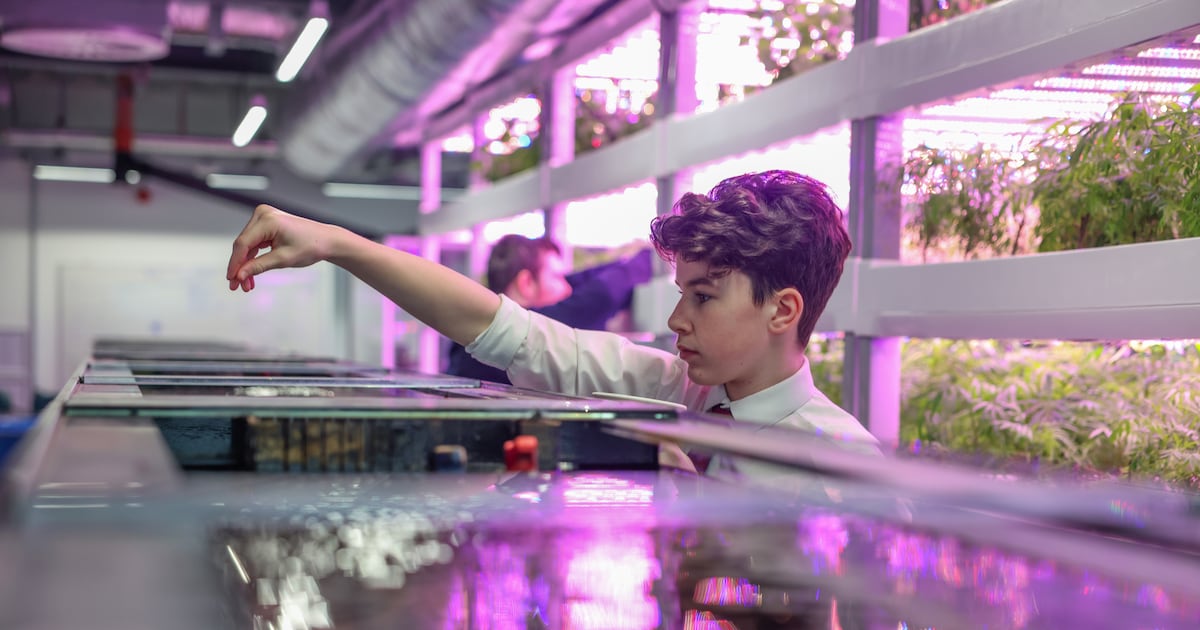
From the fifth storey of Belvedere College in Dublin 1, floor-to-ceiling glass windows give an uninterrupted view out to the Howth peninsula, taking in the city’s Georgian rooftops and the smooth blue of the Irish Sea.
This is the vista from the school’s climate-controlled grow chamber, where plants flower in vertical towers of plastic under purplish LED lighting, and fish tanks full of ornamental carp run the length of the room. It is futuristic and unexpected to find this high-tech aquaponics system, which uses fish waste to fertilise plants, in a secondary school.
“It doesn’t look like an amazing ecosystem, but it is,” says Simon O’Donnell, the educator who started the school’s urban farm in 2014. “It’s got glass, plastic, aluminium. You’re thinking it’s something artificial, but underneath all of that is a complex microbiome and mature ecosystem.”
“The fish are being fed, they’re creating waste, and rather than treating that as a problem to manage, we look at it as a resource,” says O’Donnell. “This waste runs through a pipe system to a filter, where it is broken down by bacteria, which makes it accessible to the plants as a fertiliser.”
The plants suck up the nutrients they need, and then the same water goes back to the fish. It is a constant closed loop that allows for the same water to be used and reused many times.
[ Europe needs a resilient food system and as part of its broader strategic defenceOpens in new window ]
Other than a central concrete courtyard, Belvedere College has no ground space for growing. So since its inception, the farm project needed an innovative option for soil-free food production. At any one time, the aquaponics grow chamber can be home to more than 45 different varieties of plants, from exotic Korean mint to humble garden weeds. Leafy greens are particularly suited to the system, but students are free to experiment with what interests them.
The system is unaffected by the weather, so it can consistently produce crops 365 days a year. “The plants don’t have to deal with changing weather or soil conditions. They don’t have to be as tough as if they were growing outside,” says O’Donnell.
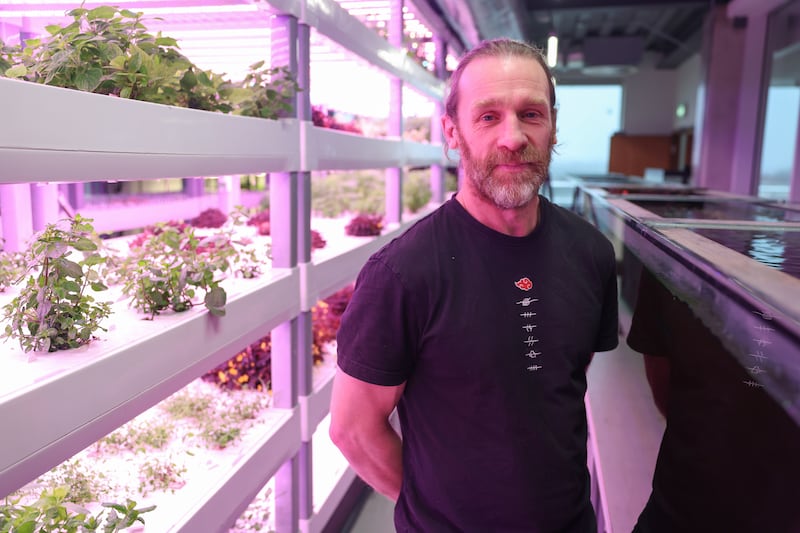 Simon O’Donnell, the educator in charge of Belvedere College’s urban farm. Photograph: Enda O’Dowd
The uniqueness of this growing climate has led to an unusual partnership.
A few years ago, a huddle of pupils descended from the grow lab to the cellar of Chapter One, a two-Michelin-star restaurant on Dublin’s Parnell Square, with a proposition.
Their school was growing a wide variety of plants, aromatic herbs and flavour-packed flowers. Would the restaurant be interested in taking them on as an ultra-local supplier?
“It started as an educational project for the business students, just to see if they could drum up a little interest from local businesses. They’re amazing salesmen,” says O’Donnell.
“The boys came back and said Chapter One was interested, and the farm really took on new life after that. Often, with growing projects in schools, students don’t get to see the life cycle of the crop. But with this, they are planting, growing, harvesting, processing and selling. There are a lot of different points of interest for different students.”
O’Donnell now begins most school days by harvesting and packing orders for the restaurant, which is led by Mickael Viljanen.
“Depending on your mood, it can be therapeutic or frustratingly slow,” he says, pinching 120 pineapple mint tips and placing each one in a small container before moving on to gather 120 butter yellow oxalis flowers.
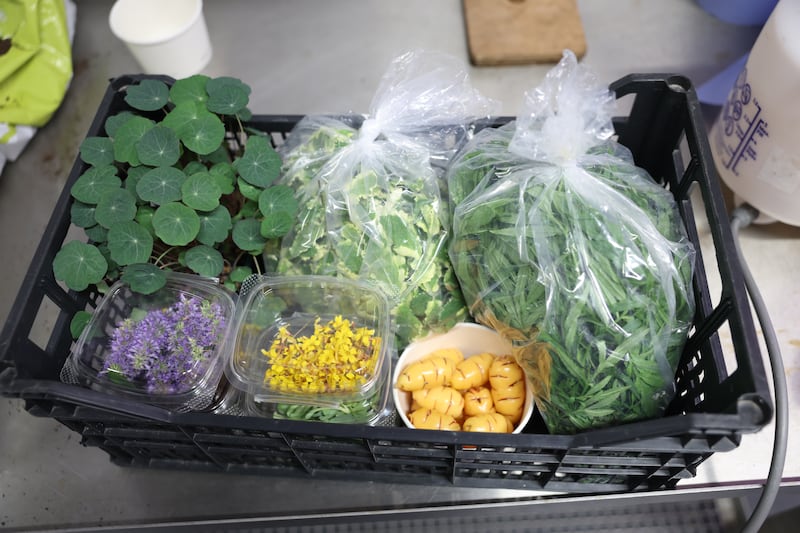 A delivery ready for Chapter One. Photograph: Enda O’Dowd
 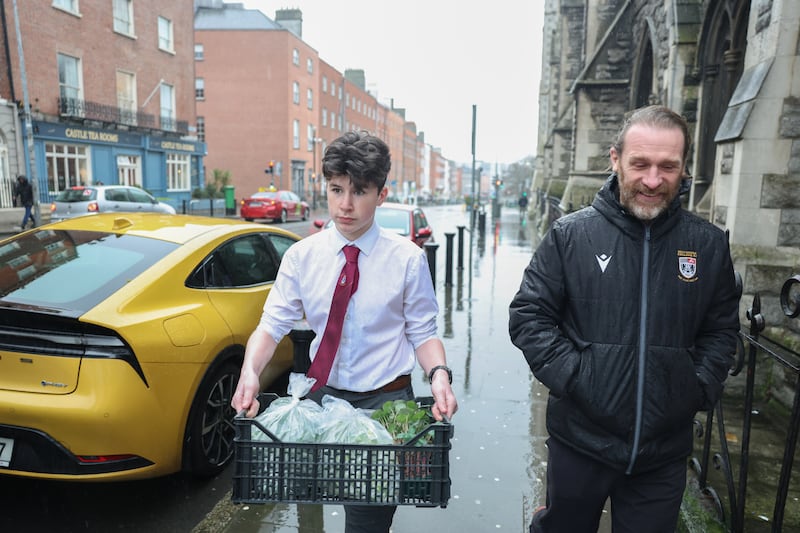 Belvedere College student Conor O’Leary on the way to Chapter One with Simon O’Donnell. Photograph: Enda O’Dowd
 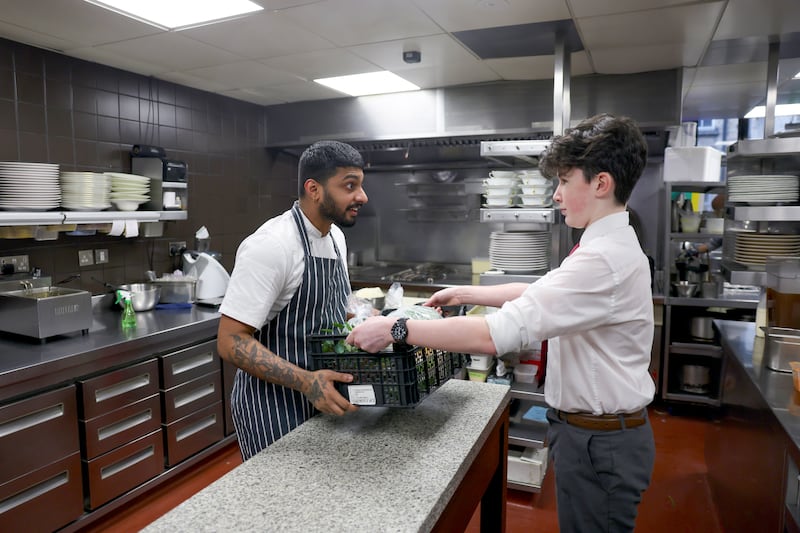 Handing over the goods: Conor O’Leary of Belvedere College delivering urban farm produce to Midhnav Manoj of Chapter One. Photograph: Enda O’Dowd
 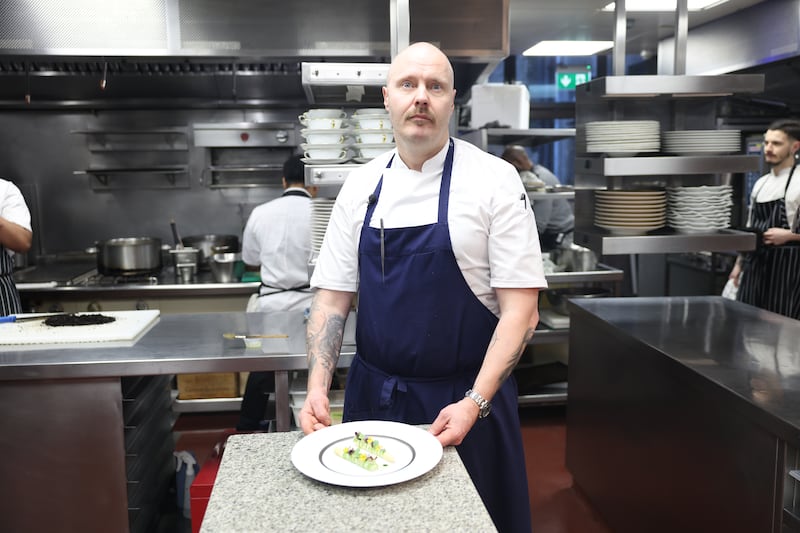 Chapter One chef patron Mickael Viljanen with a white asparagus dish garnished with herbs grown at Belvedere College. Photograph: Enda O’Dowd
 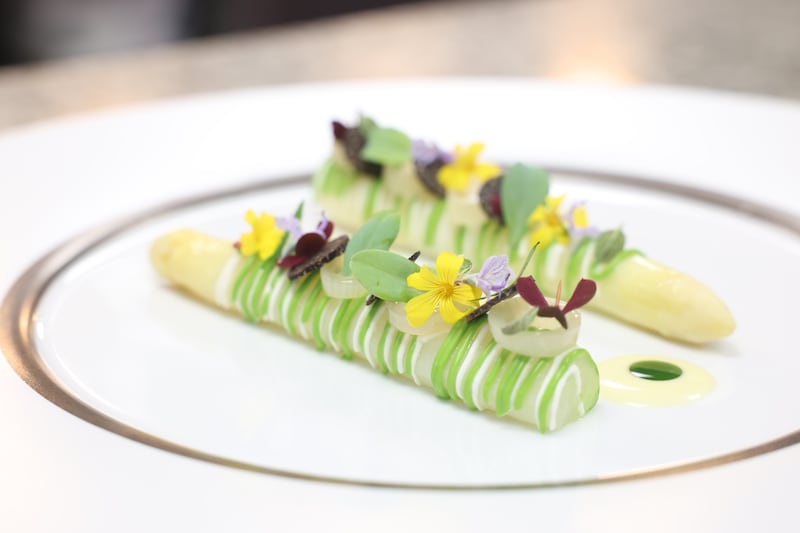 White asparagus garnished with herbs grown at Belvedere College created by Mickael Viljanen of Chapter One. Photograph: Enda O’Dowd
“Most people think of oxalis as a weed in Ireland,” says O’Donnell. “But the flower is a citrusy burst, and its leaf has this really intense flavour too. When you have restaurants doing tiny little plates, it helps to have these strong bursts of flavour.”
The flowers and leaves that the urban farm sells to Chapter One are delicate and wouldn’t be suitable for long-distance transportation.
This has led to students asking questions about where their food comes from and the challenges of the global food trade.
“You learn how things can grow in different environments, and now I am looking at where things are coming from when I’m in the supermarket,” says Joseph Smyth, a third year student. “It’s amazing that an orange can come from Spain and not be rotten.”
Of the 1,000-strong student population, roughly half will have a meaningful interaction with the farm during their time at fee-paying Belvedere, through short courses in the junior cycle, transition year projects, or subjects such as home economics, business and agricultural science.
“We do both classroom and practical work,” says Charlie Leyden, a first-year student who grew rocket at school and brought it home for his pasta. “It’s not hard to grow things, once you know how.”
As well as the aquaponics system, the urban farm has an open rooftop farm growing native Irish plants such as oyster leaf, one of the island’s rarest species, and more exotic plants such as Sichuan peppers.
Oyster mushrooms are grown in plastic bags of coffee grounds, microgreens germinate in small tubs, and rooftop beehives produce pots of honey, which students sell at Christmas and at parents’ evenings.
Daragh O’Leary, a fourth-year student and one of the school’s top honey salesmen, says he is now looking beyond honey and “would like to grow apples and have pet chickens in the future”.
Urban agriculture isn’t a new idea – already it produces between 5 per cent and 10 per cent of the world’s legumes, vegetables and tubers.
But developing more sustainable ways to grow food in population centres is becoming ever more urgent. Half of the world’s population now lives in cities and 2.3 billion people globally face food insecurity.
So innovative ways to preserve depleted soil, reduce water usage and waste, cut down on carbon emissions associated with transport and packaging, and grow food securely and locally are needed.
High-tech urban farming methods such as aquaponics are not yet a perfect solution; they consume a lot of energy and there are challenges to making them financially viable on a small scale, but the advantage of Belvedere being a school rather than a business means there is time and space for both mistakes and ambitious thinking.
This openness to experimentation is why, in a greenhouse tucked into the top of the science block, there are several tanks of feather-gilled axolotls.
Similar to salamanders, axolotls are a critically endangered species in the wild but have become popular because of their unusual biology. They can regrow limbs, parts of their brains, even their hearts.
“We’re using them in a similar way to the fish for the aquaponics. They are really cool. They don’t fully age,” explains Conor O’Leary, a second year pupil. “They have regenerative properties like octopi.”
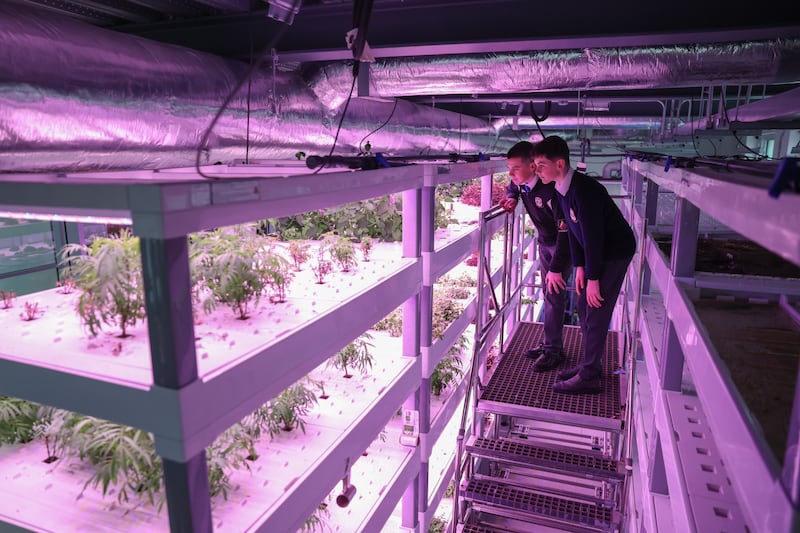 Belvedere College students Joseph Smith and Charlie Leyden monitoring the urban farm. Photograph: Enda O’Dowd
 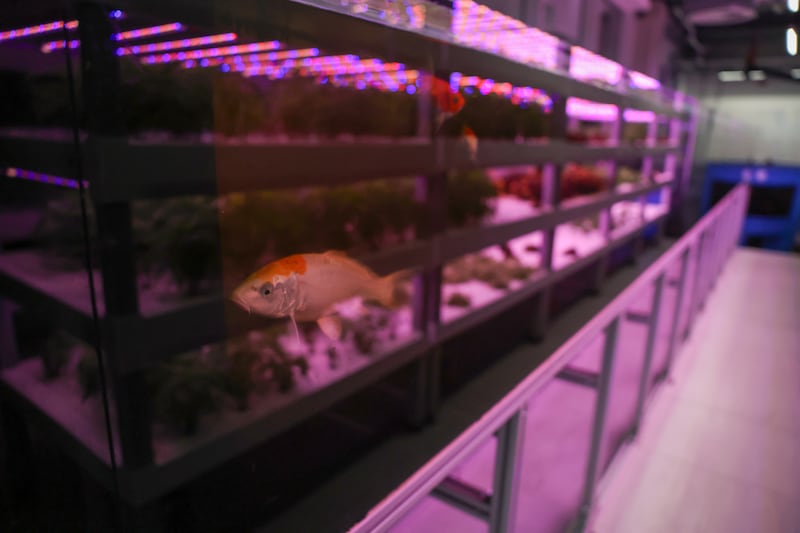 A fish swims in a tank within Belvedere College’s urban farm. Photograph: Enda O’Dowd
 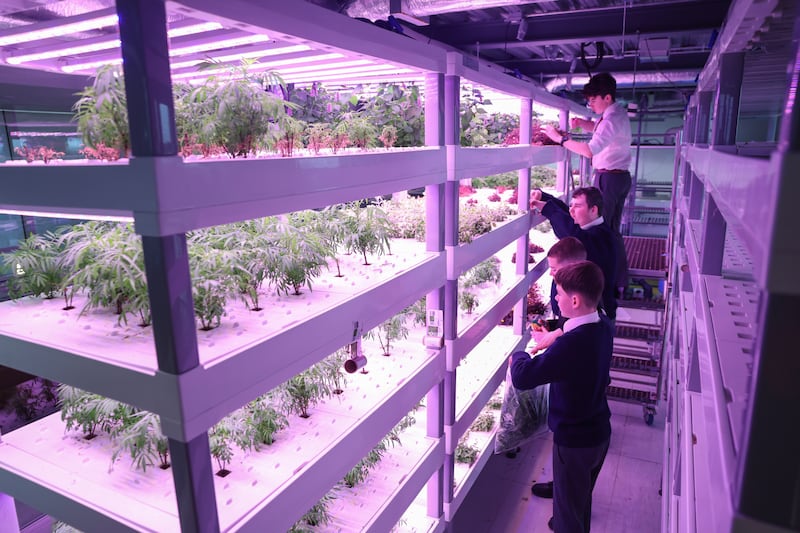 Belvedere College students keeping an eye on plants in the school’s urban farm. Photograph: Enda O’Dowd
Above the tanks of axolotls are plants growing in pellets, as well as containers of rare species such as Buddha’s hand, which produces a lemony rind, and finger limes, known as nature’s caviar. The space is less about production than experimentation.
“When I started, I thought there had to be magic to it. I didn’t think I could just put a seed in some soil with some water and it would grow,” says O’Donnell. “But that is just what happens. It’s trial and error. You don’t always know if it’s going to work, but you just try.”
“It’s not necessary to have a degree in horticulture or aquaponics,” he adds. “It’s important that schools don’t feel they have to know everything before they get started.”
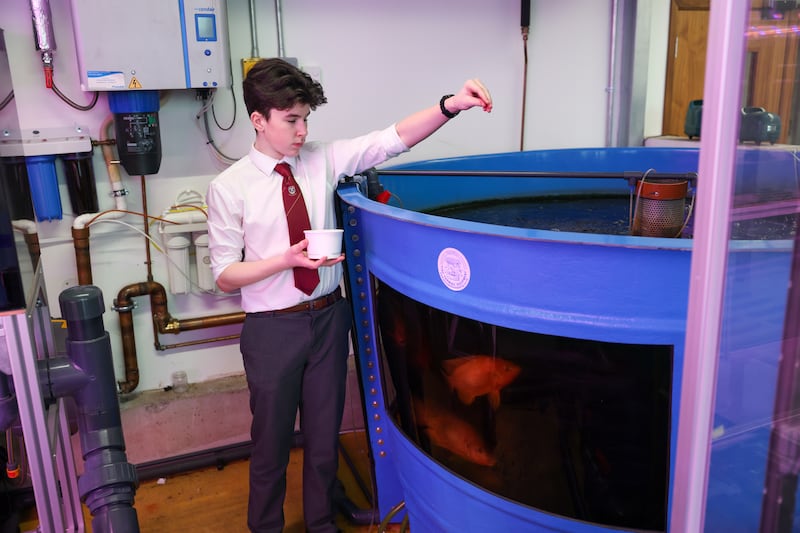 Conor O’Leary at feeding time in the urban farm at Belvedere College. Photograph: Enda O’Dowd
Before the Covid-19 pandemic, Belvedere applied for government funding to put aquaponics systems in local Deis schools, keen to share its learning with others, generate local knowledge and swap resources.
Two of the schools the team worked with, O’Connell School near Croke Park and St Kevin’s College on Clogher Road in Crumlin, have since adapted the project to suit their own needs.
St Kevin’s, which has some outdoor space, developed an outdoor edible garden, and O’Connell School developed an environmental studies, sustainability and horticulture programme.
Conor Flood, who retired from teaching last year but now runs the O’Connell School programme full-time, says, “We started from nothing in 2019, and now it has really taken off. O’Connell’s was concrete-bound until another teacher and I began reclaiming spaces within the school, and an inner courtyard has now become a space for a polytunnel and raised beds.”
Along with onions, garlic, runner beans, chillies and tomatoes, the pupils grow potatoes and cook them using the school’s air fryer.
“We were building bamboo frames today for climbing plants, and we just let the kids at it and let them solve the problems,” Flood says. “As long as they’re not on their phones and they’re learning something.”
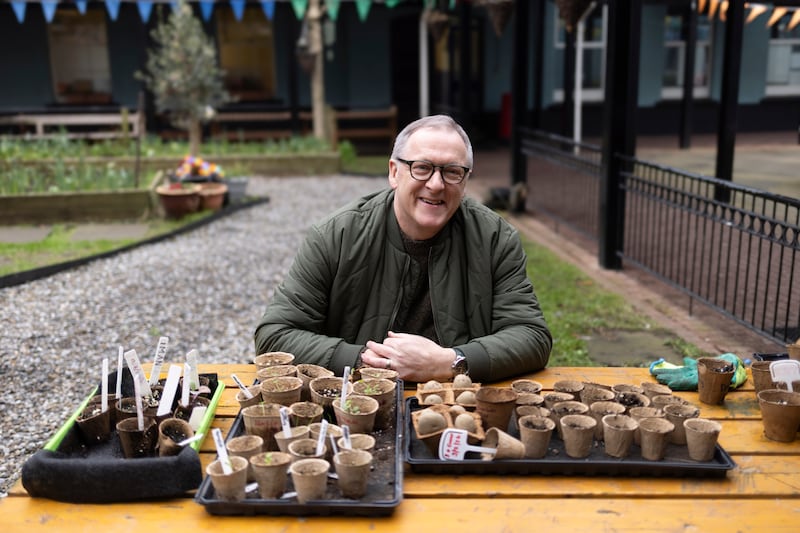 Conor Flood, who runs the garden project O’Connell School in Dublin. Photograph: Chris Maddaloni
The O’Connell School horticulture programme is self-funded, and Flood gets support from local companies, both financial and resource-led. “A few bob, it goes a long way,” he says.
The programme has given pupils who might not excel in classroom-based learning a chance to shine.
“It’s given them an opportunity to be good at something,” Flood says. “To see where food comes from, to be a little bit more comfortable getting their fingernails dirty, and it absolutely allows them to excel. We give them responsibility, and they just run with it.”
These are small-scale ventures into new ways of thinking about urban farming and local food production, but as O’Donnell says: it’s just trial and error.