
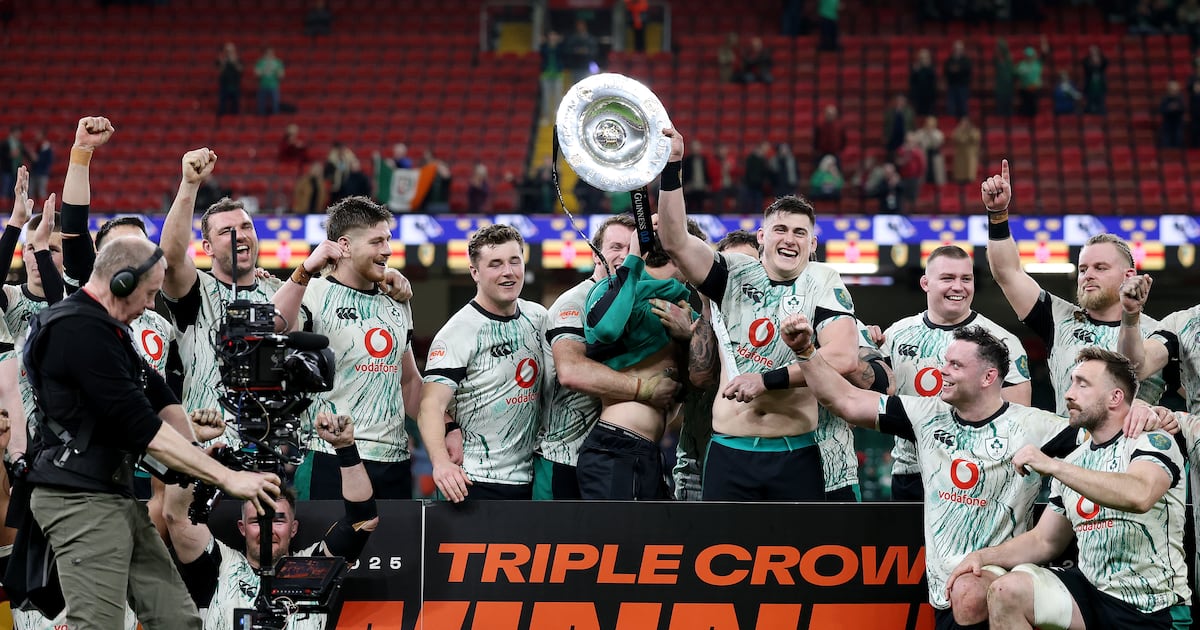
Ireland won the Triple Crown last season for only the 14th occasion. Just saying. A third Triple Crown in four years, like those of 2022 and 2023, was effectively lost in the wash. Ireland have long since been in the market for titles and Grand Slams. The Triple Crown is no longer the full bag of chips.
But if Andy Farrell’s men beat Wales at the Aviva Stadium on Friday night, then a Triple Crown shoot-out between Ireland and Scotland on Saturday week would be guaranteed.
True, the title might already be out of reach by then. For if France beat Scotland in Murrayfield with a bonus point, the title will be theirs before hosting Les Rosbifs in Saturday week’s finale in search of a Grand Slam.
Even a French win of any hue will probably suffice to clinch the title as that would take them to 19 points, which is the maximum total Ireland can reach with two bonus-point wins. Even in that scenario, France currently have a points difference of plus-89 compared to Ireland’s plus-six.
The Triple Crown is also something of a relic from the tournament’s original inception in 1883 as the Home Nations Championship, until France joined in 1910 to make it the Five Nations. Thus, its era as the Grand Slam of its time is well over a century ago, even if a Triple Crown trophy was commissioned in 2006.
Beginning with 2006, the trophy has been won seven times by Ireland, four times by Wales, three times by England and has yet to be won by Scotland during that timeframe. Ireland also won the Triple Crown in 2004, meaning they’ve won it eight times in the Six Nations era, after a barren spell dating back to 1985, whereas Scotland last won one in 1990.
Furthermore, last year’s Triple Crown was achieved in the third round with a 27-18 win in Wales, following victories at home to England and away to Scotland. So, there was no real sense of a final weekend finale. It was also then overshadowed by the 42-27 beating inflicted by France in Dublin in round four, and the scratchy last-day escape in Rome.
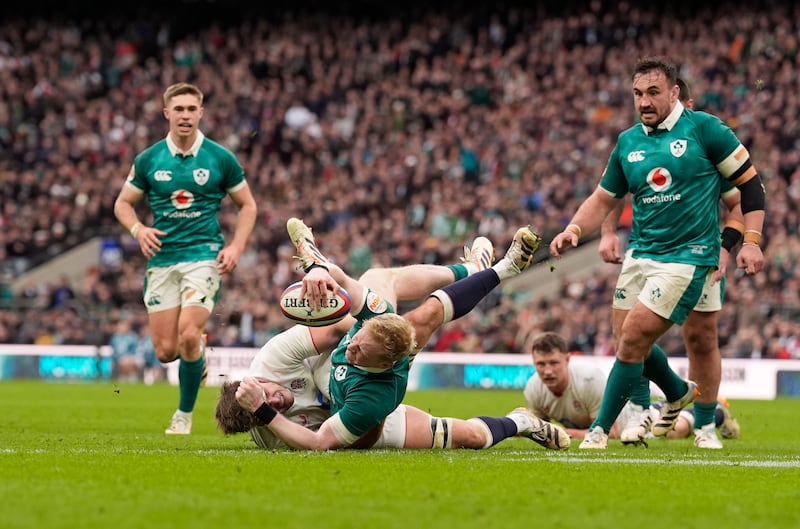
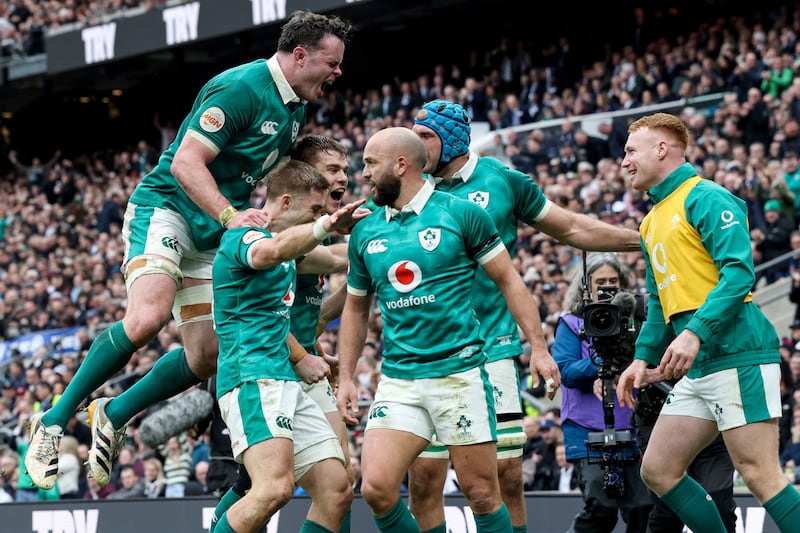 Ireland’s James Ryan celebrates with teammates Jack Crowley, Garry Ringrose and Ciaran Frawley after Jamison Gibson-Park scores Ireland’s first try in the Six Nations victory against England at Twickenham on February 21st. Photograph: Billy Stickland/Inpho
Coupled with Ireland’s need to retain its ascendancy in the rivalry with Scotland over recent times, that gives the next two weekends real meaning. A top-three finish for the 14th championship in succession ought not to be sniffed at either, not least in these financially challenging times for the sport. This is the threshold which the IRFU budget for and no other country has achieved a top-half finish for each of the last 14 seasons.
Rescaling the heights of last Saturday week’s display in Twickenham might well prove trickier. Few Six Nations are linear. In 2021, Ireland’s standout 80 minutes came on the last Saturday. That day, the team delivered the kind of performance Johnny Sexton vowed was coming – albeit nobody believed him – by beating England at an empty Aviva Stadium.
The performances were more consistent in 2022, even when losing an epic against France by 30-24 in round two. But while the 32-15 win at Twickenham after Charlie Ewels’s second-minute red card had its misguided critics, they came through the storm in a manner which would stand to them.
 Ireland pull off one of the great Twickenham days against England
There’s little doubt that beating France 32-19 at the Aviva in a round-two epic was the standout display in the 2023 campaign before doing enough in the Grand Slam finale at home to England.
Two years ago, Ireland didn’t regain the heights of their opening night win in Marseille and similarly, last season, they didn’t reproduce the quality of their first-round victory at home to England.
Andy Farrell’s belief in his players has never wavered and he has been more sanguine about the inevitable ups and downs in the team’s journey than the rest of us. But last Saturday week’s 42-21 win was a timely reaffirmation to him, the coaches, the players and the supporters, that this is still a big-game team. That’s huge, and if that can be backed up over the next two home games, the squad will take real momentum into the summer leg of the inaugural Nations Championship.
In many ways, the final two weekends will go a long way toward defining this year’s campaign for all six teams.
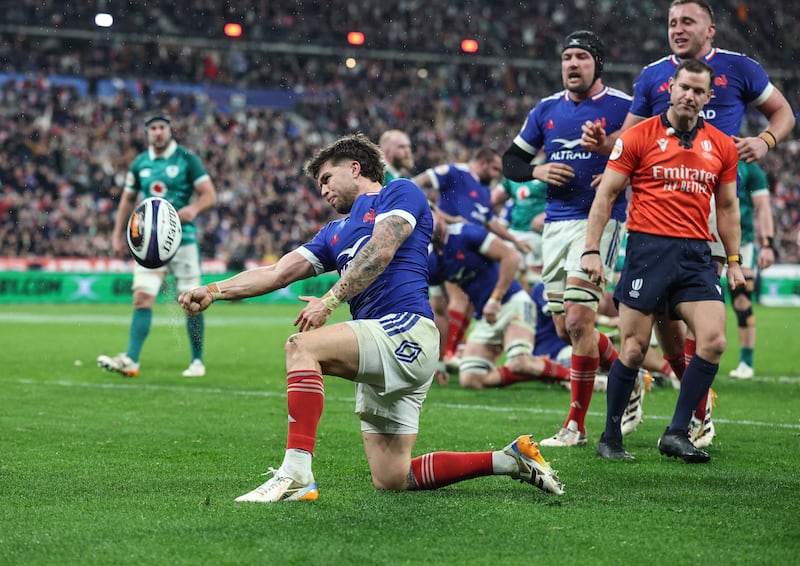 France’s Matthieu Jalibert celebrates scoring his side’s second try against Ireland on the opening night of this year’s Six Nations championship at Stade de France, Paris. Photograph: Inpho
The ultimate is still within the reach of Les Bleus, which could well herald a golden era for French rugby and see them travel to Australia for the 2027 World Cup at shorter odds than they’ve ever been before, certainly when not hosts.
Scotland still have a title and/or a first Triple Crown in 36 years to aim for. On top of the wins over England and Wales, either or both of those achievements would further banish the memory of that opening weekend loss in a sodden Stadio Olimpico.
Similarly, if Ireland can finish out the championship with four straight wins, another top-two finish and a 15th Triple Crown, that would also represent a strong response to their chastening opener in Paris.
Judging by the outraged reaction to their defeats against Scotland and Ireland, redemption is probably beyond England, especially after a dozen straight wins inflated expectations. But they now have an end-of-championship trek to Paris and to Rome in which to quieten the outside noise and even rediscover what exactly is their best team.
Italy can still have a very strong, or anti-climactic and underachieving, tournament, while Wales have two games to demonstrate that the vastly improved effort against Scotland was not in isolation.
Remember, too, that in each of the opening three rounds there have been surprise wins, upsetting both the odds and most of the forecasts – namely Italy beating Scotland, Scotland beating England and Ireland storming Twickenham by a record margin. There was nearly another when Wales hosted Scotland.
Such are the undulations from week to week and the unique aspects of the Six Nations that there probably will be further surprises over the next two weekends as well. It’s the nature of the beast and why the sport’s oldest international competition remains so captivating.
Follow our rugby WhatsApp channel
If you want the latest rugby news, analysis and opinion then you should follow our dedicated WhatsApp channel. From Gerry Thornley to Owen Doyle and Gordon D’Arcy, we have every angle covered.
Find the channel here.