
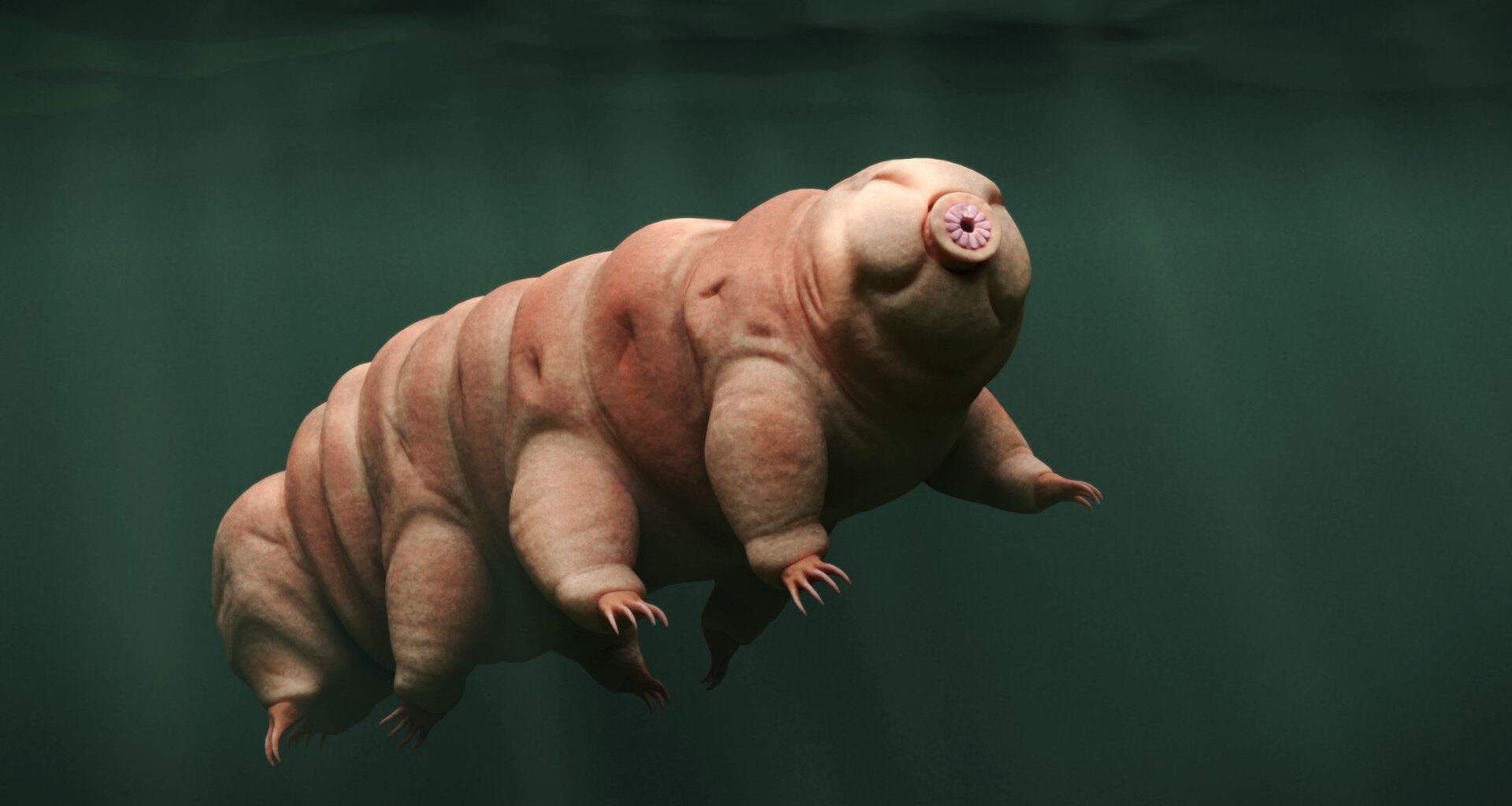
Tardigrades, the microscopic “water bears” known for surviving space vacuum, extreme radiation, and freezing temperatures, have finally found a challenge they cannot easily beat: the soil of Mars.
A new study demonstrates that while the Martian surface is naturally harmful to these tough creatures, a simple water rinse might be the key to future colonization and planetary protection.
Testing the toughest
Researchers at Penn State University determined the effects of Martian regolith—the loose mineral layer covering the planet’s bedrock—on complex multicellular organisms. While bacterial and fungal responses to simulated Martian soil have been extensively studied, its impact on animals is poorly understood.
“We know a lot about bacteria and fungi in simulated regolith, but very little about how they impact animals—even microscopic animals, like tardigrades,” stated Corien Bakermans, the study’s lead author and a microbiologist at Penn State.
A lethal environment
The researchers used two types of lab-made Martian soil simulants derived from NASA’s Curiosity rover data: MGS-1, a global simulant representing general Martian surface conditions, and OUCM-1, a composition modelled after the Rocknest Deposit in Gale Crater.
The results showed a significant decline in tardigrade activity within the MGS-1 simulant. Within two days, many specimens became inactive or died. The OUCM-1 simulant was less harsh but still significantly inhibited compared to a control group placed in standard Earth beach sand.
Microscopic analysis revealed mineral particles clustered around the tardigrades’ mouths, suggesting physical or chemical interference with their biological functions. The harshness of the untreated soil surprised the researchers, since tardigrades are famous for entering a “tun” state—a form of extreme dehydration—to survive almost any environment.
The water solution
A key breakthrough occurred when the team attempted to wash the MGS-1 simulant with water before introducing the tardigrades. The researchers found that the animals’ survival rates and vigor bounced back to levels almost the same as on Earth.
“It seems that there’s something very damaging in MGS-1 that can dissolve in water—maybe salts or some other compound,” Bakermans added.
This discovery has two important implications for future space missions. First, it suggests the Martian surface has a natural “defense mechanism” that might protect the planet from accidental contamination by Earth microbes. Second, it provides a roadmap for future colonists: if the soil can be washed, it can likely be used to grow crops and support a functioning ecosystem.
Implications for Mars colonization
The study highlights the challenges of planetary protection, the global effort to prevent biological cross-contamination between planets. If Martian soil is naturally lethal to Earth’s toughest animals, the risk of “forward contamination” might be lower than previously feared.
However, the need for water to “clean” the soil is a major logistical hurdle. Water is a precious, finite resource on Mars. While knowing that the soil can be neutralized is a major step forward, large-scale washing would require significant infrastructure.
The researchers also noted that this study focused solely on soil chemistry and did not account for Mars’ extreme temperature fluctuations or its low atmospheric pressure.
The study was published in the International Journal of Astrobiology.