
 Image: © Ignatiev | iStock
Johns Hopkins scientists have shown that Deinococcus radiodurans bacteria can survive the massive pressures of an asteroid impact, supporting the idea that life can travel between planets.
This discovery raises new questions about the origins of life on Earth and necessitates a review of space contamination policies
A new study from Johns Hopkins University has confirmed that tiny life forms can survive being catapulted into space following an asteroid impact, providing the strongest evidence yet for the “lithopanspermia” hypothesis.
Published in PNAS Nexus, the research demonstrates that hardy bacteria can withstand the extreme pressures of a planetary ejection and the harsh journey through the vacuum of space, potentially enabling life to spread between worlds such as Mars and Earth.
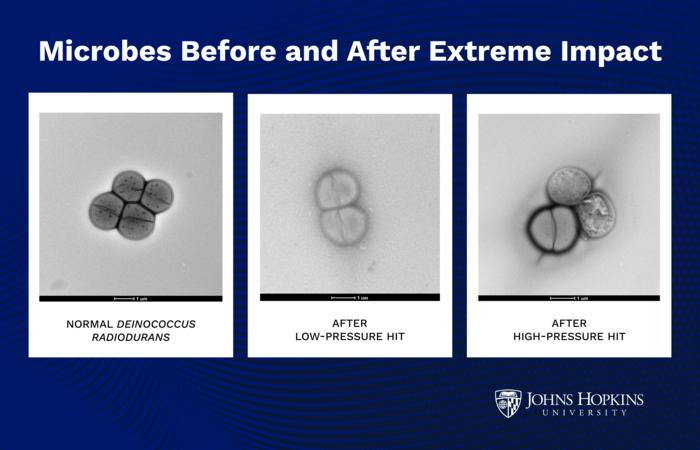 After shooting the microbes, the team determined whether they survived and examined the survivors’ genetic material for clues to how they handled the pressure. The bacteria proved very hard to kill. They survived nearly every test at 1.4 Gigapascal of pressure and 60% at 2.4 Gigapascals of pressure. The cells showed no signs of damage after the lower pressure hits, but after the higher pressure experiments, the team observed some ruptured membranes and internal damage. Credit Johns Hopkins University
Testing bacterium: Deinococcus radiodurans
To test the limits of life, researchers led by Professor K.T. Ramesh and lead author Lily Zhao focused on Deinococcus radiodurans. Often nicknamed “Conan the Bacterium,” this microbe is famous for its ability to survive intense radiation, extreme cold, and complete dehydration. The team wanted to see if it could also survive the “singular biological stress” of being blasted off a planet’s surface.
The experiment involved a high-tech gas gun that fired projectiles at the bacteria at speeds up to 300 mph. The goal was to replicate the 1 to 3 Gigapascals of pressure typical of an asteroid strike on Mars.
For context, this is more than ten times the pressure found at the bottom of the Mariana Trench.
Survival against the odds
The results surprised the researchers.
The bacteria proved incredibly difficult to kill, with a 100% survival rate at 1.4 Gigapascals and a 60% survival rate even at 2.4 Gigapascals. While the higher pressure experiments eventually caused some ruptured membranes and internal damage, many cells remained viable. In fact, the steel equipment used to hold the bacteria fell apart before the microbes did.
“We kept trying to kill it, but it was really hard,” said Zhao. The study suggests that if life exists on Mars, it likely possesses similar self-repairing abilities, making it possible for Martian fragments—many of which have already been found on Earth—to carry living “passengers.”
Implications for space missions
These findings have major consequences for “planetary protection” protocols. Current space mission rules are designed to prevent Earth’s life from contaminating other planets and vice versa. However, this study suggests that natural processes may already be moving life between bodies.
The researchers highlighted the moon Phobos as a specific concern. Because it orbits so close to Mars, it is a likely landing spot for Martian debris ejected at relatively low pressures. This means that future missions to Phobos or other nearby moons may need much stricter safety measures to account for the possibility of “hitchhiking” microbes.