
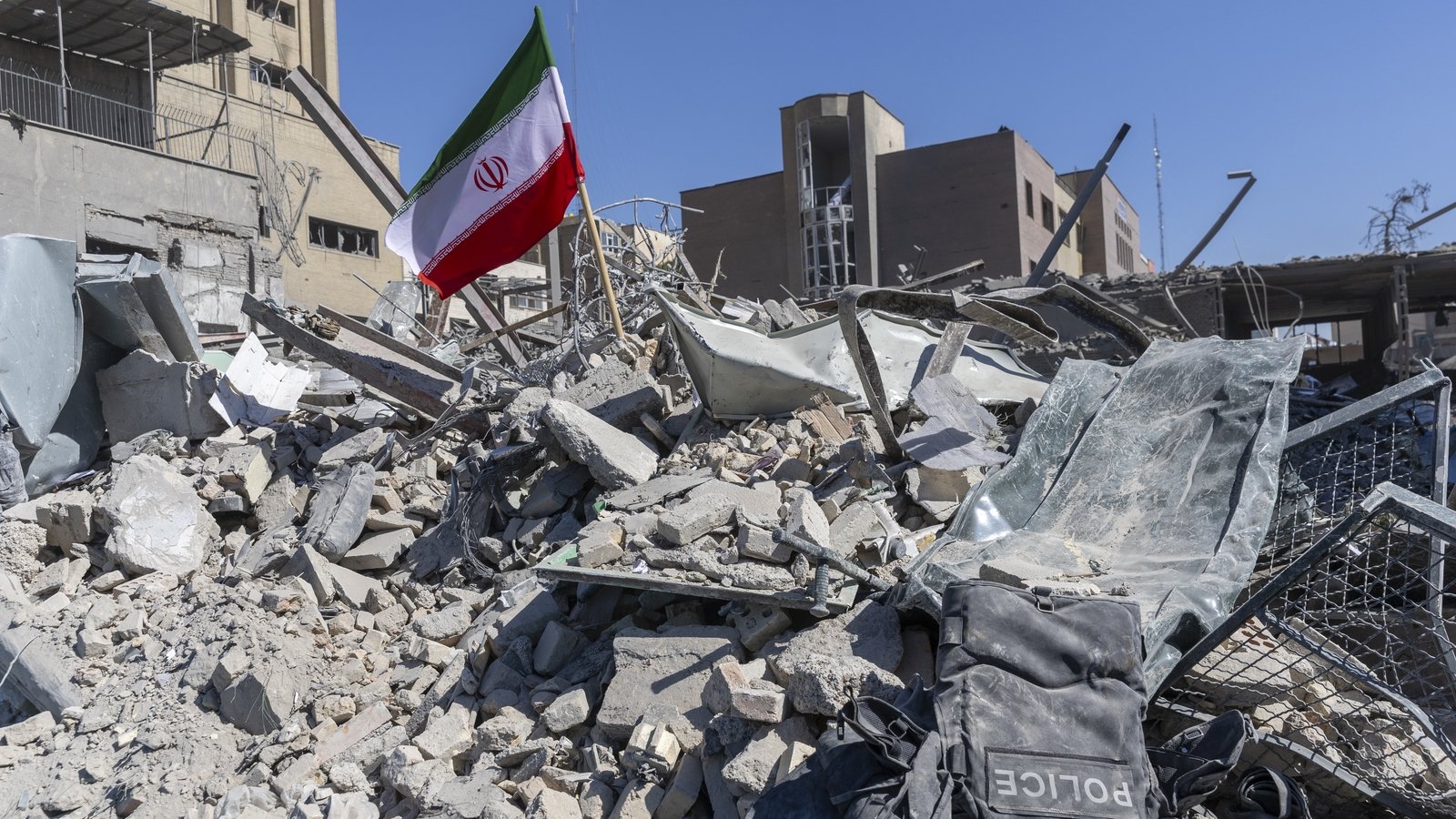
US President Donald Trump has said it is “too late” for Iran to seek talks, as strikes continued across the Middle East for a fourth day.
Explosions tore through Tehran and Beirut today and financial markets around the world tumbled at the prospect of a prolonged disruption to global energy supplies from the US-Israeli air war against Iran.
The US embassy in Riyadh this afternoon warned of an imminent attack in the eastern Saudi city of Dhahran, home to much of the kingdom’s energy installations along the Gulf coast.
“There is a threat of imminent missile and UAV attacks over Dhahran. Do not come to the US Consulate” the embassy wrote on its official X account.
The warning came just hours after the US mission in Riyadh was attacked by two drones that sparked a small fire on the embassy grounds, as Iran pressed on with retaliatory strikes across the Gulf.
The White House responded by shutting those missions and ordering non-emergency government personnel and their families to leave countries across the Middle East.
***Security Alert: Threat of Imminent Missile / UAV Attacks Over Dhahran***
**There is a threat of imminent missile and UAV attacks over Dhahran. Do not come to the U.S. Consulate.**
Take cover immediately in your residence on the lowest available floor and away from windows.…
— U.S. Embassy Riyadh (@USAinKSA) March 3, 2026
In a post on Truth Social today, President Trump said that it was too late for talks with Iran even though the Iranian government wants them.
“Their air defense, Air Force, Navy, and Leadership is gone. They want to talk. I said ‘Too Late!'” he wrote, two days after saying he had agreed to talks, amid the joint Israeli-US bombardment of Iran.
A day after President Trump and Israeli Prime Minister Benjamin Netanyahu gave open-ended answers when asked how long the war would last, a source said that Israel’s campaign had been planned to last two weeks and was moving faster than expected.
The source, familiar with Israel’s war plan, said its aim was to overthrow Iran’s clerical rulers, and there was no firm deadline to achieve it.
But the Israeli military was going through its target list faster than planned, with early success killing Iran’s leaders and taking out its defences, the source said.
Israel was also accelerating its campaign out of concern that the White House might agree with Iran’s surviving leaders to stop before Israel’s objectives were realised, the source added.
Watch: Donald Trump says Iran war could last weeks
Inside Iran, Israel struck the Tehran headquarters of the state broadcaster IRIB.
Israel also said it had launched attacks on Iran’s Presidential Office and on the National Security Council building in the Iranian capital.
Residents have jammed highways to flee cities as the bombs have fallen.
“How long will this continue? Where are the shelters? Where is the government?” Bijan, 32, a bank employee, said.
“Every night my wife and I hide in the basement. The whole city is empty. There is smoke and blood everywhere,” he added.
Iran said its death toll from the attacks had reached 787, citing the Red Crescent.
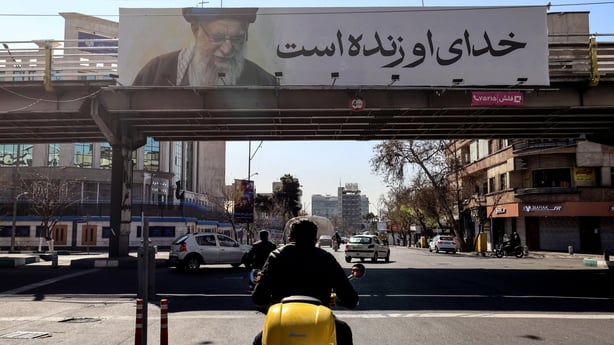
Iranians drive past a banner bearing a portrait of Iran’s slain supreme leader Ayatollah Ali Khamenei
The United Nations nuclear watchdog said the key Iranian nuclear site of Natanz suffered “recent damage”.
“Based on the latest available satellite imagery, IAEA can now confirm some recent damage to entrance buildings of Iran’s underground Natanz Fuel Enrichment Plant.
“No radiological consequence expected,” the International Atomic Energy Agency (IAEA) said in a post on X.
Elsewhere, a series of overhead explosions were heard from Jerusalem after the Israeli military said it had detected fresh missiles launched from Iran and was “operating to intercept the threat”.
While Israeli police said there were several impact areas involving munition fragments within the Tel Aviv district.
Since yesterday, the war has spread to Lebanon, where Iran’s Hezbollah allies fired on Israel, which responded with air strikes and reinforcements of ground positions in the south.
The UN said more than 30,000 people have been forced to flee their homes in Lebanon by the escalation of hostilities in the Middle East.
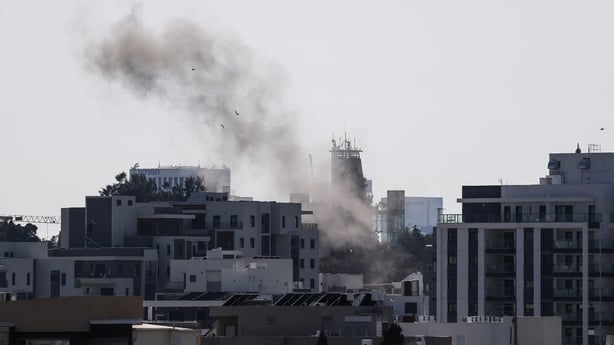
Smoke rises from behind buildings after a projectile struck the area in Tel Aviv
Iran has called the war an unprovoked attack. It has responded by firing missiles and drones at neighbouring Arab states and strangling shipping through the Strait of Hormuz, where a fifth of the world’s oil and liquefied natural gas trade travels past its coast.
The US-Israeli campaign killed Iranian Supreme Leader Ayatollah Ali Khamenei on day one, in what may have been history’s first assassination of a national leader by enemy forces from the air.
If the campaign were to achieve the aim of overthrowing Iran’s ruling system using air power with no armed force on the ground, that would also be a first.
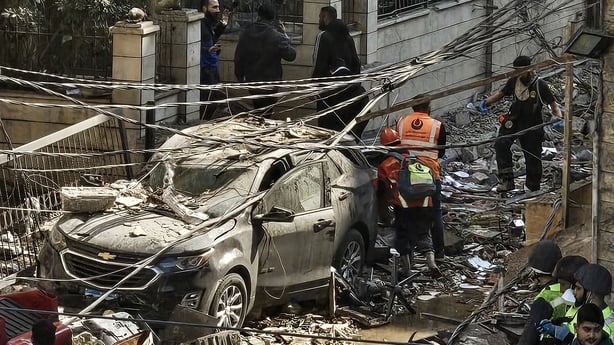
First responders work at a site of an Israeli strike on the southern suburbs of Beirut
State media showed hundreds packing the streets of the southern city of Minab to mourn scores of girls killed in the bombing of a girls’ school on the war’s first day, by far the worst of several reported attacks to hit civilian targets.
The UN human rights office demanded an investigation into the strike, which its spokesperson called “absolutely horrific”.
Some Iranians have openly celebrated the death of Khamenei, 86, who had ruled Iran for 37 years and led security forces that killed thousands of anti-government protesters only weeks ago. But the relentless bombing has sown fear even among those hoping for change.
We need your consent to load this rte-player contentWe use rte-player to manage extra content that can set cookies on your device and collect data about your activity. Please review their details and accept them to load the content.Manage Preferences
Read more:
Satellite images, tracking data show disruption in Middle East
Government considers contingency plans for Irish in Middle East
‘Last night was a pretty sleepless night’ – Irish man in Kuwait
Follow live updates
Speaking to reporters on Capitol Hill last night, Secretary of State Marco Rubio said the US attacked Iran after determining that Israel was on the verge of launching its own strike.
The White House believed any Israeli attack would prompt Iran to retaliate against US interests.
“We knew that if we didn’t preemptively go after them before they launched those attacks, we would suffer higher casualties,” Mr Rubio said.
Israeli Foreign Minister Gideon Saar earlier urged countries to cut ties with Iran, during a virtual meeting with around 60 envoys stationed in Israel.
“The foreign minister told the ambassadors that… countries around the world must cut off their relations with (Iran),” a statement issued by Mr Saar’s office said.
View: Map of attacks and counterattacks
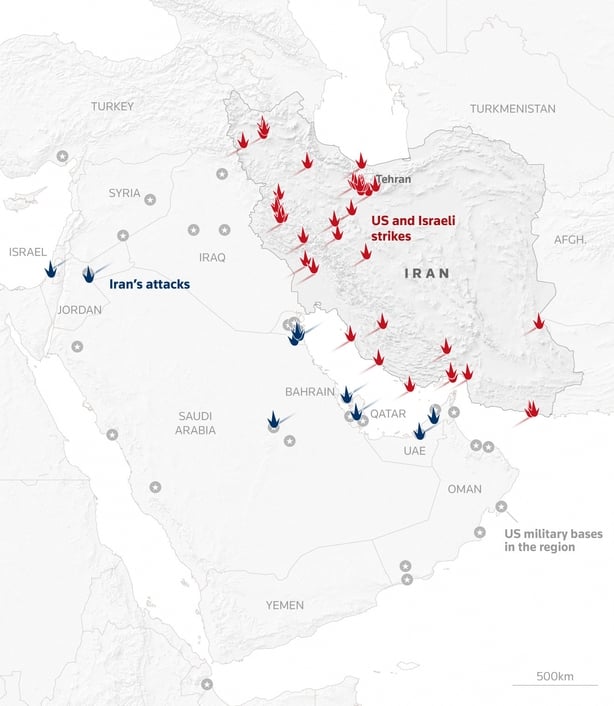
Iran meanwhile urged the United Nations Security Council to take action to stop the war.
“The United Nations Security Council has a duty… if it wishes, it can certainly act, because there is no obstacle to its action except its own will,” said foreign ministry spokesman Esmaeil Baqaei.
Iran’s Revolutionary Guards warned of more intense attacks on US forces and Israel, hours after saying it had shut the Strait of Hormuz.
“The enemy must await continuous punitive attacks; the gates of hell will open more and more, moment by moment, upon the United States and Israel,” spokesman Ali Mohammad Naini told state TV.