
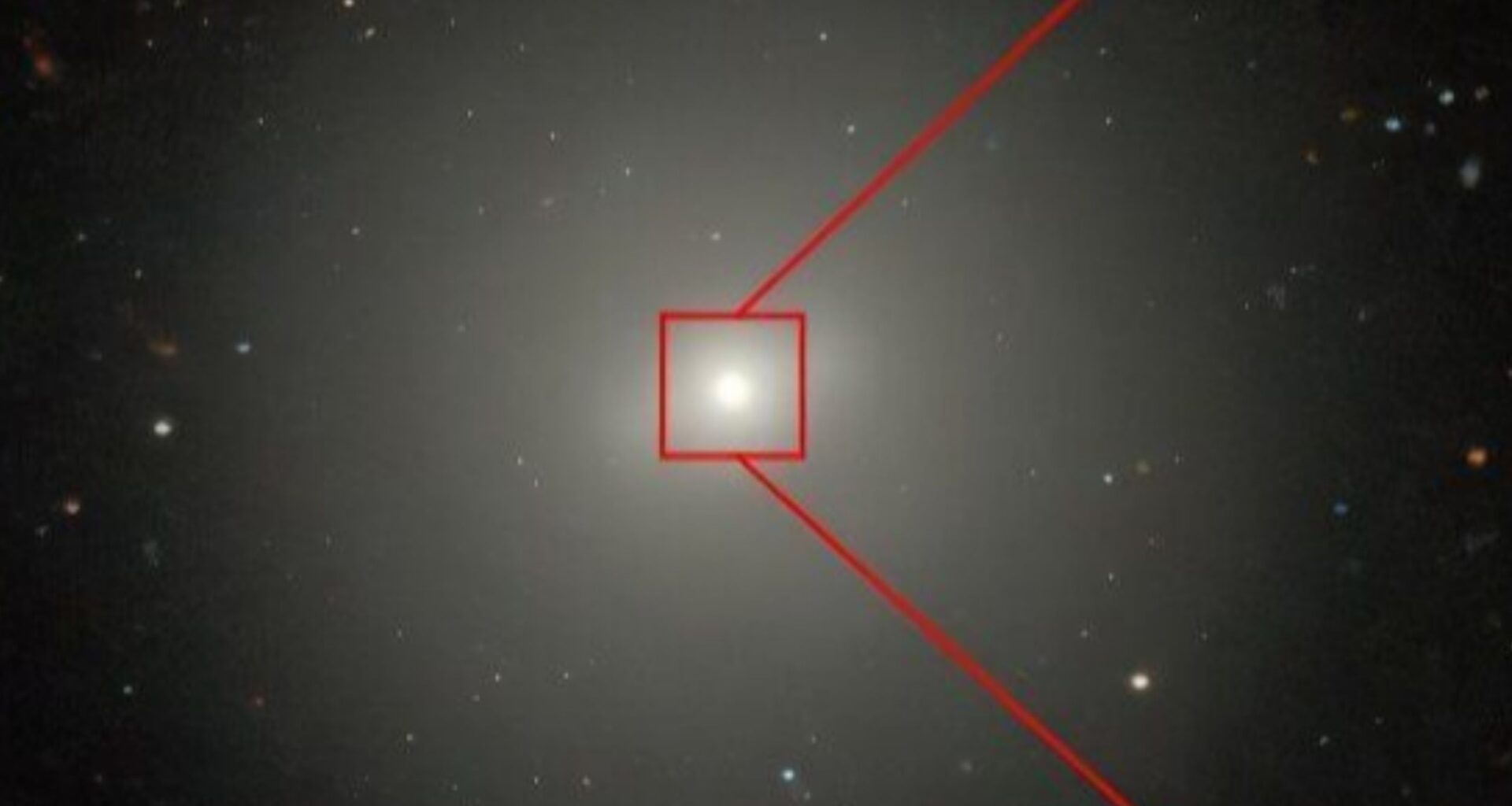
A nearby galaxy has now yielded a resolved census of 1,285 giant star-forming gas clouds.
That tally shows its cold gas does not sit as a smooth disk but gathers into discrete structures that shape how, and how slowly, new stars emerge.

Inside the lenticular galaxy NGC 1387, what once appeared to be an orderly reservoir of cold material resolves into hundreds of distinct cloud complexes spread across its disk.
A cloud census
Working with high-resolution maps from the Atacama Large Millimeter/submillimeter Array (ALMA), Fu-Heng Liang at the University of Oxford documented each cloud individually and traced how its size and mass varied with location.
Rather than revealing a few dominant, oversized structures, the inventory shows a broad population of mid-sized clouds distributed throughout the rotating disk.
That distribution narrows the question from whether the galaxy has star-forming fuel to how the character of those clouds governs what happens next.
Clouds build stars
Across many galaxies, star-making gas gathers into giant molecular clouds, cold gas-and-dust complexes that form stars, often called GMCs.
Gravity squeezes the densest pockets until they collapse and heat, and that hot core grows into a new star.
A NASA guide explains that molecular clouds can span hundreds of light-years, and cold gas clumps into denser pockets.
With clouds as the basic unit of star birth, a galaxy-wide cloud count becomes a direct clue to its future.
Sharpening galactic detail
At ALMA’s high, dry site in Chile, dozens of antennas collect faint millimeter-wave signals from cold gas.
Combining those signals makes the array behave as one much larger dish, sharpening details that a single antenna would blur.
An overview notes that 66 antennas can be rearranged, so astronomers can trade sensitivity for finer resolution.
That flexibility let the team separate neighboring GMCs in NGC 1387 instead of treating them as a single smear.
Meet NGC 1387
About 62.9 million light-years from Earth, NGC 1387 sits in the Fornax Cluster, a group of galaxies in the southern sky.
Classifiers call it a lenticular galaxy, a disk galaxy without clear spiral arms, so it often looks settled.
Measurements showed the stars and the cold gas co-rotated, giving the team confidence that they were tracing stable material.
With stability on its side, NGC 1387 offered a clean test case for asking which cloud traits depend on galaxy type.
Sizing the clouds
Once the team isolated each GMC, they could treat it as a physical object with a size and mass.
Carbon monoxide brightness stood in for harder-to-see hydrogen, letting the team estimate the gas mass of each cloud.
Across the catalog, clouds averaged about 65 light-years in radius and about 316,000 times the mass of our Sun.
Those middling sizes and masses hint that NGC 1387 forms stars in small batches rather than in rare, enormous bursts.
Patterns in the masses
Looking at the full range of cloud masses, the team found many modest clouds and few heavyweights.
A simple count showed the mass distribution fell off with a slope near -1.8, much like clouds in the Milky Way’s disk.
With a cut-off near 1.5 million times the Sun’s mass, the population lacked the biggest GMCs seen elsewhere.
That scarcity suggests the galaxy’s gas rarely gathers into extreme clouds, which can limit how fast stars accumulate over time.
Spins and alignments
Zooming in also revealed that many clouds spun in ways that did not match the galaxy’s overall rotation.
Local forces inside the disk can twist a cloud as it forms, so its spin may reflect turbulence or collisions.
Closer to the center, the largest GMCs did line up better with the galaxy’s motion, hinting at stronger coupling there.
That mixed behavior means a cloud’s path to star formation depends on both galaxy-scale rotation and smaller, messier events.
A slow star factory
Even with a rich supply of GMCs, NGC 1387 turned gas into new stars at a slow pace.
Star formation crept along at 0.008 to 0.082 solar masses per year, roughly one Sun every 12 to 125 years.
That rate fits a galaxy where most gas stays cold and stable, instead of collapsing quickly into dense cores.
By combining cloud-by-cloud data with star counts, astronomers can test which cloud properties actually predict star birth.
Early-type galaxies differ
Across early-type galaxies, smoother systems with older stars, astronomers have mapped fewer GMCs, often called ETGs in research papers.
“These results show that ETGs have more diversified GMC properties than previously thought,” wrote Liang.
To tease apart true physics from viewpoint effects, the authors called for observations of more galaxies in several molecular lines.
“We discuss potential reasons for such diversity, and viewing-angle dependency is a plausible candidate,” wrote Liang.
Broader galactic context
The new cloud inventory turns NGC 1387 into a benchmark for comparing how galaxies parcel out their cold star-forming fuel.
Future ALMA maps of other ETGs should reveal whether diversity is real, or only a trick of perspective.
The study is published in the Royal Astronomical Society.
—–
Like what you read? Subscribe to our newsletter for engaging articles, exclusive content, and the latest updates.
Check us out on EarthSnap, a free app brought to you by Eric Ralls and Earth.com.
—–