
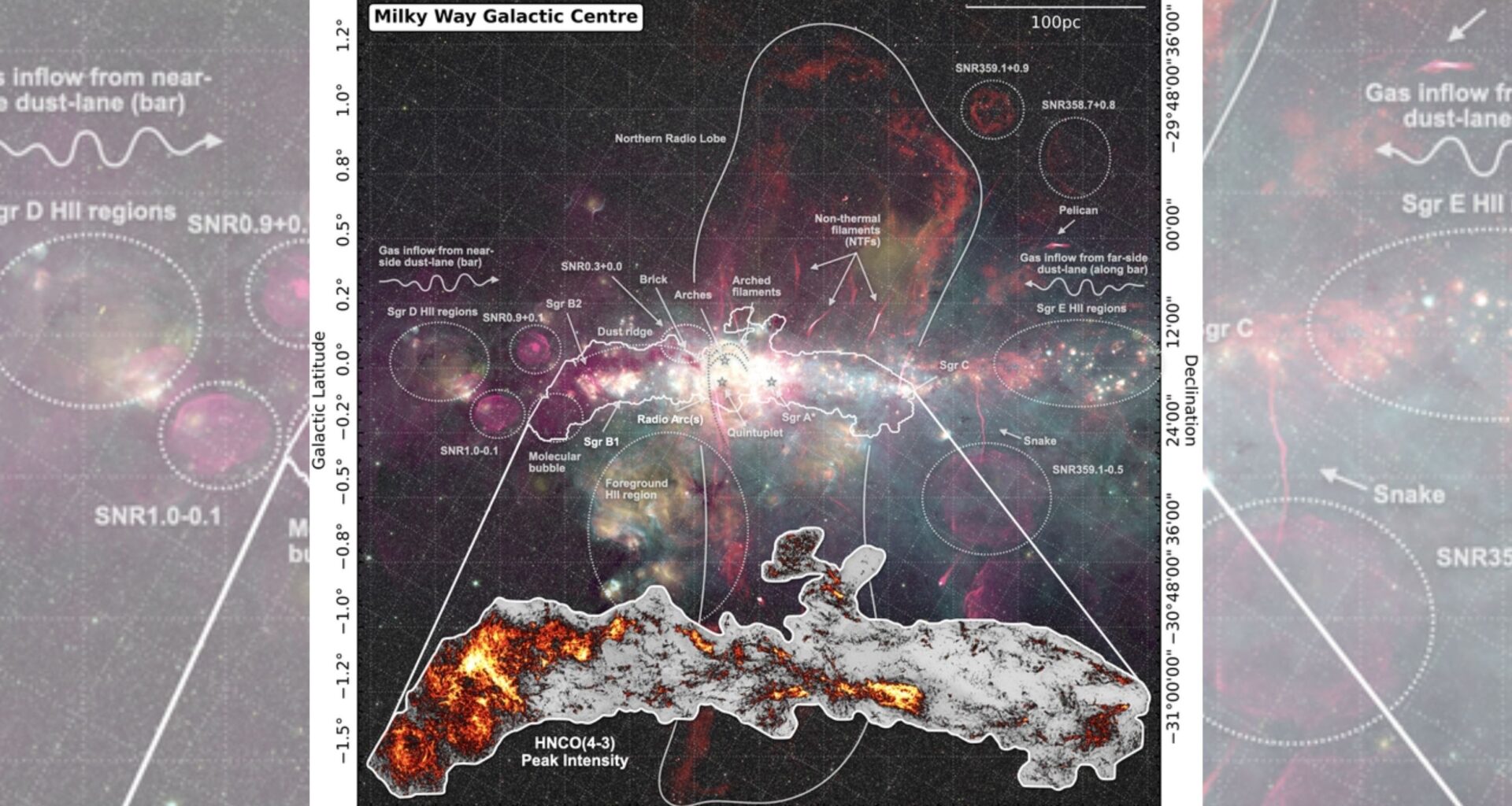
Astronomers have produced the largest image ever made of the Milky Way’s core, revealing a dense web of cold gas filaments intertwined around the galaxy’s central black hole.
The map transforms a once-blurred region into a detailed record of the raw material that fuels star birth under the most extreme conditions in our galaxy.
A mosaic of filaments

In the newly assembled mosaic, long strands of cold gas weave through the Milky Way’s center in tightly packed, overlapping lanes.
Working from this sweeping view, Steve Longmore of Liverpool John Moores University (LJMU) tracked how those lanes gather into denser knots near the black hole while extending for dozens of light-years across the region.
Rather than scattered clouds, the gas forms a connected network that links vast structures to compact clumps surrounding individual stars.
Seeing the center as a continuous system now allows astronomers to test how star-forming material behaves under the intense gravity and radiation found only in a galactic nucleus.
How ALMA saw
In Chile’s Atacama Desert, the Atacama Large Millimeter/submillimeter Array – a network of radio dishes called ALMA – captured cold-gas signals.
Dust blocks starlight, but ALMA detected millimeter wavelengths that pass through dust.
Alongside partners, the European Southern Observatory (ESO) helped run the array, which scanned an area as long as three full moons.
Wide coverage lets scientists connect galaxy-wide flows to clouds that collapse, instead of treating them as separate problems.
Inside the CMZ
Near the Milky Way’s center, the Central Molecular Zone (CMZ), a gas ring around the core, spans 650 light-years, roughly four quadrillion miles (6.4 quadrillion kilometers).
Gravity pulls gas inward, yet turbulence and radiation keep it churning, so clouds do not settle quietly.
At the middle, Sagittarius A* anchors a supermassive black hole, one with millions of times the Sun’s mass, amid crowded gas.
Cold gas composition
Inside the CMZ, ALMA’s Exploration Survey, called ACES, targeted cold molecular gas, gas made of bonded atoms.
Different molecules radiate at different frequencies, so the survey separated chemical fingerprints even when dust hid clouds.
Along with simple gases, ACES picked up dozens of molecules, including methanol, acetone, and ethanol, across the region.
The chemical mix let scientists flag places where gas heated, slammed together, or cooled enough to form new stars.
Filaments form new stars
Across ACES maps, gas lined up into filaments, long narrow strands of matter that linked distant clouds to dense clumps.
Gravity drew material along each filament, building knots until parts of the gas became heavy enough to start collapsing.
Tighter knots can form protostars, newborn stars still wrapped in gas, and the growing heat transforms the chemistry of the surrounding gas.
Tracing chains from filament to star helps explain where the CMZ does, and does not, convert gas into starlight.
Why the center differs
Near the galactic center, strong tides and shocks kept clouds moving fast, so they stayed warmer than disk clouds.
Higher pressure squeezed gas into dense pockets, while violent motion tore other pockets apart before gravity could finish.
Bright young stars and past supernovae flooded the CMZ with energy, and that heat changed which molecules survived.
Competing forces made it hard to predict where new stars would appear, even when gas piled up.
Massive stars dominate
In parts of the CMZ, dense clusters formed massive stars that burn fuel quickly and pour radiation into their birth clouds.
After a few million years, many of those giants exploded, and shock waves compressed some gas while scattering other gas.
Each explosion left expanding debris, and that debris injected heat and motion into clouds already primed by pressure.
Mapping where explosions hit could show whether blast effects trigger the next round of star birth or shut it down.
Lessons for galaxies
Far beyond the Milky Way, young galaxies built stars in cramped centers, so the CMZ offers a nearby check.
When gas piles up under high pressure, it can form stars in bursts, and those bursts reshape galaxies.
“By studying how stars are born in the CMZ, we can also gain a clearer picture of how galaxies grew and evolved,” said Longmore.
If those theories fail in the galaxy’s central region, astronomers may need new rules for star formation in the early universe.
After the first maps were complete, the team prepared a public release so others could mine the CMZ without new observations.
Anyone can download the files from the ALMA Science Portal, which bundles full mosaics plus 45 sub-mosaics into manageable packages.
Soon, ALMA’s Wideband Sensitivity Upgrade and the European Southern Observatory’s Extremely Large Telescope should catch fainter gas and more stars.
Linking new observations with released maps could pin down how black holes, star formation, and stellar explosions affect one another over time.
Interpreting the new map
Linking chemistry, structure, and star birth into one view, the dataset shows the CMZ as an active network around Sagittarius A*.
Even with sharper telescopes, researchers still must untangle overlapping clouds along our line of sight before drawing final cause-and-effect answers.
The study is published in Arxiv.
—–
Like what you read? Subscribe to our newsletter for engaging articles, exclusive content, and the latest updates.
Check us out on EarthSnap, a free app brought to you by Eric Ralls and Earth.com.
—–