
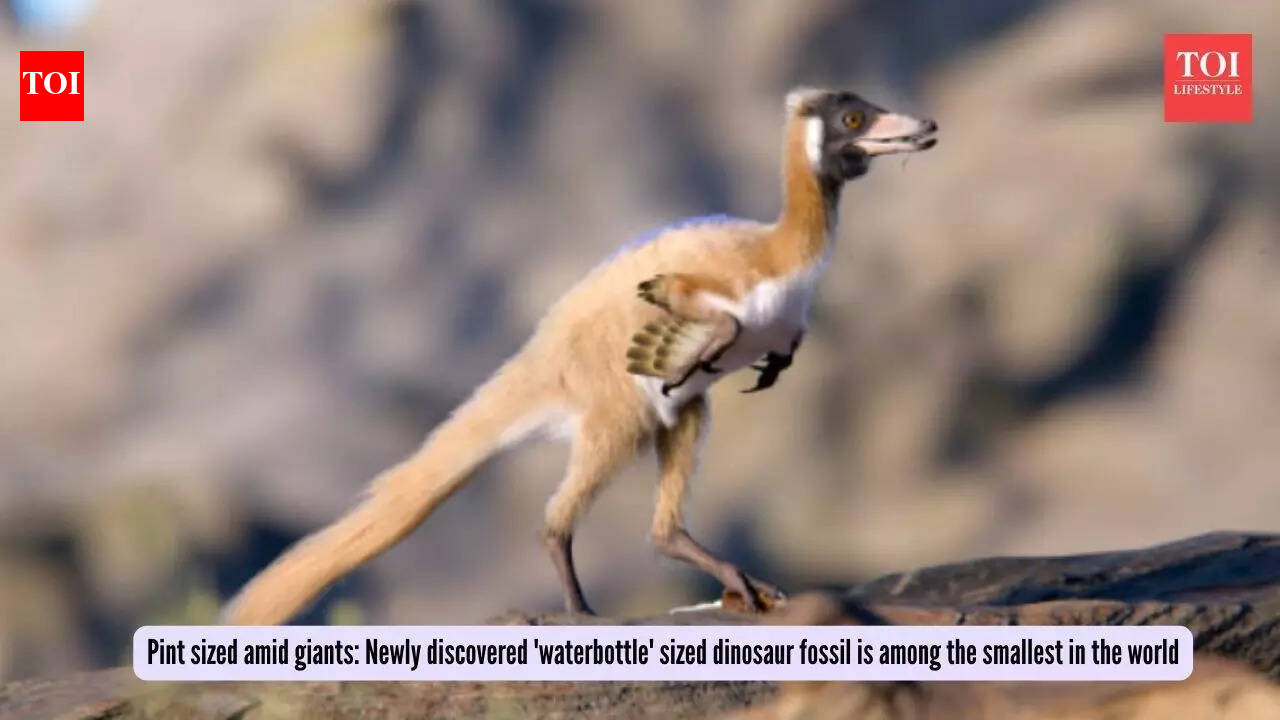
 Scientists in Patagonia unearthed the nearly complete skeleton of Alnashetri cerropoliciensis, one of the world’s tiniest dinosaurs. This crow-sized theropod, weighing just 0.7 kg, hunted small prey 95 million years ago. The discovery highlights the immense biodiversity of the Cretaceous period, proving that not all dinosaurs were giants. We have always imagined dinosaurs as colossal beasts thundering across ancient landscapes, but ecosystems are about balance, where big and small players keep nature intact.Patagonia, Argentina’s fossil jackpot, keeps surprising us with new discoveries by unearthing delicate bones that reveal life’s diversity beyond the titans.Recently, scientists discovered a pint-sized dinosaur fossil, completely changing the perspective about how we see dinosaurs.
A pint-sized predator’s fossil
In northern Patagonia’s Rio Negro Province, at the fossil-rich La Buitrera site, researchers uncovered a nearly complete skeleton of Alnashetri cerropoliciensis, one of the world’s tiniest dinosaurs.This crow-sized theropod lived 95 million years ago in a desert called Kokorkom, or the “desert of the bones” in the Mapuche language, hunting lizards, snakes, mammals, and bugs.Reuters reports the specimen, nicknamed “Alna,” was a small female who died at age four, nearly full-grown, her body swiftly buried by a sand dune for pristine preservation. Weighing just 0.7 kg, “Alnashetri is truly tiny… smaller than a chicken. It wouldn’t even reach knee height on an average adult person,” said lead author Peter Makovicky, a University of Minnesota paleontologist, in the Nature journal study cited by Reuters.
Its size was just equal to 7 small centimeter scales
Alnashetri belonged to alvarezsaurs, or odd theropods with stubby, powerful arms, slender legs, and light skulls. About 70 cm long, mostly tail, it likely had feathers like its relatives. Its sharp, numerous teeth resembled a mini Velociraptor’s, suited for small prey, unlike later alvarezsaurs’ insect-digging claws.Co-author Sebastián Apesteguía of Argentina’s Felix de Azara Foundation and CONICET noted, “Its body resembled that of a rooster, but with a long tail… Its arms were well-developed, though not long enough to allow it to fly.”Histological analysis of its fragile bones revealed exquisite details, per Apesteguía: “The level of histological detail is exquisite.” The first leg bones were found in 2004, leading to this 2014 discovery, which was prepped over 12 years.
Patagonia is a fossil haven of dinosaurs
Amid giants like the 8-ton Giganotosaurus and the 70-ton Argentinosaurus, Alnashetri stands out as a shining example of diversity. Apesteguía said, “When we think of landscapes with dinosaurs… these landscapes are almost always devoid of a crucial component of the ecosystem: medium and small animals. The era… coincided with… the ‘age of the southern giants.’ Alnashetri shows us that it wasn’t a time of giants, but rather a time of immense biodiversity.”This find proves size reduction evolved repeatedly in alvarezsaurs, expanding our view of Cretaceous life.