
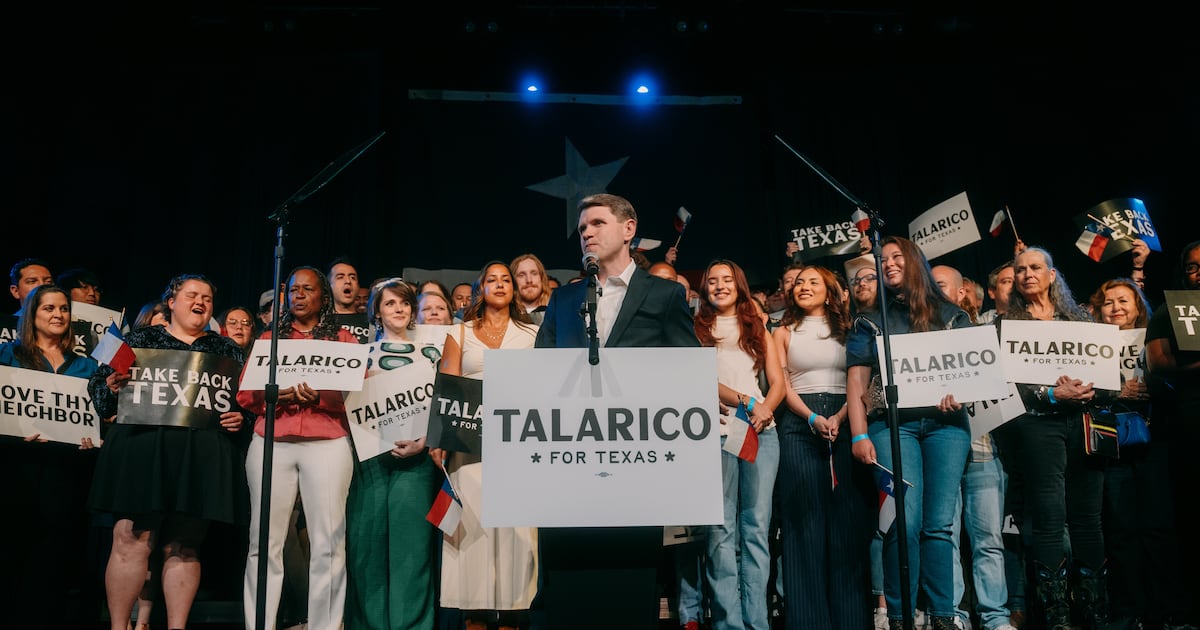
The coronation remains incomplete but as midnight fell over Texas, James Talarico looked set to lead the latest Democratic cause to turn the state blue in the race for a Senate seat following a 30-year period of Republican dominance.
In Washington on Tuesday night, meanwhile, warnings from senior opposition party figures grew louder about the dire consequences of the ongoing conflict in the Middle East.
In an extraordinary turn of events after a long and hot Senate primary election day across the 254 counties in the Lone Star State, a change to procedures in Jasmine Crockett’s voting stronghold of Dallas county led to an 11th-hour state supreme court intervention to keep the voting stations open by two hours.
In the early evening, an emotional Crockett accused the Texas Republican Party machine of chicanery in enforcing a change that this year requires voters in two counties (Dallas and Williamson, on the fringes of Austin) who for years had been permitted to cast their vote at any voting station in their county to now report to designated stations.
There were reports of a huge volume of voters turning up at wrong venues throughout Tuesday, and of the official website crashing as people scrambled for information. Not long after teatime, Crockett issued an appeal to her supporters to make their way to the allocated precinct.
“My heart is breaking. I’ve got people sending me emails, video recordings of voters who are crying, hurt. None of this should have happened. Let’s talk about the many failures and what was intentional. The Republicans only did this to disenfranchise and confuse voters. So, I am begging you to make sure that you go ahead and figure out where you were supposed to vote, stand in line, wait in line and if it means I got to come out there with you to wait with you I will do that.”
But at nine o’clock local time, Crockett made a brief, terse appearance at her watch party in Dallas to announce she did not believe the votes in the county could be tallied until sometime on Wednesday, and that a winner could not be declared. By then, the mathematical spread of Talarico’s vote, with numbers from western counties still to come in, suggested that the state legislator and evangelical seminarian’s remarkable year would continue.
The Republican primary will, as generally anticipated, stretch into what promises to be a bitter and gripping run-off contest in May between incumbent John Cornyn and Texas’s scandal-plagued but Maga-endorsed attorney general, Ken Paxton.
Cornyn (76) underlined his capacity as a proven vote-getter to lead the Republican race while falling short of the quota of 51 per cent, after spending a whopping $80 million on a campaign maligning Paxton. In a brief address to his supporters, he promised more of the same.
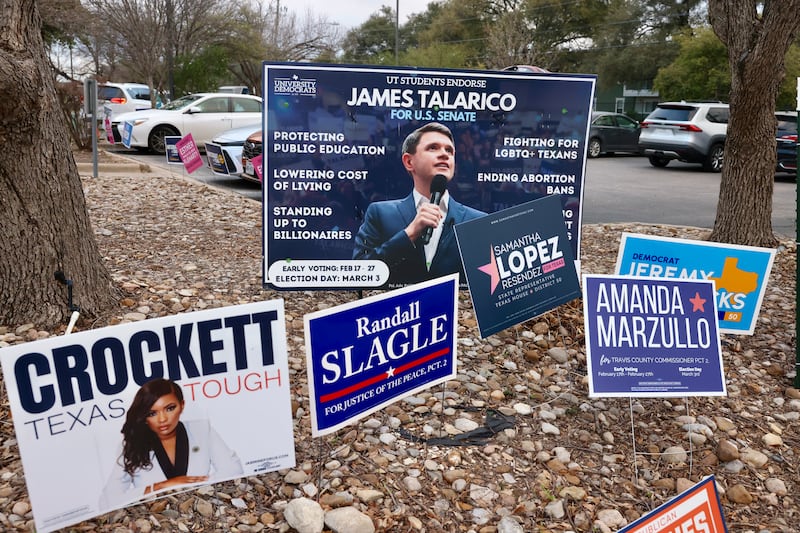 Campaign signs for US Senate candidates including Democrats James Talarico and Jasmine Crockett at a polling station on primary election day in Austin, Texas. Photograph: Ilana Panich-Linsman/The New York Times
“Ken Paxton as the nominee would be a deadweight at the top of the ticket for Republicans running all across this great state,” Cornyn said.
“Over the next twelve months, Texas Republican primary voters will hear more about my record of delivering conservative victories in the United States Senate – and learn more about Ken’s indefensible personal behaviour and failures in office. Just like the primary, we have a plan to win the run-off and we are in the process of executing it. Judgment day is coming for Ken Paxton.”
All of which would be music to the state Democratic Party had its own primary not threatened to turn contentious, and potentially litigious. In Austin, the voting centres were steady throughout the day, with the majority interested in the Democratic race in what is a broadly progressive city.
“I voted for James Talarico. I think that he can reach across party lines and refocus issues more to the root of the problem rather than an us-versus-them framework. He is also from central Texas,” Erin, a 22-year-old Austinite told The Irish Times after leaving City Hall. Her sister Page (18) was voting for the first time and voted for Crockett, even though she has doubts that Texas has changed sufficiently to ultimately send a black woman to the Senate.
“I kind of agree, sadly. I think Talarico will probably get the nomination tonight. But what’s going on in our world right now, part of me has some hope that we might flip to become a blue state. I mean, you never know but I think she probably won’t get the nomination.”
Talarico had been building his name and preaching his message across Texas for months before Crockett announced her intention to run. The confusion over the voting system deflated the atmosphere at Talarico’s watch party at Elmos’s, a well-known music venue in downtown Austin. The candidate declined to address his supporters on the night as the official Democratic result looked set to stretch into Wednesday. At about 11pm local time, with 70 per cent of the statewide vote in, he led by 868,000 to 780,000, or 52 per cent to 46.7 per cent.
But Crockett’s contentious allegations of bad-faith system engineering will both provoke resentment from the Republican Party and feed into the broader Democratic nightmare about whether the November elections will take place in a free and fair manner.
Texas primary night, with more predictable elections also taking place in North Carolina and Arkansas, marked the official beginning of the long, gruelling midterm election season, which will ultimately define the remaining two years of Donald Trump’s second term.
But in Washington, all eyes were fixed firmly on the images of smoke rising from US embassies across the Persian Gulf. After a Senate briefing, a host of Democrats emerged expressing fears that the US was on the verge of becoming mired in a new conflict, with no foreseeable outcome.
“I just want to say that I am more fearful than ever after this briefing that we may be putting boots on the ground, and troops from the United States might be necessary to accomplish objectives that the administration seems to have,” said Connecticut senator Richard Blumenthal.
“But I am also no more clear on the priorities of the administration going forward.”
A week ago, it hardly seemed credible that the Trump administration could add to what has been an extraordinarily eventful year both domestically and abroad. The attacks on Iran have radically widened the gap between president Trump’s decisions and his stated election campaign promises. But that campaign, extraordinary as it was, is already a fading memory.