
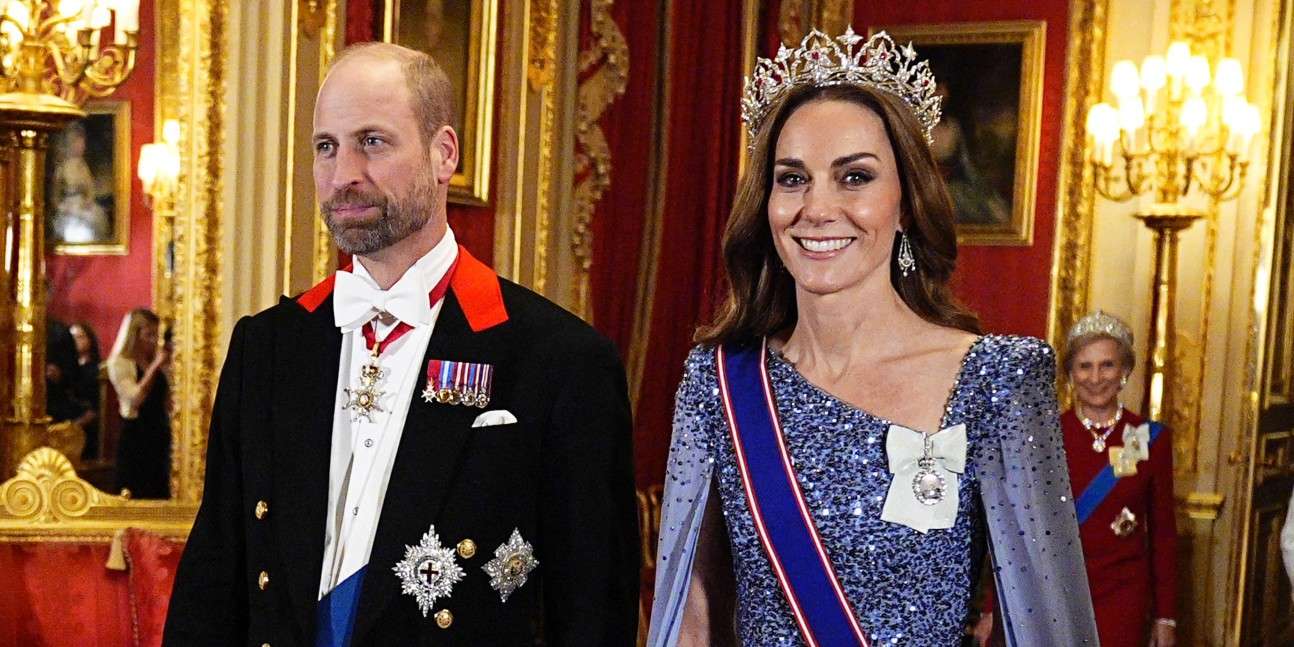
As Prince William approaches the throne someday, he and wife Kate Middleton have a “totally different vision” for the monarchy, royal biographer Russell Myers said.In a new interview with Us Weekly, Myers said that the Prince and Princess of Wales’ approach is “very, very different” than “in generations beforehand.”King Charles, too, has shifted the monarchy from the way it was done during the historic 70-year reign of his mother, the late Queen Elizabeth.
Prince William has long been keen to do it his way when it comes to how he approaches his royal role—and, according to royal biographer Russell Myers, that will continue to be the case as he approaches the throne, and particularly when he is on it.
Kate Middleton and Prince William on November 19, 2025.
Getty
William’s father King Charles also had his own vision for the monarchy—particularly slimming it down in terms of the number of working royals—but no one could have anticipated a decade ago Prince Harry leaving the Firm and relocating with wife Meghan Markle to the United States. “There’s been a lot of talk about a slimmed down monarchy for many, many years, and certainly, if you looked at what Charles’s view of that was maybe 10 years ago, it would have been Harry at the center,” Myers told Us Weekly.
Without Harry, Meghan, and Andrew Mountbatten-Windsor—who hasn’t been a working royal since 2019 amid accusations of his association with convicted sex offender Jeffrey Epstein—Myers admitted, “It does look a little bit thin on the ground at the moment, but I think what the King wanted to do was try to make the royal family much more accountable.”
Kate Middleton and Prince William on February 26, 2026.
Getty
The Prince and Princess of Wales, Myers added, “have a totally different vision for the monarchy. It needs to be accountable, it needs to speak to the younger generation, not only at home, but abroad.”
“It also needs to create a system that works for the people, and certainly what they have tried to do is get their family home life right and then work on the public profile, and that’s very, very different to how the monarch[y] has been structured in generations beforehand,” Myers said.
For his part, royal photographer Chris Jackson—who has photographed the British royal family for more than two decades now—told Vanity Fair that he, too, has noticed changes in Charles’s reign.
King Charles on December 10, 2025.
Getty
“I have noticed a significant change in the way things are done,” Jackson said. “I have always been a great admirer of King Charles, of his ability to connect with people around the world across cultures and languages, his incredible work ethic and dedication to duty.”
“King Charles has certainly approached aspects of the role differently, as one would expect, diversifying and modernizing,” he continued, adding that “the royal family is moving forward, honoring tradition while adopting a more open and modern approach to the monarchy.”
King Charles on February 26, 2026.
Getty
Jackson added that “Each member of the royal family is completely different, and that’s one of the privileges of photographing them over time, learning to capture those differences. Queen Elizabeth had an extraordinary sense of calm, duty, and subtle humor. King Charles brings a deep curiosity, warmth, and intellectual engagement to his role. And Prince William combines a strong sense of responsibility with a more informal and approachable manner that connects with many of the young people he meets. The Princess of Wales has a warmth and friendliness with many of the people she meets and is very natural with young people, always putting herself at their level and taking time to chat. Often walks greeting the public are lengthened because she tries to meet as many people as possible.”