
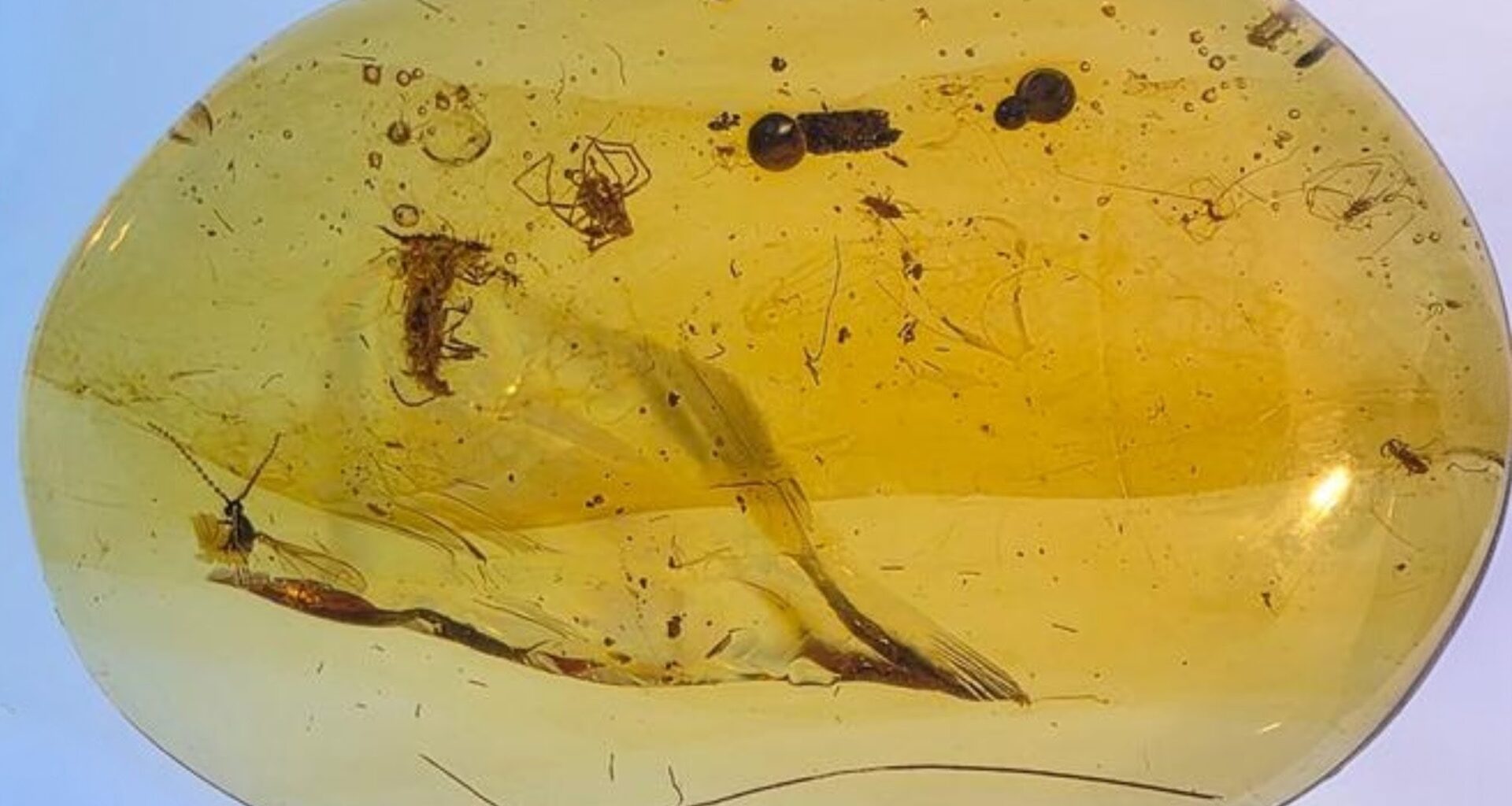
Ants once crawled across tree bark, unaware that a drip of resin could seal their fate for nearly 100 million years.
Tree resin doesn’t look like much when it slides down a trunk. It’s thick, sticky, and traps whatever gets too close. When that resin hardens into amber, it can lock away tiny moments from worlds long gone.
A snapshot of life on Earth
Sometimes, a piece of amber holds more than a single unlucky insect. Scientists find small groups instead – ants beside mites, spiders near wasps, or several species frozen together in the same golden drop of resin.
The big question is simple: were these creatures actually interacting, or were they just in the wrong place at the wrong time?
A team in Spain set out to get answers. They focused on six rare pieces of amber that preserve multiple species together, a phenomenon called syninclusion.
The work was led by Dr. Jose de la Fuente of the Institute for Game and Wildlife Research in Spain.
“Amber inclusions are representative of possible interactions between different organisms shaping the environment,” explained Dr. de la Fuente.
“The identification and morphological characterization of fossil ants in amber with other inclusions of insects provides a snapshot of life on Earth millions of years ago.”
Amber samples with ancient ants
Ants may be small, but they punch above their weight in ecosystems. They move soil, spread seeds, hunt pests, and farm fungi. They form massive colonies with complex social systems.
Understanding the early history of ants can help scientists understand how modern ecosystems took shape.
The oldest ants appeared during the Upper Cretaceous period, when dinosaurs still roamed. These early forms, known as Stem ants, left no modern descendants.
All living ants evolved later from a group known as Crown ants. There were also Hell ants, which descended from Stem ants and had strange features not seen in modern ants.
The six amber samples included both Stem and Crown ants, along with Hell ants. Four pieces dated back about 99 million years to the Cretaceous period.
One came from the Eocene, roughly 56 to 34 million years ago. Another came from the Oligocene, about 34 to 23 million years ago.
Researchers used powerful microscopes to identify each trapped species and measure the distances between them. Those distances turned out to be important.
Ants and mites: A close relationship?
In three of the six amber pieces, ants appeared very close to mites. In Case 1, a Crown ant was preserved alongside a wasp and two mites. The mites were so close to the ant that they may have been traveling on it.
In Case 4, a Stem ant and a mite were found about four millimeters apart. Case 5 contained three different ant species near a mite and some termites, along with poorly preserved mosquitoes and a winged insect.
Distance matters here. The smaller the gap, the more likely it reflects a real interaction before the resin trapped them.
“The closest ant syninclusions are more likely to reflect behavior and interactions between these organisms,” said Dr. de la Fuente. “The proposed ant-mite interactions in Case 4 may reflect two possible scenarios.”
“First, a commensal specialized temporal relationship where mites attach to ants for free ride dispersal to new habitats. Second, a parasitism when mites feed on the ant host during transport.”
Mites today often hitch rides on insects, including ants. Some simply use them for transportation, a behavior called phoresy. Others feed on their hosts. The amber hints that these relationships may stretch back nearly 100 million years.
Spiders, wasps, and possible coincidences
Not every close pairing tells a clear story. In Case 6, researchers found a Stem ant next to what appears to be a parasitic wasp and a spider. The ant seemed to be feeding on something. It rested against another insect inclusion that could be a worm or larva.
But there was no clear sign that they were interacting. The team suspects that particular grouping may have been coincidence rather than behavior frozen mid-action.
Case 2 contained a Stem ant and a spider. Case 3 held a Hell ant, a snail, a millipede, and several insects that could not be clearly identified.
Some spiders today mimic ants to avoid predators or sneak up on prey. The spider in Case 6 belonged to a type that can camouflage itself as an ant. Being near real ones might have offered an advantage in life. Whether that happened here remains uncertain.
That uncertainty is part of the story. Amber preserves position, but it does not always preserve intention.
Reading behavior in stone
Amber pieces that contain ants are rare. Pieces with multiple species are even rarer. Scientists must be careful not to overinterpret what they see. Two insects in the same resin flow do not automatically mean they were interacting.
Still, patterns matter. When ants and mites repeatedly show up very close together, it suggests something more than chance.
“To improve the analysis of interactions between different organisms in fossil amber inclusions, future research should use advanced imaging techniques,” said Dr. de la Fuente. “Nevertheless, these results provide evidence of insect behavior and ecological habits.”
New tools such as micro-CT scanning could help. These scans can reveal tiny structures inside fossils, including possible attachment organs that mites might have used to cling to their hosts. That level of detail could strengthen the case for ancient hitchhiking or parasitism.
For now, these six amber pieces offer small but powerful clues. They show that even in the age of dinosaurs, ants were already part of complex networks of predators, parasites, and partners.
Sometimes the distance between two tiny bodies, measured in just a few millimeters, can open a window into a world nearly 100 million years old.
The full study was published in the journal Frontiers in Ecology and Evolution.
Image Credit: Dr. Jose de la Fuente
—–
Like what you read? Subscribe to our newsletter for engaging articles, exclusive content, and the latest updates.
Check us out on EarthSnap, a free app brought to you by Eric Ralls and Earth.com.
—–