
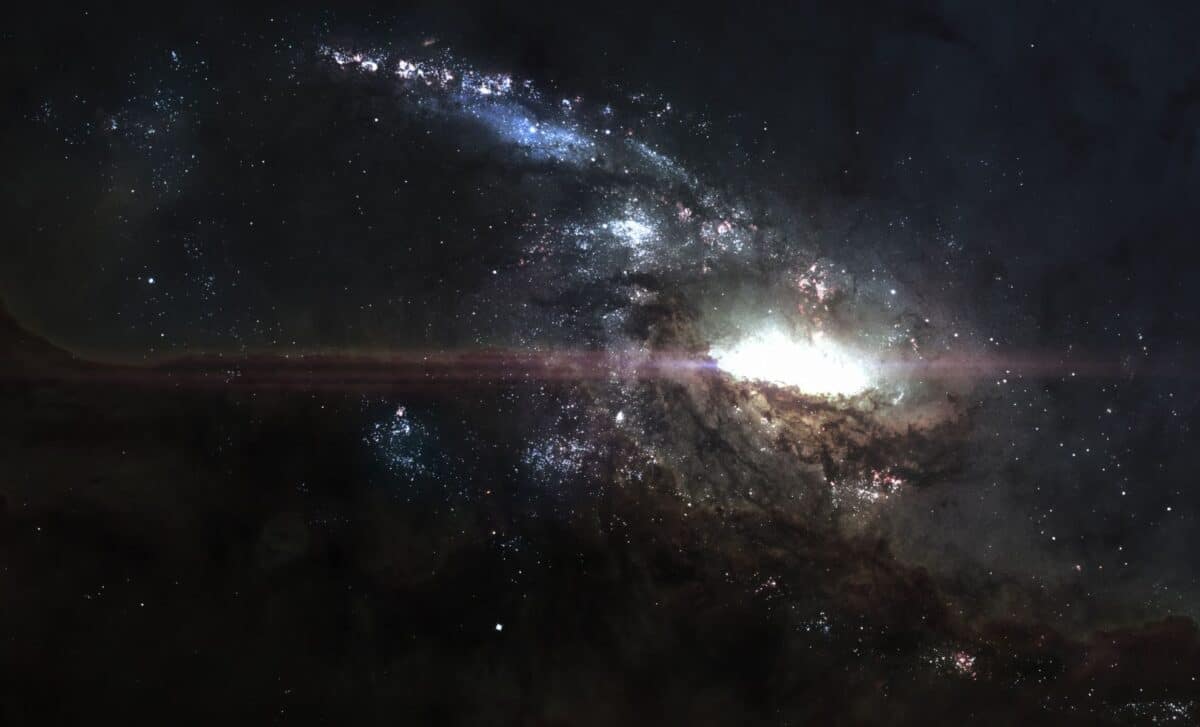
In the vast expanse of the universe, there are regions so empty they seem like the definition of nothingness: cosmic voids. But recent discoveries are upending that perception. These empty spaces, although devoid of stars, galaxies, and radiation, are not truly empty.
Despite their appearance as barren stretches of space, cosmic voids are an essential part of the universe’s structure. These ones are large-scale empty spaces between galaxy clusters, and scientists have long assumed that their emptiness is total. However, modern physics reveals a different reality. They are not merely voids of matter but are packed with a type of energy that influences the entire cosmos.
What Lies Beneath?
When we look at the cosmic voids, they appear as regions almost entirely free of matter. There are few stars or galaxies, and little to no radiation. For a long time, this emptiness led scientists to believe that nothing of significance could exist there. However, in the context of quantum field theory, this emptiness is misleading.
According to a SciTechDaily report, even the vacuum of space contains energy. This energy exists in the form of quantum fields, which are present throughout all of space, even in the most remote voids.
Quantum field theory explains that particles, like electrons or neutrinos, are not fundamental objects in themselves but are instead excitations or vibrations within underlying fields that permeate space-time. These fields have existed since the Big Bang, and their presence cannot be stripped away, even from the emptiest vacuum. So, while there may be no stars or galaxies in these regions, the fabric of space-time itself is alive with activity, even if that activity isn’t immediately visible to the naked eye.
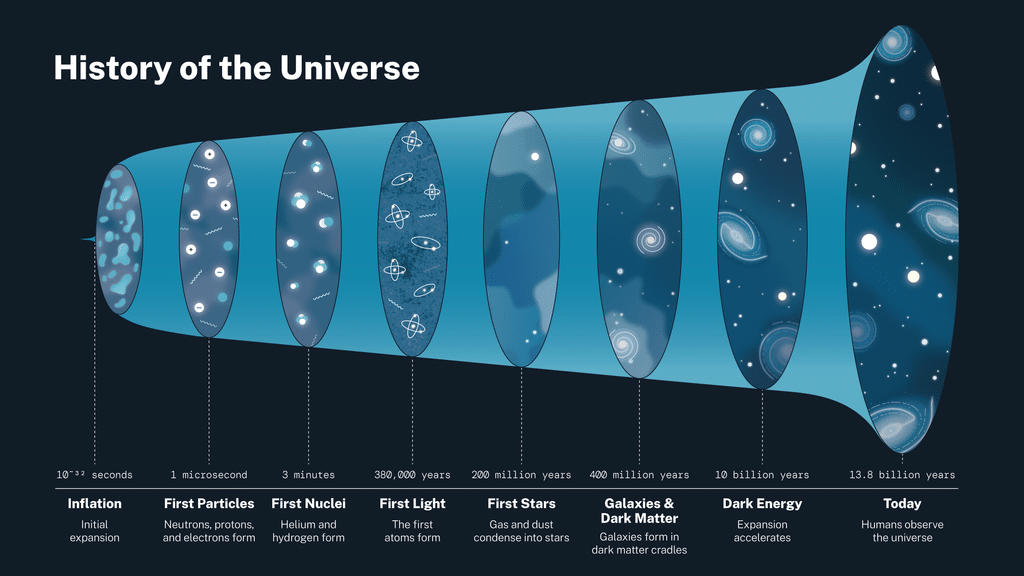 A visual timeline of the universe’s history, from the Big Bang to the present day. Credit: NASA
The Hidden Power Behind the Universe’s Expansion
As explained by the NASA, dark energy is the mysterious force driving the universe’s accelerating expansion. In the denser regions of the universe, such as galaxy clusters, matter and gravity dominate the dynamics.
“This theorized that this mystery component could be attributed to something called “vacuum energy,” which is a theoretical background energy permeating all of space,” explained the U.S. Space Agency.
However, in the emptiness of the voids, the vacuum energy, or dark energy, becomes the dominant force. This is because, in areas where matter is sparse, the influence of dark energy becomes far more pronounced.
Dark energy was first identified as a key player in the universe’s expansion in the late 1990s, when scientists observed that galaxies were moving away from each other faster than expected. These findings led to the realization that something unseen was causing this acceleration. Now, cosmic voids are understood to be the places where dark energy operates most powerfully.
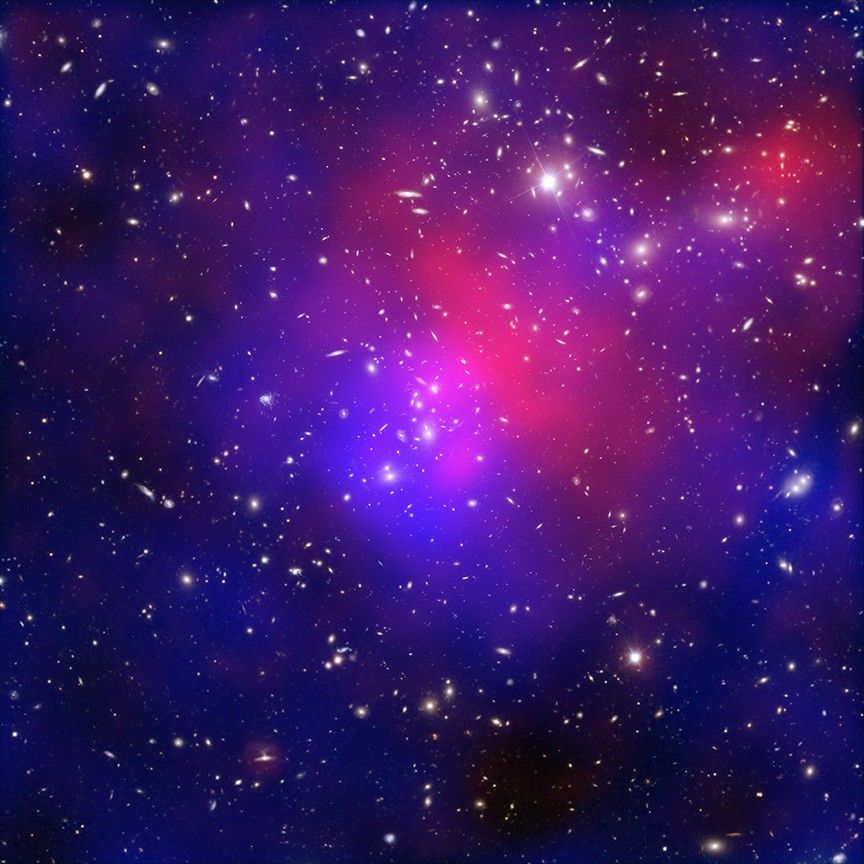 This composite image captures one of the most remarkable and intense galaxy cluster collisions ever detected. Credit: NASA, ESA, J. Merten (Institute for Theoretical Astrophysics, Heidelberg/Astronomical Observatory of Bologna), and D. Coe (STScI)
What Happens When the Universe Runs Out of Space?
The role of cosmic voids in the universe’s expansion is more than just theoretical. These regions are not static; they are expanding, and in doing so, they influence the structure of the universe at a grand scale. Over time, the voids are pushing against the surrounding matter, stretching the cosmic web of galaxies and galaxy clusters.
According to the source, the voids will continue to expand, and over the course of billions of years, they will help to slowly dismantle the cosmic structures we see today. This slow disintegration will occur as the vacuum energy within the voids drives the universe’s expansion to new heights.