
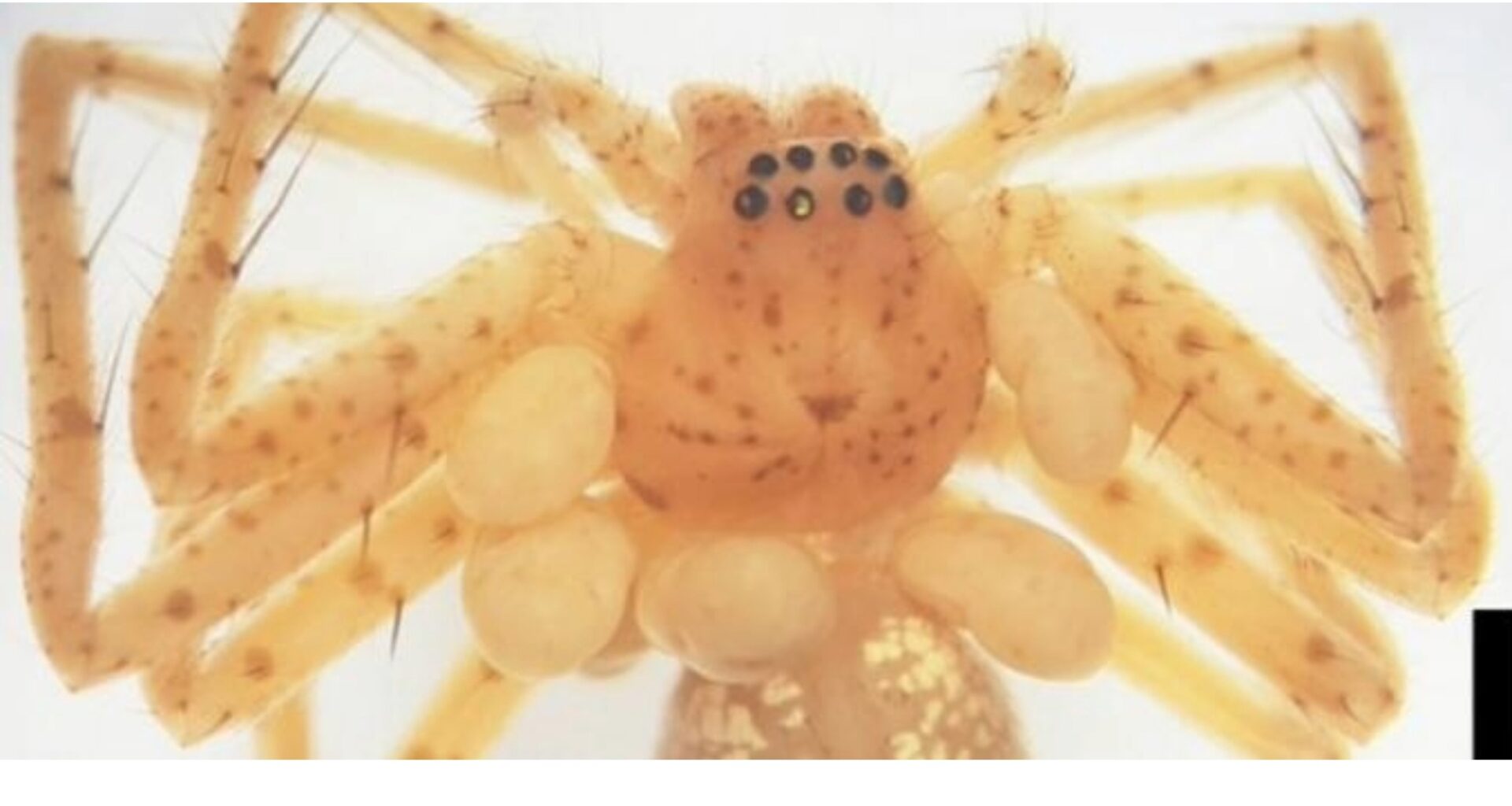
Someone at Brazil’s Butantan Institute was sorting through spiders in the collection when they spotted something that looked decorative.
On a spider only a few millimeters long, there was a neat string of pale beads clinging to its body, like a miniature pearl necklace.

Except it wasn’t decoration. It was parasite larvae. They called in a mite expert from Butantan Institute, Ricardo Bassini-Silva, and he immediately knew what he was looking at: mite larvae latched onto the spider and feeding.
That alone is rare in Brazil. What came next was even more surprising – the larvae didn’t match anything previously known from the country.
After the team examined them in detail using microscopy and scanning methods, they confirmed it: this was a brand-new species, which they named Araneothrombium brasiliensis.
Meet Araneothrombium brasiliensis
Brazil has an astonishing diversity of spider species, yet documented cases of mites that parasitize spiders are surprisingly rare. Until now, the country had only one recorded spider-parasitic mite, and it belonged to a completely different family.
That makes this discovery only the second such record for Brazil – and the first time this particular mite family has been found there. It also extends the known range of the genus Araneothrombium, which was only described recently in Costa Rica in 2017.
Finding it in Brazil strongly suggests that this group is likely spread across much more of the Neotropics than scientists have been able to document so far.
In other words, the mites may not be rare in nature – they are rare in the scientific record because few researchers are looking closely enough.
A parasite that disappears with age
The mites themselves are tiny, measuring about half a millimeter, and their spider hosts are not much larger. At the larval stage, the parasites are little more than moving specks.
Researchers found them attached to juvenile spiders from three different families, visibly engorged after feeding and swollen in size. Notably, only larval mites were found – no adults. For this group, that is expected.
“For this group of mites, it isn’t uncommon to know many parasitic species only through their larvae, since in adulthood they become free-living predators, living in the soil and feeding on small insects and even other mites, which makes them very difficult to find,” Bassini-Silva said.
In effect, the larva represents the parasitic phase of the life cycle. Once mature, the mite leaves the spider and retreats into the soil.
There, it lives a completely different life, which makes it extremely difficult to link the parasite and predator unless researchers catch the species at exactly the right moment.
Caves and hidden parasites
The parasitized spiders were collected in Pinheiral, in Rio de Janeiro state, near caves and grottos.
That detail rings a bell because Brazil’s only other known spider parasite, the mite Charletonia rocciai, was also discovered in a similar setting.
It doesn’t necessarily mean caves “cause” these parasites. Instead, it suggests these environments may be good hunting grounds for researchers trying to find more examples, or at least places where these interactions are easier to preserve and notice later.
Araneothrombium brasiliensis attacks
These Araneothrombium brasiliensis larvae don’t try to bite through the toughest parts of the spider’s body. Instead, they target the pedicel – the thin “waist” that connects the front section (where the eyes and mouthparts are) to the abdomen. Why there? Because it’s basically the weak link.
“This is the spider’s most vulnerable region since other parts have a lot of chitin, which forms an exoskeleton difficult for the mites’ fangs to penetrate,” Bassini-Silva said.
They feed on lymph-like body fluid circulating inside arthropods. So they anchor themselves where it’s easiest to tap in.
The fact that the hosts were juveniles also makes sense. Younger spiders are generally more exposed and less able to defend themselves, so parasites that rely on opportunity may do better by targeting them.
Are these mites strictly “spider parasites”? Maybe not. Even though this new species was found on spiders, the researchers don’t assume it’s exclusive to them.
Some related mites can feed on multiple kinds of arthropods. The earlier Brazilian species, Charletonia rocciai, isn’t picky – it’s been observed parasitizing insects from at least two different orders.
So Araneothrombium brasiliensis might turn out to be a spider specialist, or it might be a generalist that also uses other hosts. Right now, the evidence shows that it definitely uses spiders, and the rest is still up in the air.
Unearthing secrets in collections
This wasn’t discovered during some dramatic jungle expedition. The spiders had been sitting in a collection for years. The mites were there the whole time, and just went unnoticed until someone spotted the “necklace.”
That’s a good reminder that museum collections aren’t dead storage. They’re full of undiscovered stuff, especially when it comes to tiny organisms and weird relationships like parasitism.
And Brazil is basically a goldmine for this kind of work. “With more than 3,000 species of spiders alone, Brazil has immense potential for discovering new parasitic mites,” Bassini-Silva said.
Thus, if one tiny spider in a drawer can reveal a brand-new parasite species, there are probably plenty more surprises waiting, not just in the forest, but already sitting on shelves.
The study is published in the International Journal of Acarology.
Image credit: Ricardo Bassini-Silva
—–
Like what you read? Subscribe to our newsletter for engaging articles, exclusive content, and the latest updates.
Check us out on EarthSnap, a free app brought to you by Eric Ralls and Earth.com.
—–