
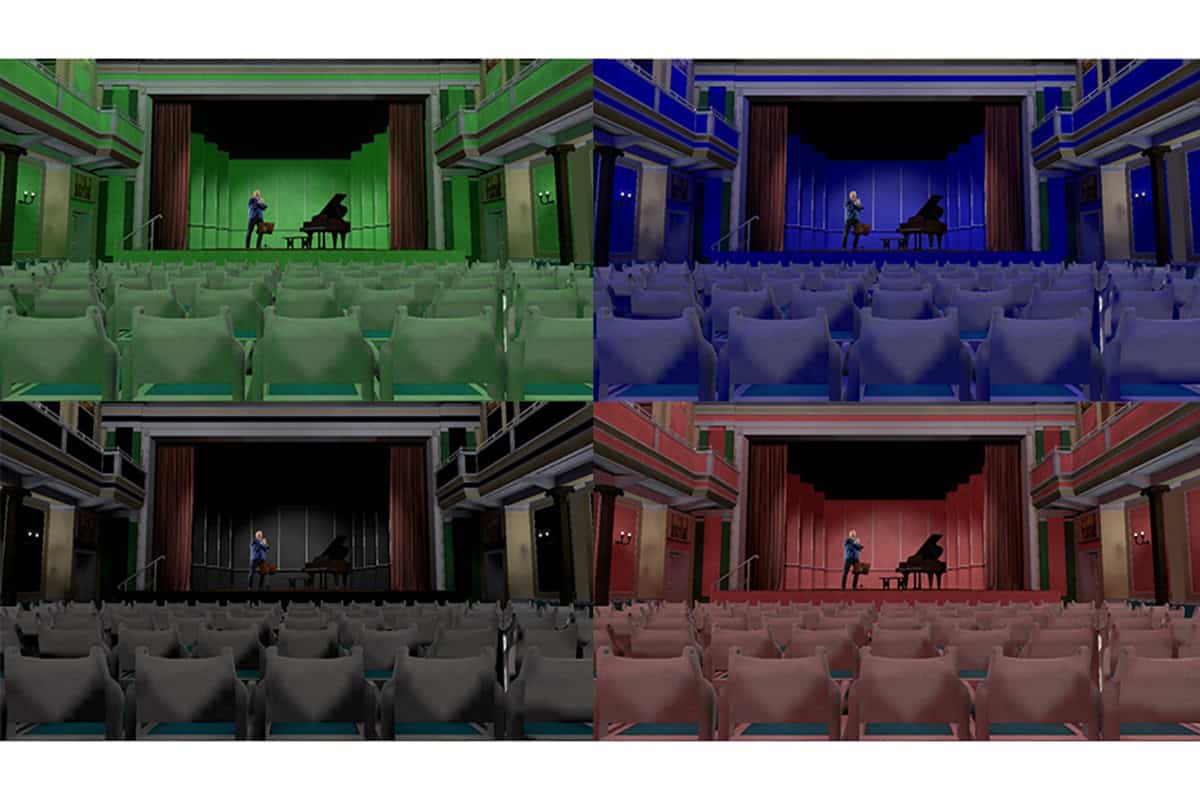
 The virtual concert hall presented to the participants in different color schemes. Credit: The Journal of the Acoustical Society of America, 2026.
The world’s best concert halls are perfectly tuned to deliver the best sound quality. No effort is spared in designing the right hall geometry and picking just the right acoustic absorbing materials so you don’t hear ringing, knocks, weird reverbs, and overtones that distract from the music itself.
But objective acoustics is one thing, and sound perception is another. It turns out that the human brain can be tricked into hearing sound differently by things that shouldn’t affect sound at all, such as the color of the concert hall’s seats.
According to a new study from the Technical University of Berlin, the color of a concert hall physically changes how you perceive the “flavor” of a performance. While the actual decibel level remains the same, a change in hue can make a clarinet sound “colder” or a violin feel “warmer.” It turns out that when we sit down in a theater, we aren’t just listening with our ears — we’re subtly listening with our eyes, too.
The Virtual Architecture of Sound
To figure out how vision hacks our hearing, researchers Stefan Weinzierl and his team didn’t build twelve different physical concert halls. That would be an architectural nightmare. Instead, they leaned into the future of psychoacoustic research: high-fidelity virtual reality.
The team recruited 48 participants and strapped them into Varjo VR-2 Pro headsets. They were “transported” into a digital replica of the Small Hall at the Konzerthaus Berlin. This wasn’t a static 360-degree photo. The researchers used motion-tracked musical performances — where professional violinists and clarinetists were recorded against green screens — and placed them on a virtual stage that responded to the listener’s head movements.
 Audio and video recording in front of a green screen in the anechoic chamber of the TU Berlin. Credit: Christos Drouzas.
The researchers systematically altered the hall’s color scheme using the HSL (Hue, Saturation, Lightness) model. They tested three main hues — red, green, and blue — at varying levels of brightness and saturation.
As the participants watched these digital soloists perform Bach and Grgin, they had to rate the room’s acoustics. They had to judge specific “timbre” qualities like brilliance, warmth, and roughness.
Why Volume Stays the Same While Feeling Changes
One of the most interesting findings was what didn’t change. Despite decades of anecdotal evidence suggesting that bright rooms sound louder, this study found no significant link between a room’s brightness and its perceived loudness or reverberation.
×
Thank you! One more thing…
Please check your inbox and confirm your subscription.
“Room acoustics perception is multidimensional,” said author Stefan Weinzierl. “So, we perceive halls as more reverberant or less reverberant; we perceive them as louder or softer, but we also perceive different timbres of a hall — a hall can appear warm, [or] it can appear bright or metallic in sound.”
The study suggests that loudness and echo are “unimodal,” meaning they are handled mostly by the ears alone. However, “warmth” is a different story. The researchers found a significant cross-modal effect: the more saturated the color of the hall, the less “warm” the music sounded to the audience. Specifically, visually “cool” saturated colors like deep greens and blues evoked a colder, more metallic sound.
The Semantic Bridge Between Senses
Why does this happen? The researchers point to a concept called “semantic mediation.” Humans have a habit of using the same words to describe completely different sensory experiences. We talk about “warm” blankets (touch), “warm” colors (sight), and “warm” sounds (hearing).
Because our brains use the same linguistic bucket for these concepts, the visual “warmth” of a red room can leak into our auditory processing. It’s a glitch in our internal filing system that inadvertently impacts how we enjoy art.
This isn’t the first time science has seen this sensory bleeding. Past studies have shown that red cars are often judged to be louder than green ones, even when the model and engine throttle are identical.
The Expert’s Burden: Why Training Matters
Not everyone hears the “color” of sound in the same way. The Berlin study utilized the Goldsmiths Musical Sophistication Index (Gold-MSI) to measure the participants’ musical backgrounds. They found that people with high levels of musical training or “active engagement” (people who live and breathe music) were actually more susceptible to these visual tricks.
For instance, listeners who spend a lot of time analyzing music in their free time tended to enjoy the music more when the room was highly saturated with color. Conversely, those with formal musical training often preferred less saturation.
The study found that including these personal musical backgrounds increased the “explained variance” of the results significantly. In plain English, your history with an instrument acts as a lens that changes how much the room’s color affects your ears.
Designing the Future of Performance
This research is obviously important for the architects who build the world’s great performance spaces. When an orchestra spends millions of dollars on a new hall, they usually focus on the materials of the stage and the curve of the ceiling. But this study suggests they should be just as worried about the upholstery and the lighting.
“Considering the effort that is done to improve acoustical properties — all the money that is spent for making a concert hall sound well — I think it should not be overlooked that the visual appearance makes its contribution [to] the sound of the hall,” Weinzierl noted.
If a hall is designed to have a “warm” signature sound, but the architect paints the walls a vibrant blue, they might be fighting an uphill battle against the audience’s own brains. The researchers suggest that lighting and interior design should be treated as “frequency-dependent” acoustic tools, just like sound-absorbing panels.
“If you design a concert hall, don’t forget to think about the visual appearance,” Weinzierl said. “It will have an effect on how the sound is perceived.”
The findings appeared in The Journal of the Acoustical Society of America.