
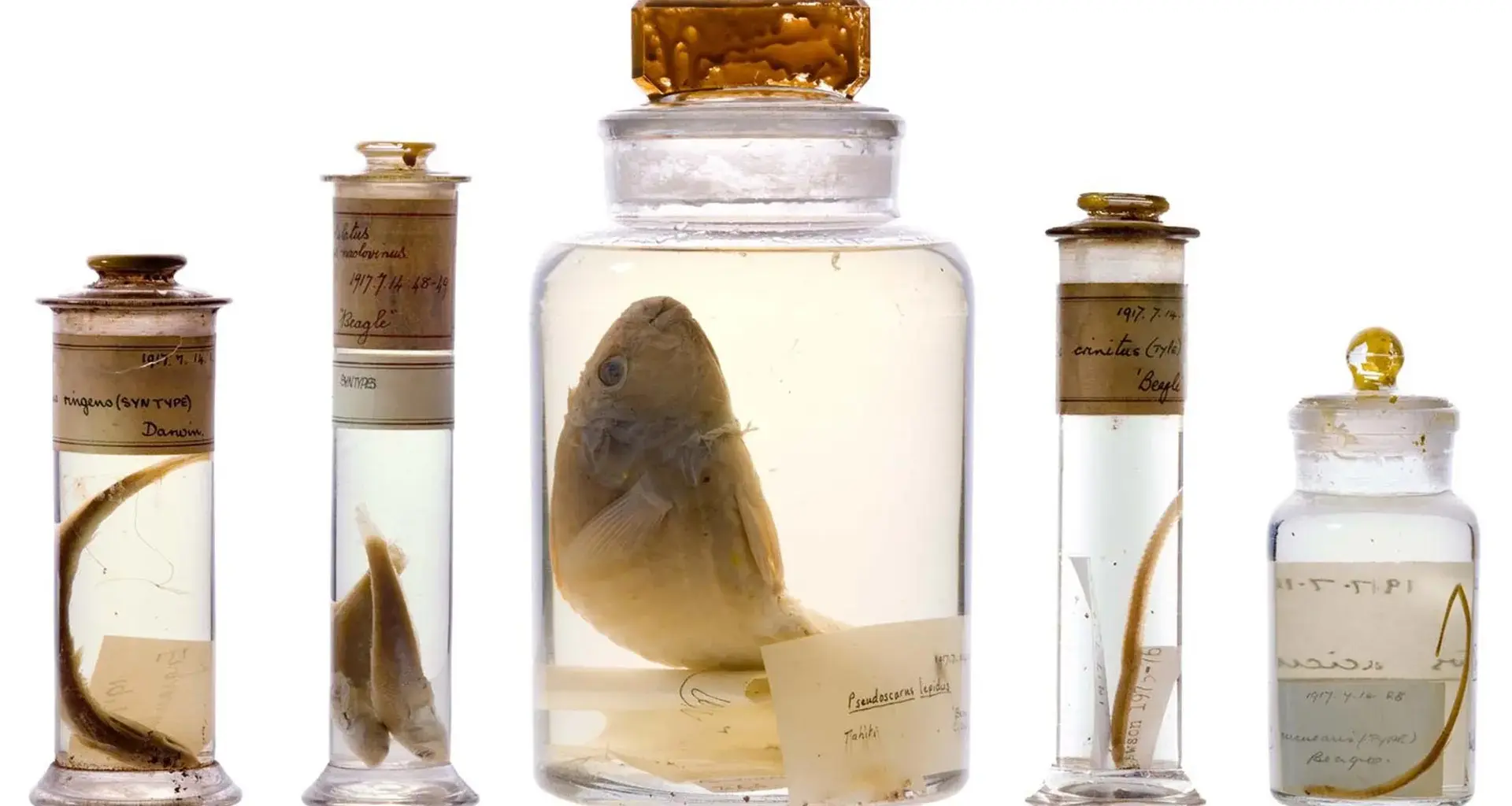
Scientists have found a way to study Charles Darwin’s original specimens from his famous HMS Beagle voyage (1831 to 1836) to the Galapagos Islands.
Even more remarkable, they were able to examine the samples without opening the nearly 200-year-old jars that preserve them.
Studying Darwin’s Historic Specimens
The research focused on 46 historic specimens housed at the Natural History Museum in London. These included mammals, reptiles, fish, jellyfish, and shrimp collected by Darwin and other naturalists during early scientific expeditions.
The analysis revealed that preservation practices varied depending on both the type of organism and the time period in which the specimen was stored.
For example, mammals and reptiles were often treated with formalin before being stored in ethanol. Invertebrates, however, were preserved using a wider range of liquids, including formalin, buffered solutions, or mixtures that contained additives such as glycerol.
Identifying Preservation Fluids
The researchers were able to correctly determine the preservation fluids in about 80% of the specimens they tested. In another 15% of cases, the technique provided partial identification.
The method also revealed whether the containers were made from glass or plastic. This information helps scientists better understand how storage practices have changed over time.
The project was a collaboration between:
the Science and Technology Facilities Council (STFC) the Natural History Museum Agilent Technologies
Portable Laser Technology Scans Specimen Jars
To perform the analysis, researchers used a portable laser spectroscopy method called Spatially Offset Raman Spectroscopy (SORS). This technology allows scientists to examine the chemical composition of preservation fluids through the walls of sealed containers.
SORS works by directing laser light into a jar and measuring how the light changes when it scatters and reflects back. These subtle wavelength shifts reveal the chemical signatures of substances inside the container.
Originally developed at STFC’s Central Laser Facility, SORS is also used in airport security scanners worldwide through Agilent Technologies.
Dr. Sara Mosca, STFC Central Laser Facility said:
“Until now, understanding what preservation fluid is in each jar meant opening them, which risks evaporation, contamination, and exposing specimens to environmental damage.
“This technique allows us to monitor and care for these invaluable specimens without compromising their integrity.”
A New Tool for Museum Collections
Museums around the world hold more than 100 million specimens preserved in liquid.
For curators, knowing the exact chemical makeup of the preservation fluid is essential for monitoring the condition of these collections. Over time, fluids can degrade or evaporate, potentially damaging the specimens.
Being able to analyze these liquids without opening the containers gives museum professionals a powerful new way to track collection health and intervene before problems occur.
Transforming Natural History Research
Wren Montgomery, research technician at the Natural History Museum, says:
“As part of NHM Unlocked, here at the Museum we can analyse jars containing specimens without opening and disturbing their integrity.
“This work is the next step in demonstrating the Museum’s commitment to transforming the study of natural history.
“Analyzing the storage conditions of precious specimens, and understanding the fluid in which they are kept, could have huge implications for how we care for collections and preserve them for future research for years to come.”
The study was published in ACS Omega and was featured as the ACS Editors’ Choice on January 13, 2026.