
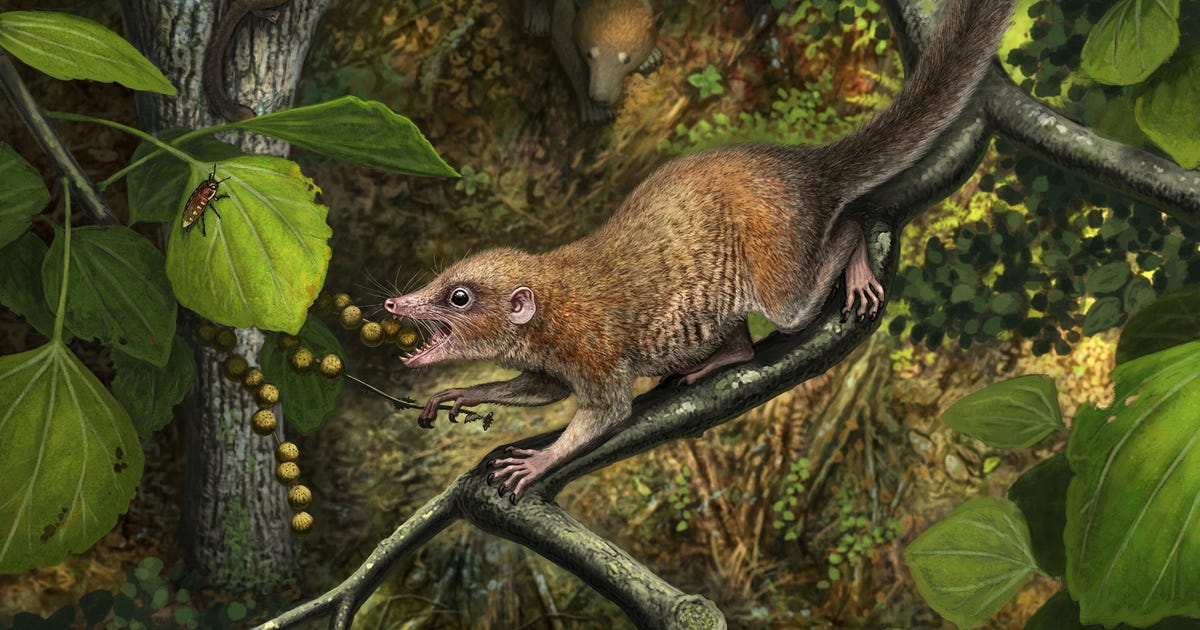
Almost 66 million years ago, an animal that looked like a rat, or maybe a squirrel, died in Corral Bluffs, Colorado. Its name was Purgatorius. It was either our earliest ancestor or a relative of it, and its discovery 800 miles south of its previously known stamping ground in Cretaceous Canada and Montana means proto-monkeys ranged both farther and earlier than we had thought.
Depending on which artistic interpretation you ascribe to, Purgatorius was either an adorable proto-primate with liquid eyes or a vicious rat-like predator of other small animals and fruit. Considering the belligerence of its descendants, this being written partly during a missile attack, its nomenclature was prescient.
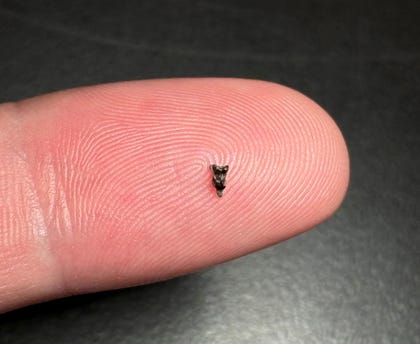
Beforehand, Purgatorius fossils had only been found in Montana and Saskatchewan, and are now reported from the Denver Basin by dint of meticulous work. The teeth are hard to notice in situ, and they weren’t noticed. They are very small. They were found while screen-washing sediments from the Corral Bluffs research area, Stephen Chester of the City University of New York and colleagues reported Tuesday in the Journal of Vertebrate Paleontology.
Related Articles
Wondrously: The Colorado Purgatorius teeth show differences compared with Purgatorius teeth from Montana and Canada. The team feels confident they came from Purgatoriuses and not some other pre-monkey. Thus the newfound teeth may show early divergence among Purgatoriids, the authors suggest.
 Close
Close
The upper molar of Purgatorious, discovered in Corral Bluffs, Colorado. Credit: Stephen Chester
The upper molar of Purgatorious, discovered in Corral Bluffs, Colorado. Credit: Stephen Chester
So by 66 million years ago Purgatoriids were diversifying right under the noses of the great dinosaurs. And as the towering giants died out, a host of early mammals, including the plesiadapiforms that would become monkeys, could come into their own.
Good word from Hell Creek
We can’t be sure we descended from Purgatorius, but it is one of the earliest proposed members of the primate line. It was called after Purgatory Hill in the Hell Creek formation in northeastern Montana where it was first found.
Non-locals wonder what went on there to earn the region such monickers. Histories suggest that migrating white people in the 18th century found the terrain to be objectionable.
Note that Purgatorius is absolutely not an early mammal, it is an early proto-monkey. The earliest mammals, such as Morganucodons, began to appear some 225 million years ago, and also looked like rats. We only have teeth of Morganucodons, whereas from Purgatorius, by now we have jaw and skull remains too, which speak loudly of simian.
So can we say it was daddy? The latest research agrees that it was a stem or basal primate, but more than that, we can’t say. Like there were multiple human species, over time there were a lot of Purgatoriids. But in any case the team is confident that the three tiny teeth they sieved out of the Cretaceous sediment were from some type of Purgatorius and not some other predatory mammal.
 Close
Close
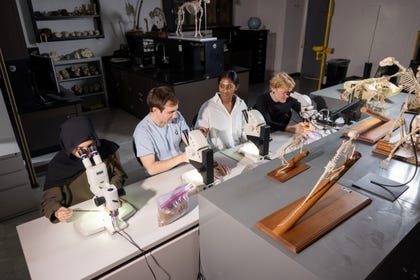
A team led by Stephen Chester of the City University of New York made the discovery. Credit: Stephen Chester
A team led by Stephen Chester of the City University of New York made the discovery. Credit: Stephen Chester
Moreover, the evidence to date suggests Purgatorius was expanding its geographic range from north to south. It still cannot be said whether the Pan-Primates originated in northern North America or in Asia, but Purgatorius is looking like an early northern North American. The fact that it hadn’t been found south of Montana before is at least partly discovery bias, the team concludes. Fact is, they found its teeth in Hell Creek, in the southwestern interior, only after screen-washing tons (tons!) of sediment.
We add that the Chicxulub asteroid impact would have devastated arboreal environments with decreasing effect as one goes north, and the range of arboreal creatures would have been appropriately affected. The purgatoriids in Colorado are younger than the ones in Montana and Canada. The earliest Purgatorius to date is reported from northeastern Montana, about 120,000 years after the asteroid cataclysm.
The ancestor of all primates lived with dinosaurs and were among the first mammalian groups to exploit the suddenly wide-opened niches and diversify. They were successful. Discovered in Canada and by the border with Canada, now we find they had reached the western interior too, and they or their relatives would hang on throughout the ages, culminating in the creation of We. Yay Purgatoriids!
What is our take-home? Sci-fi flicks showing guys in safari outfits pitted against a T-rex weren’t entirely wrong – they should just replace the human with a squirrel representing a proto-monkey, and this could have gone down in the interior United States, not only by its border with Canada. The T-rex would likely not have roared but hissed, and wouldn’t have even noticed the tiny mammalian, which was probably about six inches long and may have weighed about 1.2 ounces. The team predicts that if tons more sediment is screen-washed in the west, more such tiny teeth may be found, shedding more light on this most successful of mammalians, the pre-monkey.