
Battery and charging
The Pixel 10a has the same 5100mAh battery as the Pixel 9a. Google has made minor improvements to the charging speed, so the new phone now charges at 30W instead of 23W using a wired PPS charger, and at 10W instead of 7.5W using a Qi-wireless charger.
The faster charging speeds do have a measurable improvement in the charge times. However, we are looking at a few percentage improvements and an overall charge time reduction of about ten minutes. As such, the Pixel 10a remains a slow-charging phone, much like its predecessor.
While we do not test the wireless charging speeds, the Pixel 10a does claim to be a bit faster on that front as well, but the difference is likely to be small once again. What’s frustrating is that the Pixel 10a still does not support Qi2 wireless charging, which also means that there is no magnetic charger support. The only way to remedy this is by spending on a case with a magnet on the back.
Thankfully, the Pixel 10a also retains the good battery life of its predecessor. You can easily get through a day or two with this phone, depending on your usage.
Speakers
The Pixel 10a has the same set of stereo speakers as the Pixel 9a, but Google has tweaked the sound and the way volume works, which makes a notable difference.
The Pixel 10a is slightly louder than the Pixel 9a for most of its volume range. This is especially noticeable in the middle region of the volume band, where the Pixel 10a sounds 2-3 levels louder. However, this is mostly achieved by distributing the same overall volume of the speakers down to lower levels, and the increase in loudness fizzles out at higher volume levels. In fact, at maximum volume, the Pixel 9a actually sounds a bit louder.
The change in how the volume works does alleviate how annoyingly logarithmic Pixel volume control can be, and instead of having all the usable loudness at the top, it is now spread out a bit more over the lower values. However, it’s still a relatively small difference, which means you will still mostly be punching the volume way past the halfway mark to get usable audio outdoors.
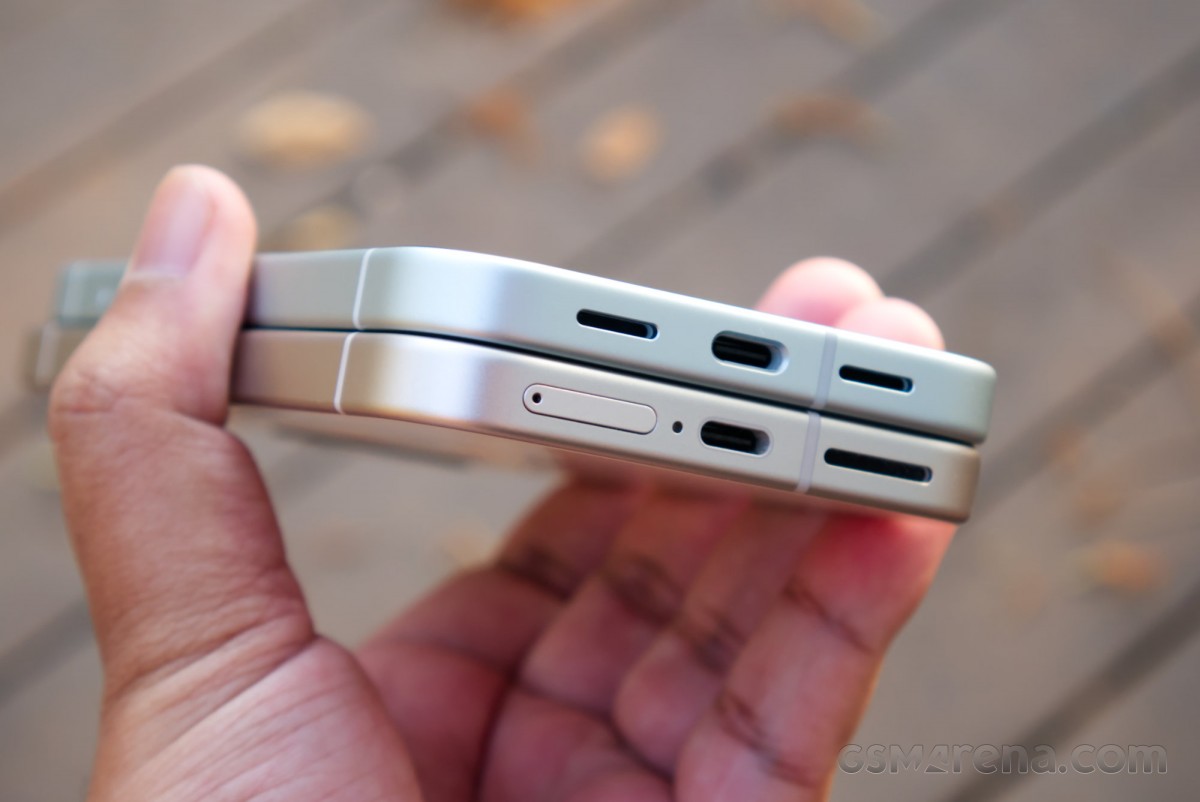
The sound has also been tuned slightly differently for the Pixel 10a. An attempt has been made to give the sound a bit more of a bottom-end, but it comes at the cost of a slightly less prominent mid-range. This is what causes the Pixel 9a to sound louder at max volume, as the bass trails off on both phones at that point, but the 9a’s higher mids make the sound come across louder than the 10a’s.
There have also been a couple of changes on the software front. The Pixel 10a now gains spatial audio for speakers and connected wired and wireless audio. The Pixel Buds Pro 2, for example, which did not offer spatial audio on the Pixel 9a, now have the feature accessible on the Pixel 10a. Spatial audio is still very limited on Pixel phones; it only works with apps that support Google’s implementation of spatial audio instead of just supporting popular codecs like Dolby Atmos, which means not every app that has spatial audio will be usable here. It also only works with select devices for wireless playback, which mostly includes Google’s own Pixel Buds.
The Pixel 10a does not have the Adaptive Sound feature listed under its audio settings. This option on the Pixel 9a claimed to adjust the sound from the speakers to your environment by monitoring using the microphones, but in all honesty, it didn’t seem to do much at all. The Pixel 10a does not have a dedicated toggle for this, which could either mean it has been done away with entirely or has just been permanently enabled.
The specs for the Pixel 10a also mention the addition of a noise suppression feature, but we couldn’t find any mention of it in the settings or figure out what exactly it could be referring to.