
Unlock the Editor’s Digest for free
Roula Khalaf, Editor of the FT, selects her favourite stories in this weekly newsletter.
“I work for them for free,” says French photographer François Coquerel. He’s talking about his friends Lilya Turki and Antonio Fazio, the husband and wife co-founders of Archyvio, a design studio that sells vintage objects. When Coquerel photographed a selection of their ceramics and glassware at his apartment in Versailles, the “payment” was his pick from the collection. He chose a rare and highly sought-after pair of stoneware urns, created in the 1930s by Swedish artist and designer Wilhelm Kåge, in a vivid-green glaze – pieces that Turki and Fazio had been eyeing up for their own collection. “Oh, Antonio’s face!” exclaims Coquerel, laughing. “He hasn’t recovered yet.” Fazio smiles: “I think, François, in the future we need to rediscuss the terms of our collaboration…”
 The living room, with a Pierre Chapo bench displaying a B&N ’60s accordion vase by Linde Burkhardt. The tall ceramic vase on the floor is by Luigi Santi. On the coffee table is a ’40s glass fruit bowl by Alfredo Barbini and a black carafe with red stopper by Anne Nilsson, 1996 © François Coquerel
Coquerel first met Turki, a Swiss-Tunisian creative director, 10 years ago; she was working at Marie Claire magazine and hired him for a shoot. Coquerel’s focus is still-life photography; he has created campaigns for brands such as The Row, Hermès and Tolix furniture, as well as editorial for magazines including HTSI and Harper’s Bazaar France.
When you get obsessed with design and furniture, it can become like a disease
François Coquerel
He moved to Versailles from Paris eight years ago, in search of more green space for his now 12-year-old son. The apartment is found in a “very typical, very classical 18th-century building”, but the interior design is the fruit of another creative exchange. He collaborated with the French architect Marine Bonnefoy, whom Coquerel also met through work. She first commissioned him to photograph an apartment she’d designed in the Lyon countryside. “Since then I’ve shot most of her projects,” he says; in return, Bonnefoy helped to renovate his home.
“We co-designed the place,” says Coquerel. “We tried to do something a little bit different. We didn’t try to be too original or too modern. It was about finding the right balance between my own taste and the Versailles vibe.”
 The living room. The iridescent terracotta vases on the rug are by Riccardo Gatti. The shelves hold works by Enzo Mari, Wilhelm Kåge, Åke Holm and Gunnar Nylund. The vase next to the record player is by Stig Lindberg © François Coquerel
 A red Zbigniew Horbowy vase and ’30s glassware by Vicke Lindstrand © François Coquerel
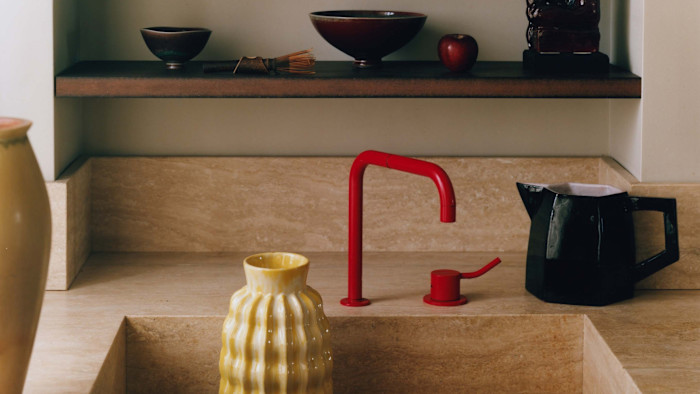
The result is slightly ’70s, serene but playful. A blue micro-tiled bathroom summons “a swimming pool in the forest”, says Coquerel, but also hosts a grand marble column next to the shower. The kitchen worktop and sink are hewn from neutral travertine marble but offset with a bright red tap and cabinet handles – a nod to the bright colours of his childhood home.
The Archyvio pieces – lined up on shelves and clustered on surfaces and table tops – look completely at home. Turki and Fazio describe their project as “a gallery of shapes and colour presenting unique design pieces from different eras”. Ceramics are a strong point – particularly midcentury Scandinavian. The current offering includes a c1950s double teapot by Gunnar Nylund for Rörstrand (€500) and a number of square stoneware dishes by Swedish designer Stig Lindberg (from €530). A rare Persian herb jar, decorated with painterly deep-blue brushstrokes, dates back to the 17th century, while a sculptural Ettore Sottsass glass vase is pure 1980s (both price on request). “I love the Murano glass bowl of fruits [by Alfredo Barbini in the 1940s or ’50s] on the living-room coffee table and the ceramic vase placed on the marble shower column,” says Bonnefoy.
 The office with (left) a ’60s wooden puzzle by Enzo Mari and a vintage Italian green coffee pot on the desk © François Coquerel
The gallery grew out of Turki and Fazio’s own collection, which they started when they were living in Lausanne but which really took shape in New York, where they moved in 2018 (when Turki got a job as a creative director at Tiffany & Co). “We had these big shelves in our apartment and Antonio decided to classify the pieces by colour,” says Turki. Among their most treasured items are Gio Ponti collaborations with master enameller Paolo De Poli in the shape of cats, birds and the odd watermelon.
 Archyvio ceramics on the table in the kitchen. The chairs are by Bruno Rey © François Coquerel
 Travertine marble and red fittings in the kitchen, with vases by Berndt Friberg (left) and Anna-Lisa Thomson (in sink). The black jug is 1930s French art deco © François Coquerel
Recommended

For Fazio, an art director and designer who has worked with brands such as Versace, Prada, Maserati and Swatch, Archyvio is “also an extension of what we’re doing on a daily basis through our respective work. It requires creativity; we constantly need to find inspiration through colours, shapes and materials.” Coquerel, on the other hand, is not a collector. “I’m trying to get rid of objects and not own too much,” he says. “When you get obsessed with design and furniture, it can become like a disease. People get crazy. I’m trying to get better.” He’ll no doubt make the odd exception for select pieces of vintage Swedish ceramics, if only to ensure this virtuous circle of friendship and creativity keeps on flourishing.