
Ellora McTaggart ’23 was diagnosed with attention-deficit/hyperactivity disorder as a sophomore at Carolina.
“My diagnosis helped me understand my experience,” McTaggart says. “For years, I felt like I had to work harder than everyone else while being evaluated by a system that did not match how my brain works.”
Today, as the co-founder and CEO of the biotech startup Carolina Instruments, she hopes to help others identify and understand their needs sooner.
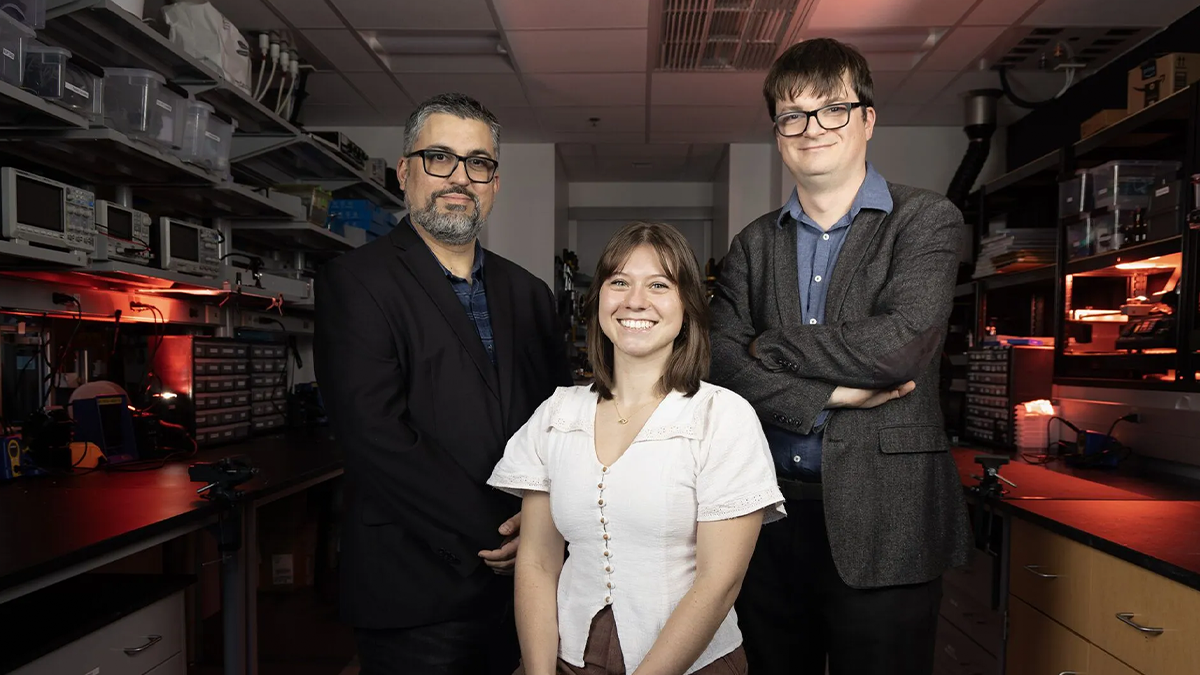
The company is developing eye-tracking smart glasses that offer insight into how people respond to the world around them. The other co-founders are two of McTaggart’s former mentors at Carolina: Nicolas Pégard, associate professor in the UNC College of Arts and Sciences’ applied physical sciences department, and Jose Rodríguez-Romaguera, assistant professor in the UNC School of Medicine’s psychiatry and cell biology and physiology departments.
Their latest prototype looks like an ordinary pair of black-rimmed glasses with a few pieces of metallic hardware along the bridge and inside the frames. Unlike traditional eye trackers that rely on cameras and video processing, these glasses use Pupil-Light technology developed by Pégard and Rodríguez-Romaguera. The compact, camera-free eye-tracking system detects subtle changes in pupil size and eye movement by converting light signals directly into measurements.
“The eyes give us a window into how people experience the world,” McTaggart says. “My hope is that making pupil measurements more accessible will add context beyond performance-based assessments, which often don’t tell the full story.”
Seeing an opportunity
Shifts in pupil size and eye motion often precede visible changes in behavior in people with neuropsychiatric conditions like ADHD, depression, anxiety or post-traumatic stress disorder. Pupil dynamics can offer real-time insight into changes associated with stress and engagement. Capturing those patterns outside the lab could provide richer behavioral context than observation alone.
“My dream as a mental health scientist is to have an actual impact in the clinic,” Rodríguez-Romaguera says. “The minute I realized we had a device that could potentially do that, I knew we needed to explore the commercial side in parallel to our scientific pursuits.”
McTaggart turned to KickStart Venture Services at Innovate Carolina, which helps student and faculty innovators create companies built on University research.
“Beyond the direct support, tapping us into the academic entrepreneurship ecosystem has been incredibly valuable,” McTaggart says. “We have some unique challenges as a University spinout, and KickStart has helped us navigate them.”
McTaggart also immersed herself in North Carolina’s biotech and startup community. She cold-contacted industry leaders on LinkedIn, built a network of mentors and advisers, secured a grant and participated in a business accelerator program.
Then she brought that business and fundraising knowledge back to Pégard and Rodríguez-Romaguera. “We started out as her mentors, and now she knows more about the industry than we do,” Rodríguez-Romaguera says. “She’s now the one advising us.”
Looking toward the future
The team recently secured a $400,000 Small Business Technology Transfer grant from the National Institutes of Health, led by McTaggart as principal investigator.
“As virtual and augmented reality devices advance, eye-tracking is becoming an essential feature,” McTaggart says. “Integrating pupil-tracking technology into existing smart eyewear could scale this capability to far more people, without requiring us to build and distribute the end device.”
PupilLight’s camera free design dramatically cuts the data processing and power required for wearable eye-tracking — a key advantage for extending battery life in immersive reality headsets. As major companies continue acquiring developers of alternative optical tracking technologies, McTaggart sees a similar path as a promising future for Carolina Instruments.
“Our North Star is better behavioral insights,” McTaggart says. “If integrating our technology into an existing platform is the most effective way to deliver broader access, then that’s the path we will prioritize.”