
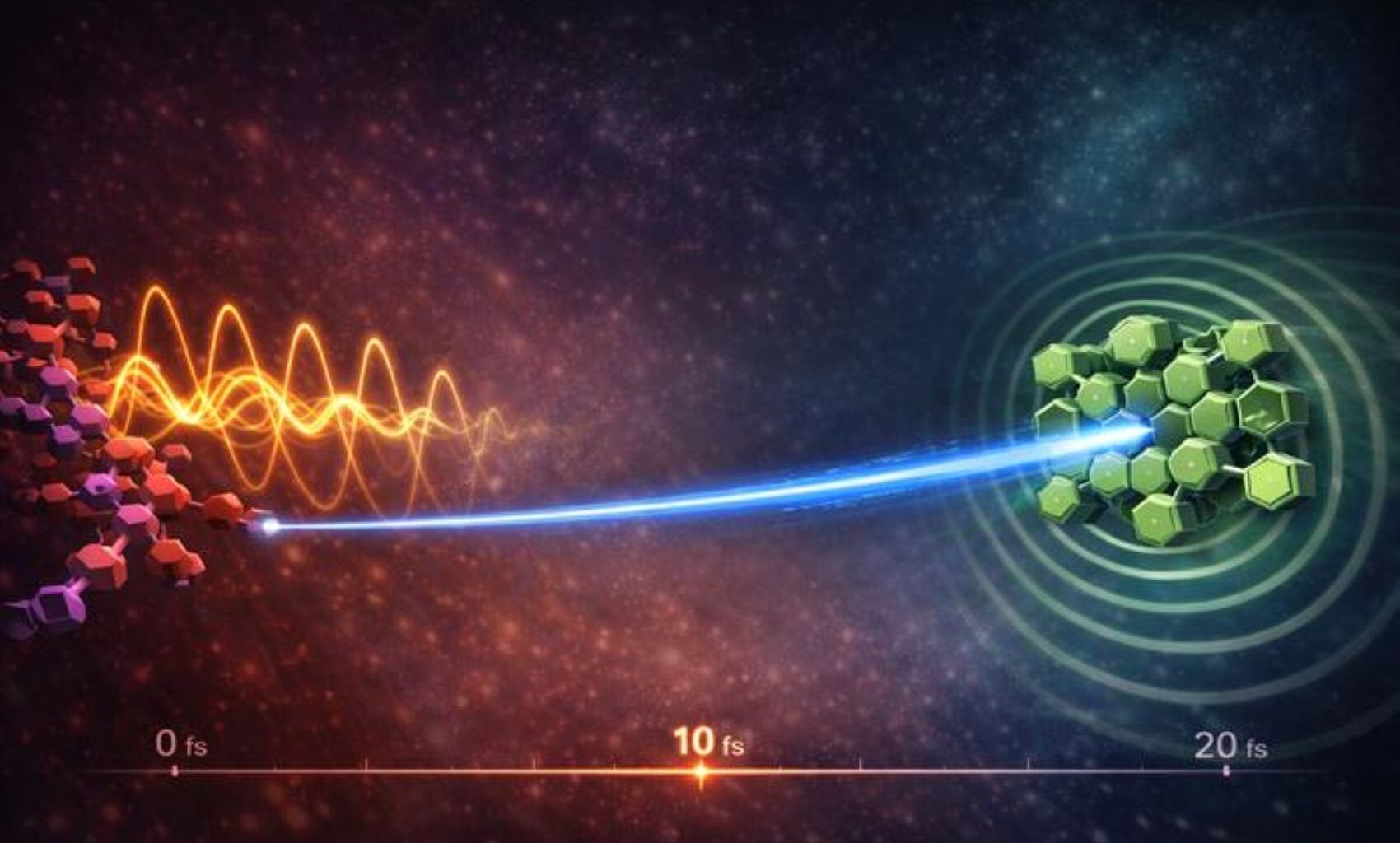
The process charge transfer occurs when light-excited electrons jump between molecules. This is the key process in solar cells, photosynthesis, and photocatalysts.
For years, scientists thought it required big energy gaps and strong molecular bonds, but those conditions often slow devices down.
According to a new study, it is possible to ‘kick’ the electrons across solar materials at nearly the fastest speed nature allows. This is surprising, as it challenges long-held ideas about the operation of solar energy systems. Also, it could help design smarter, prominent ways to capture sunlight and turn it into electricity.
Here’s why it matters: when light hits many carbon-based materials, it creates an exciton, a tightly bound duo of an electron and its partner, a hole. For the smooth functioning of solar cells, detectors, and photocatalysts, the quick splitting of a pair into free charges is important.
PolyU researchers achieved a record efficiency with organic solar cells
The faster this happens, the less energy is wasted. This ultrafast separation is one of the crucial steps that decides how effectively solar panels and other light-harvesting devices can transform sunlight into usable power.
To see if the usual trade-off was truly unavoidable, researchers at St John’s College, Cambridge, built a deliberately “weak” system. Instead of relying on strong donor–acceptor bonds, they tethered a perylene diimide acceptor to a low-bandgap polymer donor, creating a model junction with a tiny energy gap (<100 meV) and weak coupling.
Surprisingly, this fragile-looking setup still achieved charge transfer in just 18 femtoseconds, faster than most organic systems ever studied, and on the same timescale as atoms themselves move.
In fact, the process caused precisely timed vibrations, waves that rippled across the acceptor’s surface every 26 femtoseconds.
Dr. Pratyush Ghosh, Research Fellow at St John’s College, Cambridge, and first author of the study, said, “We deliberately designed a system that, according to conventional theory, should not have transferred charge this fast. By conventional design rules, this system should have been slow, and that’s what makes the result so striking.”
“Instead of drifting randomly, the electron is launched in one coherent burst. The vibration acts like a molecular catapult. The vibrations don’t just accompany the process; they actively drive it.”
The researchers observed charge separation within the rhythm of a single molecular vibration, unfolding as quickly as the molecule itself can move.
Ultrafast laser experiments revealed the secret: After light excitation, the polymer begins vibrating in rapid, high-frequency motions, thereby shuffling its electronic states.
This gives the electron a decisive “kick” across the boundary. Instead of meandering slowly like a random walk, the electron shoots forward in a clear, ballistic path, guided by the molecule’s own internal beat.
Once the electron lands on the acceptor molecule, it sets off a fresh, synchronized vibration, a kind of molecular “echo” of the transfer. This coherent motion is a rare fingerprint of ultrafast charge separation and has been glimpsed only a handful of times in organic materials.
Dr. Ghosh said, “That coherent vibration is a clear fingerprint of how fast and how cleanly the transfer occurs.”
“Our results show that the ultimate speed of charge separation isn’t determined only by static electronic structure. It depends on how molecules vibrate. That gives us a new design principle. In a way, this gives us a new rulebook. Instead of fighting molecular vibrations, we can learn how to use the right ones.”
Professor Akshay Rao, Professor of Physics at the Cavendish Laboratory and former St John’s College Research Associate, who was a co-author of the study, said: “Instead of trying to suppress molecular motion, we can now design materials that use it – turning vibrations from a limitation into a tool.”
Journal Reference:
Ghosh, P., Royakkers, J., Londi, G. et al. Vibronically assisted sub-cycle charge transfer at a non-fullerene acceptor heterojunction. Nat Commun 17, 2165 (2026). DOI: 10.1038/s41467-026-70292-8