
Readers of a certain vintage may recall a 1980s advertising campaign for an insurance company that bore the tagline, “We won’t make a drama out of a crisis”. Whatever the veracity of the claim in that particular instance, it’s a slogan that springs to mind when listening to Claire Byrne cover the war in the Middle East.
She wasn’t always renowned for injecting unnecessary drama – or indeed excitement – into proceedings during her five-year stint on RTÉ Radio 1’s Today show, but the host’s deliberate, unflustered tone on her new programme, The Claire Byrne Show (Newstalk, weekdays), makes her the ideal presence when the proverbial faecal matter hits the air-circulation apparatus.
Byrne is the personification of calm proficiency when dealing with the widening conflict that follows US and Israeli attacks on Iran. “It’s difficult to know where to start because the theatre of war is so broad,” she ruefully comments. But as she methodically filters her way through a slew of reports, analyses and eyewitness accounts, she provides a good overview of the situation, with probably as much clarity as the rapidly deteriorating circumstances allow.
Accordingly, Byrne hears from journalists such as Matt Frei (the Channel 4 presenter thinks US war aims violate the late US general Colin Powell’s so-called Pottery Barn rule about attacking countries, namely “you break it, you own it”) and academics such as Ray Murphy of the University of Galway, who sketches out potentially chaotic scenarios for Iran if the war persists.
Byrne brings a studied inquisitiveness not only to these discussions but also to more urgent conversations with Irish citizens stuck in Dubai. The mood of these exchanges varies: one holidaymaker, Nicola Hanlon, sounds frustrated and worried, while a Dubai resident, Roseanne Kenny Scully, coolly recounts how people gather around pools and in cafes after Iranian rocket attacks: “It’s absolutely surreal.”
That the testimony of ordinary Iranians should be absent from Byrne’s coverage is probably inevitable, but another missing element speaks to the presenter’s preferred modus operandi. Whereas her predecessor, Pat Kenny – whose new weekend show for Newstalk debuts this Saturday – was never shy about voicing his low opinion of Donald Trump’s intentions and actions, Byrne is more circumspect.
The nearest she gets to staking out a position comes during her interview with Minister for Foreign Affairs Helen McEntee. As the Minister talks about Government hopes to get the warring parties “around the table”, the host observes, with faint exasperation, that the US president disregards international law.
Otherwise, Byrne eschews editorialising, as has been her style throughout her career. Her reticence is understandable – advisable, even – during the early stages of what her ministerial guest euphemistically terms the “evolving situation” in Iran and beyond: projecting objectivity may even add to Byrne’s air of authority as she consolidates her Newstalk show. But as the fog of war lifts, one wonders if she’ll still keep her counsel.
Away from grave issues, however, the host is subtly changing the tenor of her approach. For all her composed demeanour, Byrne has never shut off her personal side, regularly making passing references to her family. But since moving to Newstalk she appears to have more occasion to chat about her home life.
Speaking to paediatric sleep consultant Lucy Wolfe, Byrne recalls her children’s bedtime routine and discusses her own sleeping habits with the GP Harry Barry, a regular guest from her Radio 1 days. Intentional or not, it all adds to the impression of a broadcaster seeking a more relaxed on-air manner to go with her new home.
Byrne even allows a glimpse of deeper emotional wells. Speaking to the novelist Colum McCann about his charity Narrative 4, which seeks to foster empathy among people from different communities by sharing stories, the host sounds an almost philosophical note as she reflects on the accounts she has been hearing from the Middle East.
“I think about your project and storytelling and swapping lived experiences,” she says to McCann, “and how there would be much greater understanding if you put yourself in the shoes of the other person.”
It can pay to show balance during a crisis.
Shane Coleman, one of the hosts of The Hard Shoulder (Newstalk, weekdays), often casts himself as a voice of moderation, particularly when sparring with his fellow presenter Ciara Kelly. But for someone who signs off each show with an amiable “Tóg go bog é”, Coleman is conspicuously not taking it easy on Monday’s show. “I’m so angry,” he says, seething in a fashion that would do Network’s Howard Beale proud.
Coleman is mad as hell at the news that Larry Murrin, the Bord Bia chairman, is to stand aside temporarily following farmers’ protests at his food company’s use of Brazilian beef. The presenter sees it as another example of special interests trumping the greater good, one of his particular bugbears.
Though he and his co-anchor serially engage in theatrical displays of high dudgeon, in this instance his fury is palpable: Kelly remarks on the sincerity of Coleman’s ire and takes her cue by interviewing Francie Gorman of the Irish Farmers’ Association with combative energy.
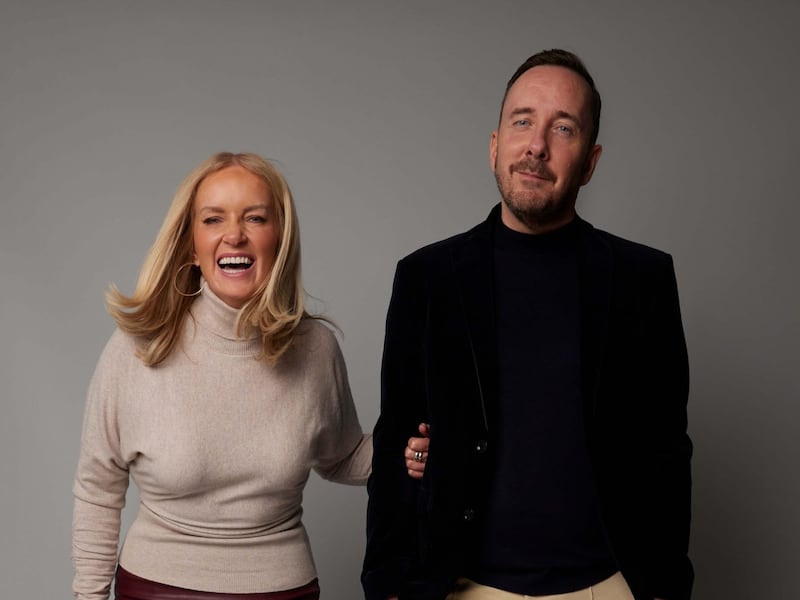 The Hard Shoulder presenters Ciara Kelly and Shane Coleman. Photograph: Newstalk
Such moments aren’t exceptional from either host, but they have been given a lift since moving from mornings to early evenings in last month’s station reshuffle. Any worries that their partnership mightn’t click at drivetime have so far proved unfounded: if anything, their forthright style, which could be a bit much over breakfast, works better later in the day when the mood of listeners is likely to be more jaundiced.
And, certainly, Coleman and Kelly offer a jaded view of contemporary foibles, particularly anything that smacks of – trigger warning – wokeness. Hearing that Gen Z – a term the hosts utter with the sense of exotic wonder normally associated with rare butterfly species – apparently value sustainable habits as much as good looks on dates, the duo react with jokey cries of “baloney” and “bunkum”.
Then a texter’s opinion that right-wing people are more accommodating to different views prompts Coleman to impishly suggest: “They may even be right.”
But beyond such gleeful provocations, the pair take their duties seriously. Kelly talks to the former Iranian ambassador Seyed Hossein Mousavian about the impact of the war on the country’s civilians – a rare view from that perspective – while Coleman quizzes the former Irish ambassador Dan Mulhall about our Government’s ambivalent stance on US actions.
“Why are we so reluctant to say what everyone knows, that these strikes are illegal?” the host bluntly asks.
Mulhall, well versed in international realpolitik, replies that the conflict presents a difficult balancing act for small countries like Ireland. Maybe so, but sometimes you need to take a side.
Moment of the week
Rachael English, host of News at One (RTÉ Radio 1, weekdays), has an amiable style, but can deftly wield the stiletto, as Minister for Health Jennifer Carroll MacNeill learns when discussing the long-delayed national children’s hospital.
The Minister says the opening date depends on the construction company BAM, but she adds that her department has control of one completed floor, calling it “fantastic”; not only does it have beds and cots, she says; it also has bins and bathrooms. English is politely unimpressed. “And it has lovely murals,” she replies. “It’s looking well. But it’s closed.”