
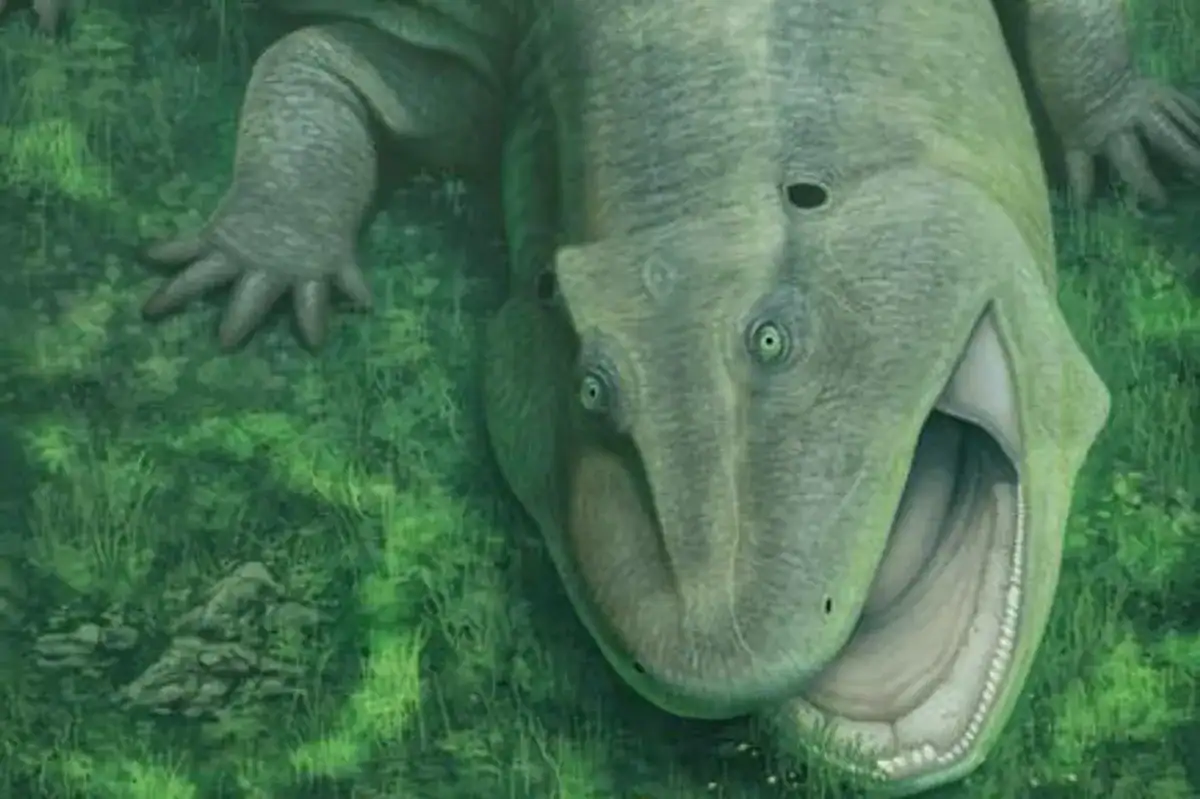
 Artist’s reconstruction of Tanyka amnicola. Credit: Vitor Silva
Paleontologists surveying a dry riverbed in northeastern Brazil repeatedly encountered the same type of fossil: a lower jaw about six inches long, curved and thick, and twisted in an unexpected way.
A single specimen could have been written off as a distortion. But after the team recovered nine jaws from the Pedra de Fogo Formation—all preserving the same pronounced rotation in three dimensions—they concluded the feature reflected normal anatomy rather than damage.
In Proceedings of the Royal Society B, the researchers describe the jaws as evidence of a distinct species and an unusual feeding apparatus from deep in tetrapod history.
They named the animal Tanyka amnicola, pairing tañykã, “jaw” in Guaraní, with a Latin term meaning “river dweller.” It lived about 275 million years ago, in the early Permian, when this region formed part of Gondwana. By that time, Tanyka belonged to a lineage of stem tetrapods that had largely disappeared elsewhere, persisting alongside groups that would later give rise to modern amphibians, reptiles, birds, and mammals.
“Tanyka is from an ancient lineage that we didn’t know survived to this time, and it’s also just a really strange animal,” Jason Pardo, the study’s lead author, said in a statement. “The jaw has this weird twist that drove us crazy trying to figure it out.”
The Sideways Chew
 Jaw rotation during mandibular adduction in Tanyka. (a) Jaw in closed position, lateral view; (b) jaw in closed position, anterior view; (c) jaw in open
position, lateral view; (d) jaw in open position, anterior view. General skull shape speculative, based on Baphetes. Credit: Proceedings of Royal Society B
The oddity begins with orientation. In most tetrapods, lower-jaw teeth point upward toward the roof of the mouth. In Tanyka, the researchers report, the mandible is strongly twisted so that the chewing surface faces partly outward rather than directly upward toward the palate.
Along the top edge, the animal carried a row of relatively large teeth in the dentary. But the main chewing surface sat farther in, on a set of bones called the coronoids and a piece of bone near the front of the jaw. These elements bore a dense pavement of denticles—small tooth-like bumps—arranged into a broad pad far wider than the main tooth row.
The paper describes the fossil as a “remarkable battery” of enlarged denticles on a strongly arched coronoid, with some denticles showing wear consistent with repeated contact during feeding.
×
Thank you! One more thing…
Please check your inbox and confirm your subscription.
 MAP-PV 097, close-up of symphysis, showing simple symphyseal surface and dentition (a). MAP-PV 662, close-up of coronoid denticles, showing wear (b). Scale increments equal 1 mm. Credit: Wikimedia Commons
That sort of motion suggests a complex chewing pattern documented in the modern aquatic salamander Siren lacertina, which uses three-dimensional jaw movements to rake food against palatal teeth.
Because the team has not yet identified an upper jaw or skull bones that clearly match the mandibles, many details remain unknown. The twist would have made the denticle field—not the outer tooth row—the main point of contact with food. Researchers propose a feeding stroke that included long-axis rotation of the jaw, producing a rasping motion across the palate.
What did Tanyka rasp? The paper frames the jaw as an adaptation for specialized processing of small invertebrates or for consuming some plant material. Still, Pardo said that “we expect the denticles on the lower jaw were rubbing up against similar teeth on the upper side of the mouth,” creating “a relatively unique way of feeding.”
And Juan Carlos Cisneros, a coauthor at the Federal University of Piauí, stated, “Based on its teeth, we think that Tanyka was a herbivore, and that it ate plants at least some of the time.”
Gondwana’s holdouts
 Holotype jaw of the animal, MAP-PV 662. (a) lingual view of the fossil; (b) interpretive drawing in lingual view. Credit: Proceedings of Royal Society B
If the jaw is the hook, the bigger story may be where Tanyka sits on the family tree.
In two separate phylogenetic analyses, the authors recover Tanyka as an unambiguous stem tetrapod, with affinities to a cluster of mostly Carboniferous forms often called baphetid-grade tetrapods—animals best documented from Laurussia, the northern supercontinent that once encompassed much of North America and Europe.
Many paleontologists see the late Carboniferous as a major reset for early four-limbed animals. As climates dried—a shift often discussed in connection with the Carboniferous Rainforest Collapse—older stem-tetrapod lineages appear to fade from the record, while groups closer to today’s amphibians and the first amniotes become more prominent. Tanyka doesn’t fit that straightforward story, at least in Gondwana’s southern ecosystems.
This is not the first sign that Gondwana could shelter holdovers. The paper points to Gaiasia, a giant stem tetrapod from Namibia described in 2024, as another late-surviving relic with ties to lineages otherwise characteristic of earlier northern deposits. Together, the fossils suggest that “current hypotheses of Carboniferous tetrapod turnover are oversimplified,” the authors write.
The Pedra de Fogo Formation sits at the center of the team’s case. In the paper, the authors describe it as the most extensive early Permian tetrapod assemblage yet known from Gondwana. Against that backdrop, Tanyka is the first tetrapod with baphetid-like affinities reported from Gondwana, and the only known Permian member of that broader grade, according to the researchers.
For now, the animal remains mostly a mouth without a body. The holotype jaw measures 17.2 centimeters (about 6.8 inches), and one specimen is roughly 25% larger, but the team cannot yet anchor those jaws to a full skeleton. Pardo added that, by comparison to relatives, it might have looked “kind of like a salamander with a slightly longer snout.” That guess may change with the next field season—perhaps when a paleontologist finally finds the rest of the twist.