
Free climbers scrambling over a steep coastal mountain in Italy noticed something odd on a broad slab of limestone. The rock sitting on the Monte Conero anticline near Ancona, in Italy’s Marche region, holds many deep, paddle-like footprint tracks packed together on one surface.
The climbers stopped because the slab looked nothing like a normal rocky ledge. At first, the surface even looked like wet “cement,” but it was solid rock under their hands.

Footprints usually show up where soft mud meets air, not where seawater rolls over the bottom. However, the seafloor can sometimes preserve footprints, too.
In some places, carbonate mud settles into a smooth, thick layer that can take an impression and hold it long enough for the shape to survive.
When that mud hardens quickly, the track turns into a trace fossil, which captures behavior rather than body parts.
A track can show where an animal touched down, pushed off, turned, or paused, even when no bones appear nearby.
Turtle tracks and earthquakes
After the climbers reported the site, a research team treated the slab as a snapshot of the Cretaceous Period. Their main idea links the fossil tracks to a quick two-step event: an earthquake shook the ancient seabed, and marine reptiles moved across the soft mud during the shaking.
The paddle-like impressions at Monte Conero look similar to track marks that flippers can leave behind, so the team points to ancient sea turtles as the most likely culprits.
The same ground disturbance caused by the earthquake also helped preserve the Monte Conero tracks.
A dense underwater flow of sediment swept in soon afterward and sealed the surface before currents or other animals could smear the impressions. If not for this rapid “burial,” the seafloor tracks would have disappeared quickly.
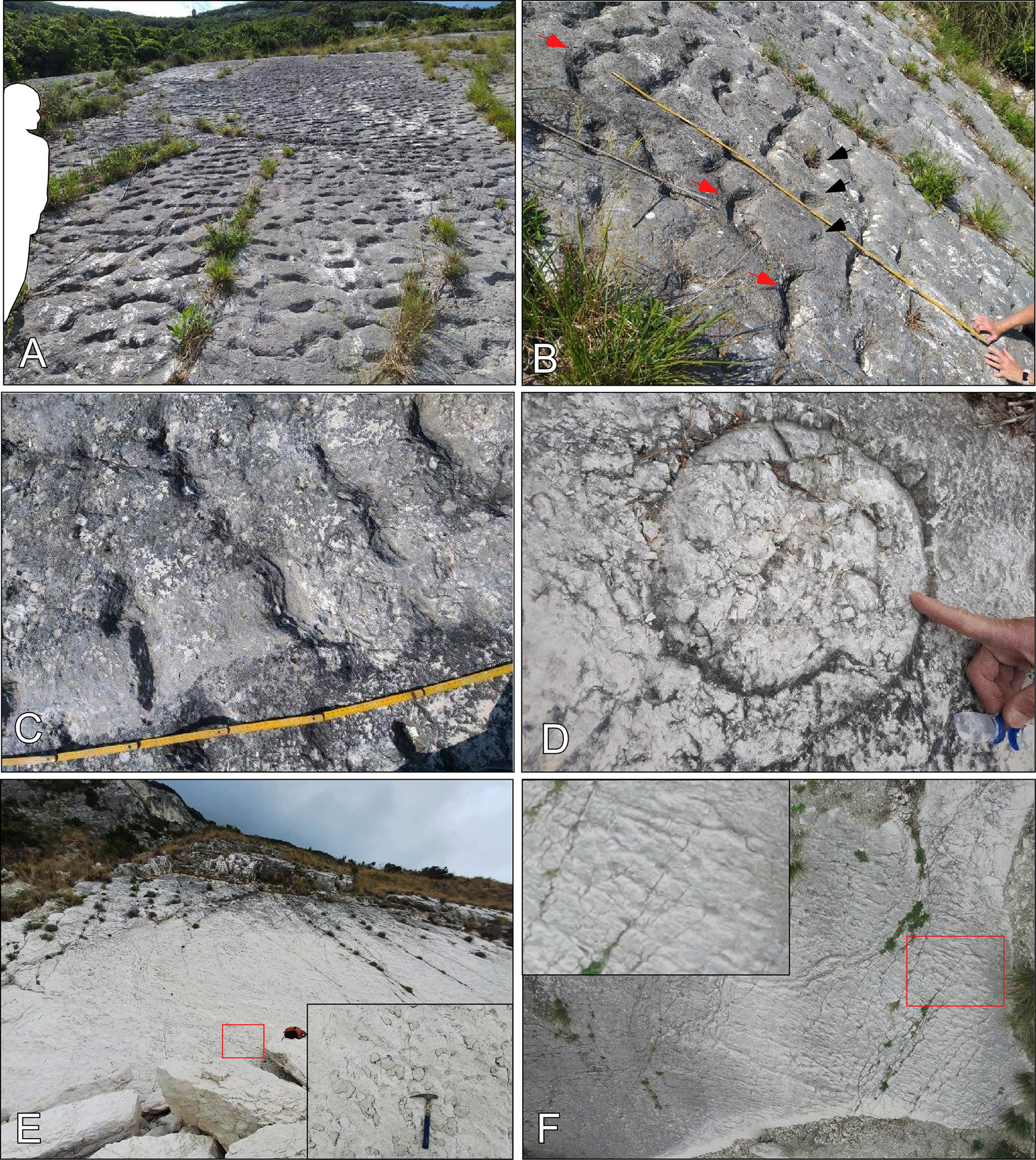 Several different viewpoints showing the sea turtle fossil prints at the Monte Cònero anticline. Credit: ScienceDirect. Click image to enlarge.Reading the rock layers
The team’s study did not rely on the Monte Conero track surface alone. They studied a nearby coastal exposure where the same footprint-bearing layer sits inside a thicker rock section that extends about 131 feet.
The layers in that stack work as a timeline because rocks in the higher layers formed later than rocks below.
In that sequence, the team describes alternating carbonate deposits that formed under different conditions. Some layers built up slowly as fine material settled through deeper water.
Other layers arrived in sudden pulses carried by energetic underwater flows that dumped sediment quickly, a style that geologists often call turbidites.
When these rapid layers repeat through the section, they suggest recurring triggers that destabilized slopes and set sediment in motion. In tectonically active basins, earthquakes are one likely trigger.
Dating the Monte Conero turtle tracks
The word “Cretaceous” covers a long span of time. The team narrowed the age of the track layer using microfossils, which are tiny organisms that once floated in the water column and later settled to the seafloor.
Some microfossil species changed quickly through geologic time and spread widely, so their presence can lock a layer into a specific slice of Earth history.
The researchers used that fossil “time stamp” to place the footprint horizon in the lower Campanian, within the Late Cretaceous.
They also used Earth’s magnetic history to strengthen that age estimate. Over long spans, the planet’s magnetic polarity has flipped many times, and minerals in sediments can lock in the field direction as the material accumulates.
The team sampled the rock section, measured magnetic directions in the lab, and matched the pattern of normal and reversed polarity to the global reversal timeline. They correlated their section to the lowermost part of a normal-polarity interval called C33n.
Magnetic tests in lab
This kind of magnetic dating depends on careful sampling and clean signals. The team collected oriented rock cores at regular intervals so they could track changes up the sequence and keep the original direction of each sample.
In the lab, they demagnetized samples step by step to strip away later magnetic “overprints,” and then measured the remaining stable signal with very sensitive instruments.
They also measured magnetic susceptibility, which shows how strongly the rocks respond to a magnetic field. Susceptibility can change when the mix of minerals and sediment shifts, so it helps confirm that the measurements reflect real changes through the section rather than random noise.
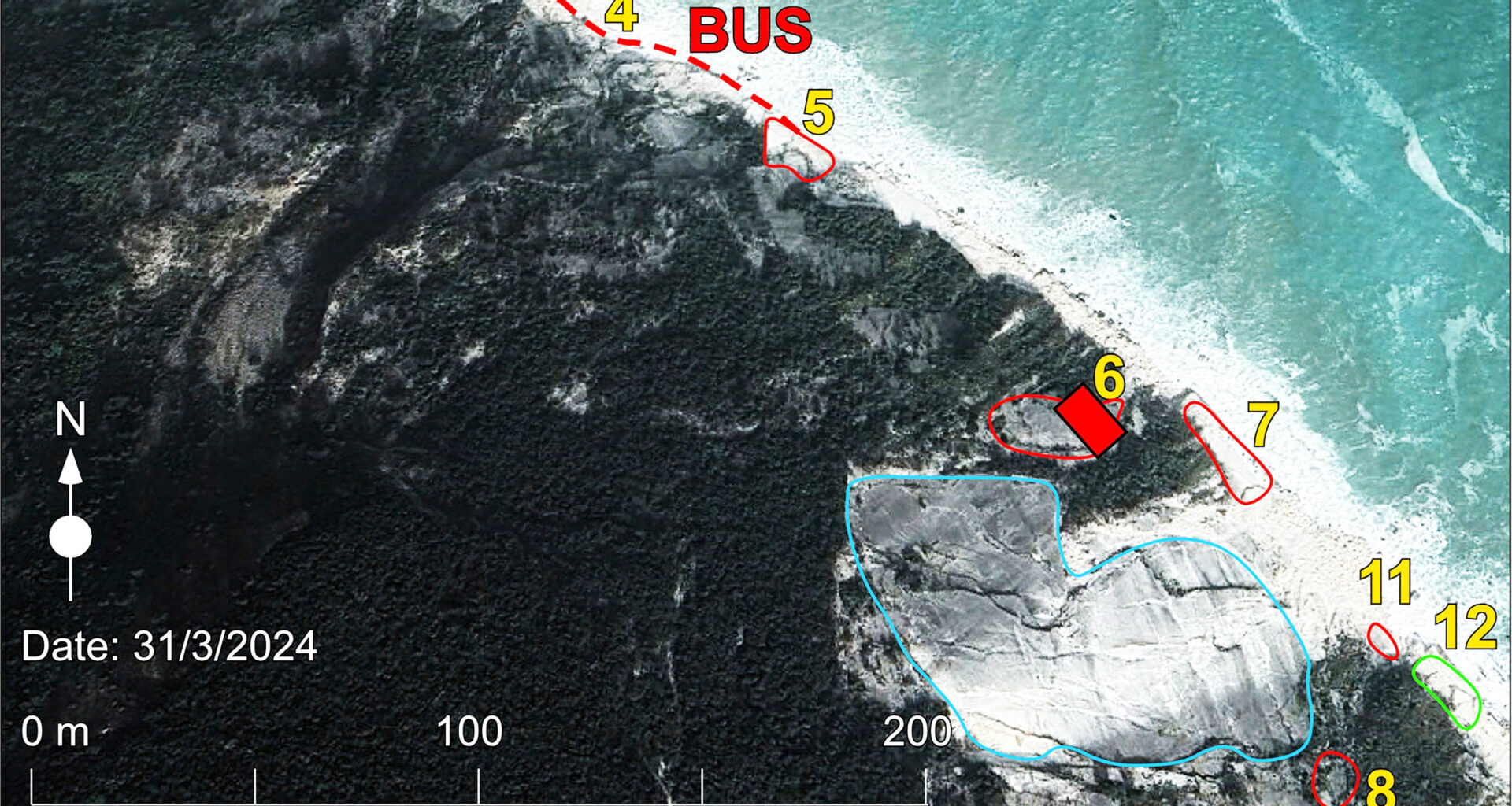
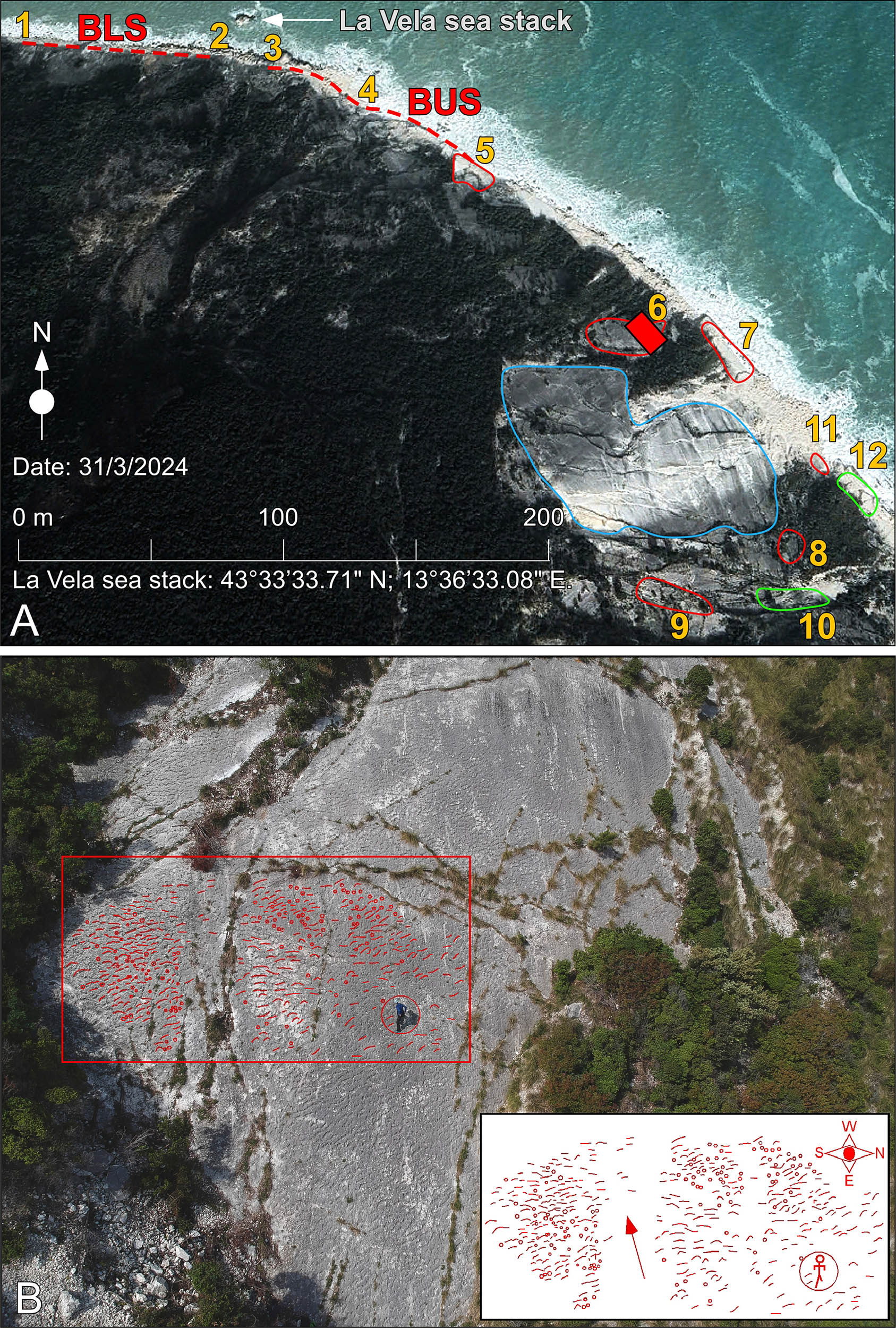 Aerial image of the studied La Vela area on the steep northeastern limb of the Monte Cònero anticline. Dashed red lines along the coast indicate measured and sampled stratigraphic sections. The yellow numbers indicate sites where the bedrock formations were inspected and measured along the beach. Credit: ScienceDirect. Click image to enlarge.Sea turtle tracks in Monte Conero
The team connects the footprint layer to a wider phase of heightened seismic activity in the region during that Late Cretaceous interval. They also argue that global sea-level changes could have influenced how easily sediment moved and how often slopes failed.
When sea level rises or falls, it changes where sediment piles up, how steep underwater slopes become, and how stable those deposits stay, which can make a basin more sensitive to shaking.
The researchers also explain what the tracks cannot prove. Footprints do not carry a neat species label, and more than one kind of marine animal can leave similar impressions.
Even so, the paddle-like shapes and the marine setting point strongly toward sea turtles or a similar flippered reptile.
Sea turtles or not, the Monte Conero rock slab preserves a rare pairing in one place: animal movement impressed into soft seafloor mud and a sudden physical disturbance preserved by the layers that sealed it.
The full study was published in the journal ScienceDirect.
—–
Like what you read? Subscribe to our newsletter for engaging articles, exclusive content, and the latest updates.
Check us out on EarthSnap, a free app brought to you by Eric Ralls and Earth.com.
—–