
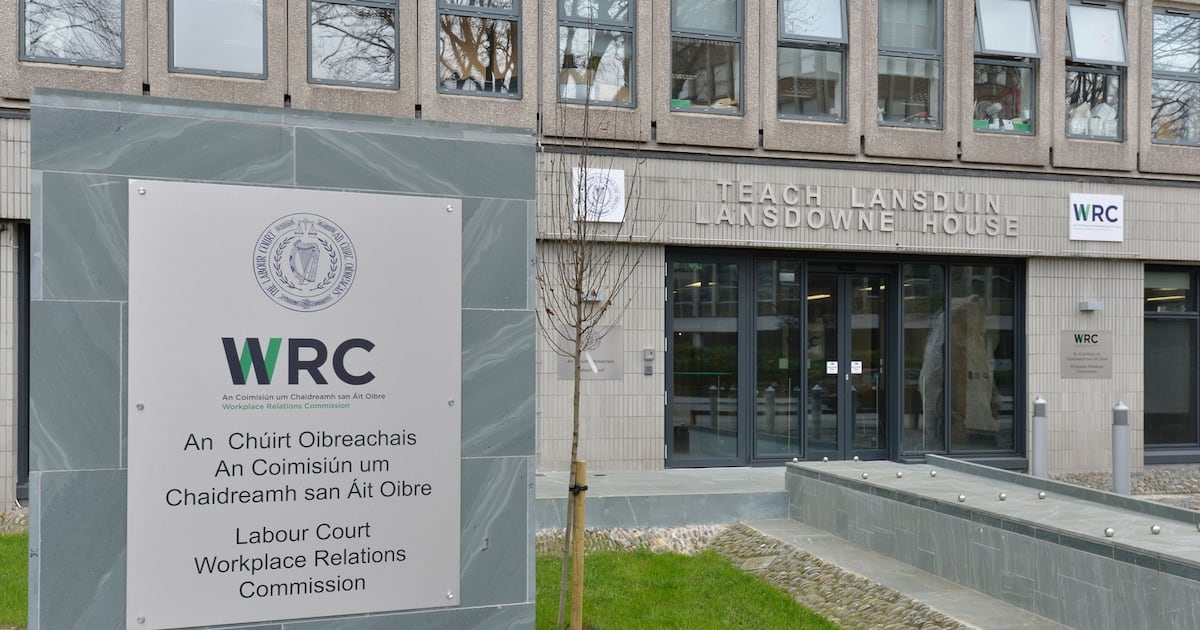
A witness has said he was told that the director general of the State’s employment rights watchdog declared that neither he nor his colleague would “ever get an interview or any jobs” in the agency as long as she was in charge.
The tribunal heard that Workplace Relations Commission (WRC) boss Audrey Cahill was alleged to have said the comments when a senior civil servant went to her to say she was leaving the agency last year.
Giving evidence before a hearing of the employment tribunal on Friday, witness Andrew Heavey said it was his belief that the alleged remark explained why he and fellow adjudicator Seamus Clinton were not shortlisted for interview for management jobs at the WRC.
He said he believed this was because he and Clinton had acted as shop stewards when a group of around a dozen WRC adjudicators employed as civil servants campaigned to have their jobs boosted in grade.
The State has advanced the proposition that the departing official may have had “an axe to grind” against Cahill. Heavey was giving evidence this evening on complaints brought by Clinton under the Employment Equality Act 1998, the Protection of Employees (Provision of Information and Consultation) Act 2006, and the Protected Disclosures Act 2014 against the Department of Enterprise, Tourism and Employment.
Clinton and Heavey were among 10 applicants – five men and five women – to apply for three senior posts as regional managers overseeing the WRC’s conciliation and mediation services (CAMS) in October 2024, the tribunal has heard.
Only one of the men was shortlisted, and three women were ultimately appointed, according to data obtained by Clinton when he initiated an equality case over the recruitment competition.
Heavey said on Friday that on April 2nd, 2025, a colleague approached him in the workplace and asked for a word. He said she told him that Cahill “had said some things to her that were very upsetting”.
The departing official went on to say that in the course of the conversation, the question of the internal adjudication officers’ campaign for regrading came up, Heavey said.
“All I ever hear about is internal AOs [adjudicating officers], and I’ll tell you something else: neither Andrew Heavey nor Séamus Clinton will ever get another interview or any jobs in the WRC while I’m director general,” were Cahill’s alleged words, according to the departing official, Heavey said.
Asked why he thought he didn’t get an interview for the management position, Heavey said: “In my view, it was our role as representatives on the upgrade – that’s what I believed.”
Heavey pointed to 33 years’ experience in the Civil Service, nine as an adjudication officer at the WRC, and two prior interviews he had attended for vacancies at principal officer grade, a level above the job opening in dispute.
He said he was “gobsmacked” not to make the cut.
Counsel for the Department of Enterprise Stephen Hanaphy said: “You know, I wonder about that, because we’re two days out from International Women’s Day; you were saying you were gobsmacked – the reality is: you just didn’t perform.”
“That’s your contention, Mr Hanaphy. I believe my application was thorough, well-prepared and submitted in good faith,” Heavey said.
Giving evidence on Friday, Paul Malone, the deputy general secretary of Clinton’s trade union, the Association of Higher Civil and Public Servants (AHCPS), said it was “very unusual, in fact possibly unique” that the employer had decided to draw up a shortlist for “a relatively small number of internal candidates”.
“We found it extraordinary,” he said.
Clinton claims he was penalised for acting as a trade union branch rep for a group of adjudication officers seeking an upgrade of their roles, from principal officer grade in the Civil Service to higher principal officer. Malone’s evidence was there was a “hostile” attitude towards the regrading process from the Department of Enterprise.
“That hostility has maintained through the last two to three years,” he said, adding that the position of the adjudicators had been met by “obfuscation, defensiveness, hostility and a lack of positive inclination to this claim” on the part of administrators, he said.
While the Civil Service Arbitration Board had granted the regrading – and backdated it to July 2023 – the response of the Department of Enterprise was that it had not been sanctioned by the Department of Public Expenditure.
The State’s position is that Clinton does not meet the definition of a staff representative for the purposes of the Protection of Employees Act.
Malone said he was satisfied Clinton had a “mandate to speak for the collective group” of adjudicators. Clinton gave his evidence-in-chief last week, and was cross-examined on Friday by counsel for the State, Stephen Hanaphy.
Clinton had referred to what he said was a contemporaneous diary note of a phone call with his colleague, Heavey, recounting what the other official had told Heavey.
“Part of it was written in blue ink, part in black,” counsel said. He put it to the complainant it was “not a contemporaneous note”.
“I clarified that the difference in ink colour was, in preparing submissions and getting my case to my legal team that I would have checked with Andrew Heavey to say: ‘Andrew I recorded this, what did you say.’”
“[Heavey] made an addition: ‘As long as she was director general of the WRC, I wouldn’t be selected for interview or I wouldn’t get a competition,’” the complainant added.
“So, the diary entry in blue is purported to be a contemporaneous note; the black amendment to that is the result of your having had a subsequent conversation with Mr Heavey,” Hanaphy said.
“Less an amendment, more an addition,” Clinton said.
Hanaphy put it to Clinton: “You assumed you’d coast in and get the interview – otherwise you wouldn’t have been knocked over by a feather.”
“I expected to get an interview,” Clinton said.
Hanaphy said it seemed to him Clinton thought he would “impress the interview panel orally had had underestimated the written application. “You put all your eggs in one basket: the interview process,” he said.
“No,” Clinton said. “There was only 10 applications. It would never have dawned on me there would have been a shortlist and that I would not get on the shortlist,” he added.
“You filled in those boxes and failed to give as much specific information as other candidates. Can you accept that’s what’s happened?” Hanaphy said.
“No,” Clinton replied. Hanaphy put it to him that his claim for discrimination “doesn’t stack up”.
“It’s not just an impression. It’s backed up by documentary evidence,” Clinton replied. Adjudicator Brian Dalton has adjourned the case.