
When I think of James Cameron’s Terminator 2: Judgment Day, I think about all the groundbreaking visual effects and CGI that changed movies and TV forever…and also about how it’s one of the greatest sequels of all time.
I mean, that liquid metal CGI that changed cinema forever.
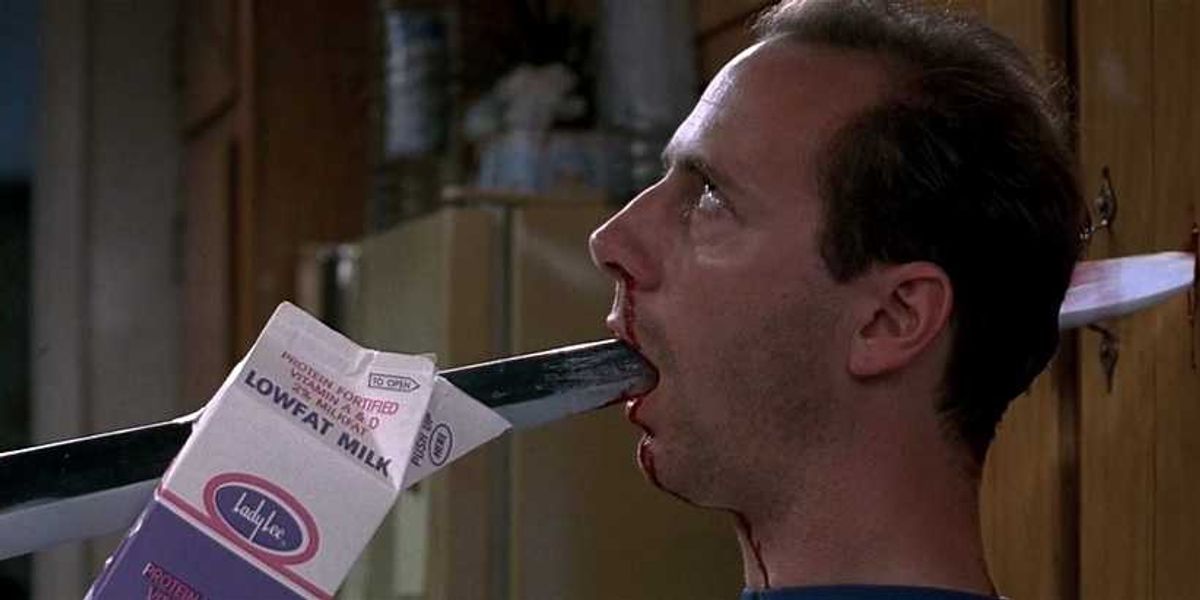
Still, one of the things that made the movie so special was that not all the effects were CGI. In fact, maybe the coolest one in the movie, the shocking scene where the T-1000, disguised as John Connor’s stepmother, impales the stepfather through a milk carton, was done practically.
Let’s look at how Stan Winston’s legendary team was able to put it on screen for James Cameron.
Let’s dive in.
– YouTube www.youtube.com
The Anatomy of a Practical Impalement
Look, the only way I’d know how to do this was to actually impale someone, but the people behind the movie had better ideas.
The secret behind the “blade through the head” wasn’t a computer; it was a clever prosthetic rig.
A mechanical apparatus was mounted to the back of the actress’s neck. This rig featured two distinct parts:
One part extended out the back to simulate the entry point.The other was aimed toward her face, with only a small, safe portion entering her mouth to sell the illusion of the blade passing through.Solving the “Thin Blade” Problem
One of the biggest challenges for the effects team was the blade’s physics. Because the prop was designed to be incredibly thin and sharp, it lacked the structural integrity to support the weight of the milk carton on its own.
This is such a funny problem to have, but it’s one they had to fix so it would be camera-ready.
In early tests, the carton had to be held by hand to prevent the blade from bending. For the final shot, the crew used a low-tech solution: a crew member legit held the milk carton in place with a stick, positioned just out of the frame.
This allowed the actor to let go of the carton as the blade retracted, creating the haunting image of the carton “hanging” on the blade for a split second before the T-1000 pulls back.
To this day, I am in awe of this scene and how visceral it feels.
Look, if you go back into the way-back machine to 19991, CGI was just not something on everyone’s minds.
CGI shots were astronomically expensive and time-consuming, and they didn’t look all that good (yet).
Cameron and Winston relied on practical effects for as many “physical” interactions as possible so they could maintain the realism of the movie’s world, and it’s what made this film stand the test of time. Everything still looks so good because it was mostly real!
The Takeaway for Filmmakers
This shot serves as a reminder that the best “special” effects are often the ones that combine multiple disciplines. You can’t just use all computers to make everything better, no matter where your budget lies.
Brainstorm with your crew what you can do, and honestly, get on YouTube and see how other people have done it back in the day, too.
You can do even more than you think if you just think outside the box.
Let me know what you think in the comments.