
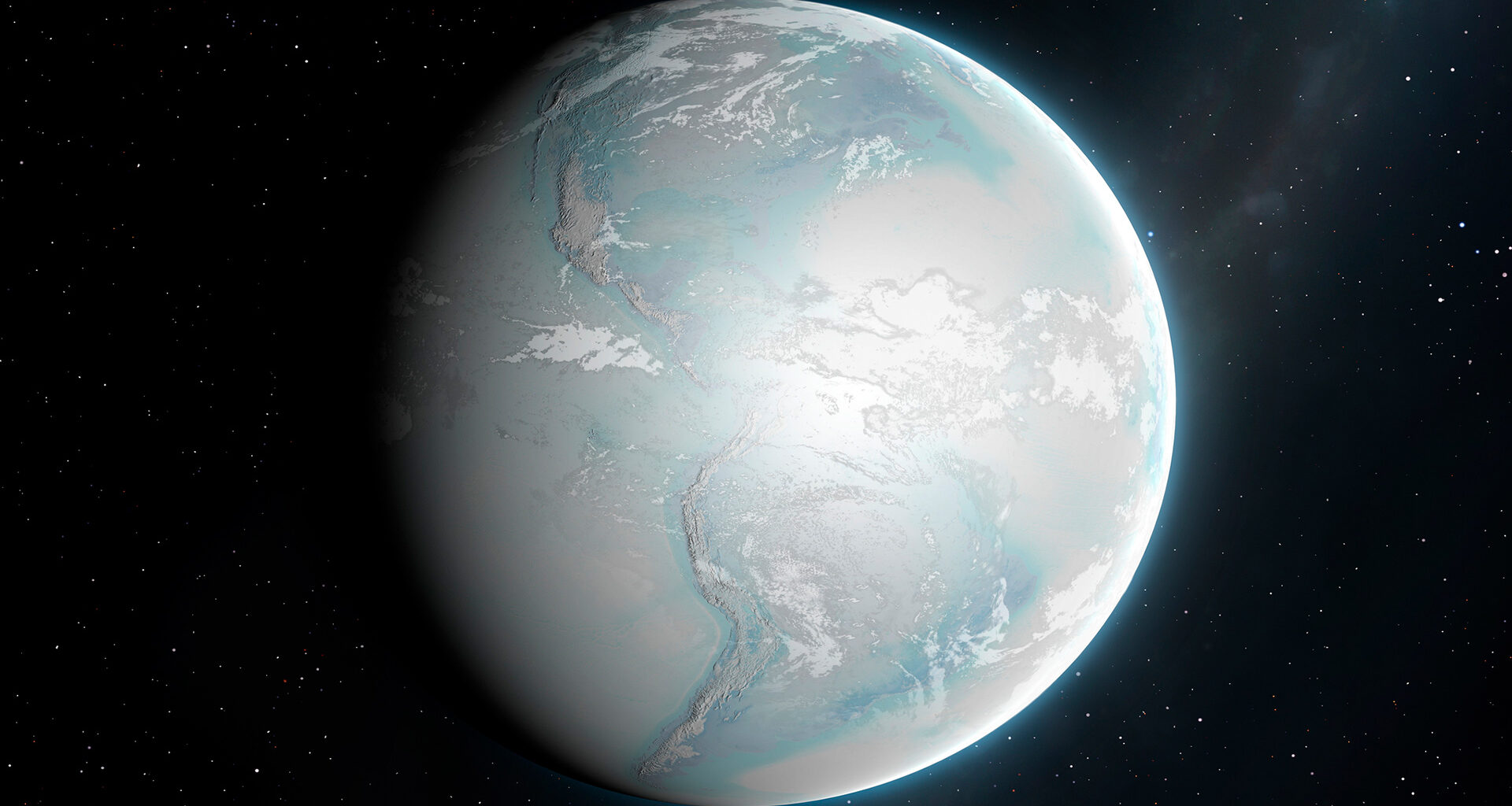
Between 720 million and 635 million years ago, Earth may have experienced one of the most extreme climate episodes in its history. During this time, known as Snowball Earth, ice sheets are thought to have spread from the poles all the way to the tropics, possibly covering most of the planet’s oceans and continents.
Geologists know this because ancient rocks found at low latitudes carry unmistakable traces of glaciers—evidence that ice once existed in regions that are warm today.
Scientists have long believed that the freeze intensified because of the ice-albedo feedback, a process in which expanding ice reflects more sunlight back into space. The brighter the planet becomes, the less heat it absorbs, allowing ice to spread even further.
However, this explanation might not tell the whole story. A new modeling study suggests that salt left behind on sea ice could have made the planet even brighter and colder as global glaciation began.
“Our results suggest that salt precipitation may have played a role in shaping the early climate of Snowball Earth,” the study authors note.
Freezing oceans may have created a reflective salt crust
The mechanism begins with how seawater freezes. Ocean water contains dissolved salts, and when ice forms, most of these salts are pushed out of the crystal structure. Some of them remain trapped inside tiny pockets of concentrated salty liquid known as brine.
In extremely cold environments, this brine can eventually crystallize, leaving solid salt behind. The researchers propose that during a Snowball Earth phase, this process could have happened over vast regions of sea ice exposed to the atmosphere.
Another key process is sublimation, where ice turns directly into water vapor without melting first. Under the dry and frigid conditions expected on a Snowball Earth, large areas of ice may have gradually sublimated.
When that happened, the salt trapped within the ice would not disappear with it. Instead, it would remain on the surface as fine crystals forming a pale, reflective coating. This is because salt crystals can reflect sunlight efficiently, such deposits might have increased the planet’s overall brightness.
In climate science, the more sunlight reflected away from Earth, the less heat remains to warm the surface, encouraging even more ice formation.
To examine how important this effect might be, “we implement a feedback mechanism with proposed relevance for Snowball Earth in a simple climate model, a salt–albedo feedback,” the researchers from UiT (The Arctic University of Norway) note.
Results from the climate model
The simulations showed that once salt began accumulating on the ice surface, it amplified the cooling already taking place during the early stages of global glaciation.
In other words, the salt layer acted like an extra boost to the freezing process, helping push Earth toward a deeper frozen state.
The model also suggested that this salty surface could have made the planet more resistant to warming. Compared with simulations that only included traditional ice reflectivity, the version with salt deposits required much stronger warming before the frozen planet could begin to thaw.
“We have shown that a salt-albedo feedback introduces two coexisting Snowball Earth states in a simple climate model, one with a lag deposit of salt crystals and one without, where the former is significantly colder,” the study authors said.
The researchers also note that the colder state may better match geological evidence from the Neoproterozoic era, when Snowball Earth events are believed to have occurred.
Future studies using more detailed climate models will explore how these processes interact and whether the salt effect remains strong under more realistic conditions.
“Our results highlight salt precipitation as an important physical process that warrants further research in future modeling studies of Snowball Earth,” the study authors concluded.
The study is published in the journal Climate of the Past.