
Iran to suspend strikes on neighbours unless attacks from themTrump says Iran will be ‘hit very hard’ on SaturdayIran envoy says 1,332 Iranian civilians killed in warIsrael strikes targets in LebanonTehran rejects Trump demand for say over next supreme leader
“I personally apologise to neighbouring countries that were affected by Iran’s actions,” Iranian President Masoud Pezeshkian said, urging them not to join U.S.-Israeli attacks on Iran.
He dismissed U.S. President Donald Trump’s demand for the Islamic Republic’s unconditional surrender as “a dream”, but said its temporary leadership council had agreed to suspend attacks on nearby states unless strikes on Iran originated from their territory.
Trump nonetheless cast Iran’s apology as a surrender, while saying the country would be “hit very hard” on Saturday and warned the U.S. could widen its attacks to areas and groups of people that were not previously designated targets.
Iran says it targeted US bases
Pezeshkian’s comments caused a political stir in Iran, prompting his office to reiterate Iran’s military would respond firmly to attacks from U.S. bases in the region. Hamid Rasai, a hardline cleric and lawmaker, wrote on X, “Mr Pezeshkian, your stance was unprofessional, weak and unacceptable”.
Hours after Pezeshkian’s announcement, Iran’s Revolutionary Guards said their drones struck a U.S. air combat centre at Al Dhafra Air Base, near Abu Dhabi, capital of the United Arab Emirates. Reuters could not independently verify that report.
The Revolutionary Guards also targeted U.S. forces at a base in Bahrain, the Iranian state media said. Blasts were also heard in Doha, a Reuters witness said.
Gholamhossein Mohseni-Ejei, Iran’s judiciary chief, said evidence from Iran’s armed forces indicates that the territory of some regional countries was being used to carry out attacks against Iran.
Heavy strikes on those targets will continue, said Mohseni-Ejei, who is also a member of the interim leadership council set up after Supreme Leader Ayatollah Ali Khamenei was killed in an airstrike on his compound at the start of the conflict.
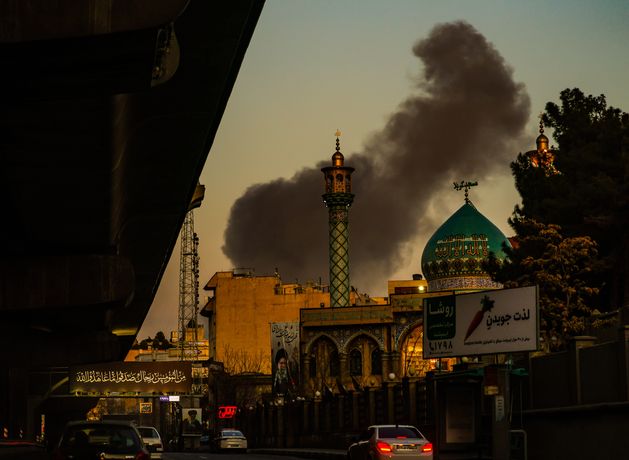
Huge explosions were heard in several parts of the Iranian capital, state media reported.
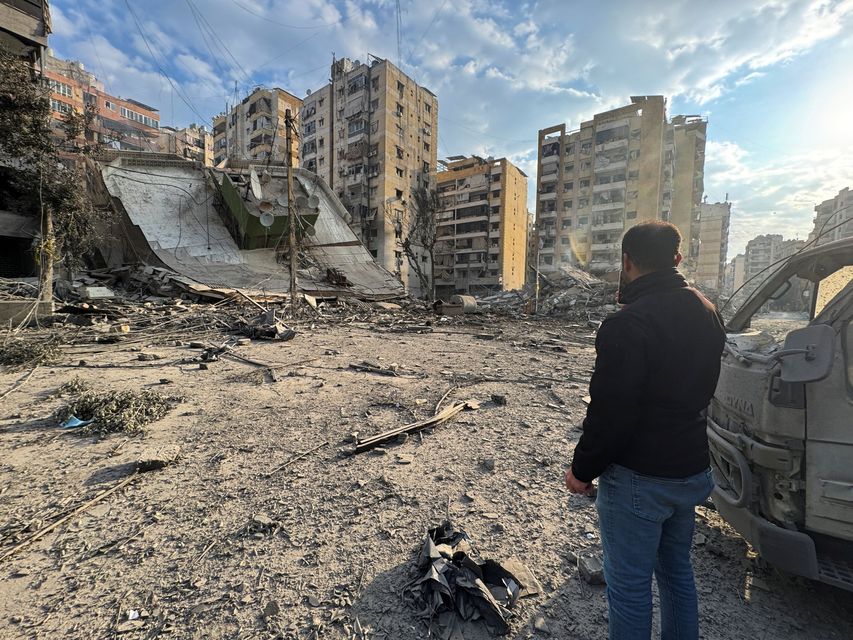
Damaged buildings after an Israeli strike on Beirut’s southern suburbs. Photo: Reuters
Gulf states hit by drones and missiles
The U.S.-Israeli war on Iran has already spilled beyond Iran’s borders, as Tehran has responded by hitting Israel and Gulf Arab states hosting U.S. military installations and Israel has launched fresh attacks in Lebanon after the Iran-aligned militia Hezbollah fired across the border.
Gulf states voiced outrage that their civilian infrastructure – hotels, ports and oil facilities – was struck despite their having had no part in the U.S.-Israeli attacks.
The UAE, Kuwait, Qatar, Bahrain, Oman, Saudi Arabia and Iraq have all reported drone or missile attacks over the past week.
Iran had mended fences with its Gulf neighbours in recent years, including with former regional arch-rival Saudi Arabia.
An Emirati official said the United Arab Emirates wanted the Iranian aggression against the Gulf states to end immediately.
“We don’t want the war to expand. We want to start with the Iranians realising that they are not helping themselves by attacking their whole neighbourhood and to stop there and realize that,” the official said.
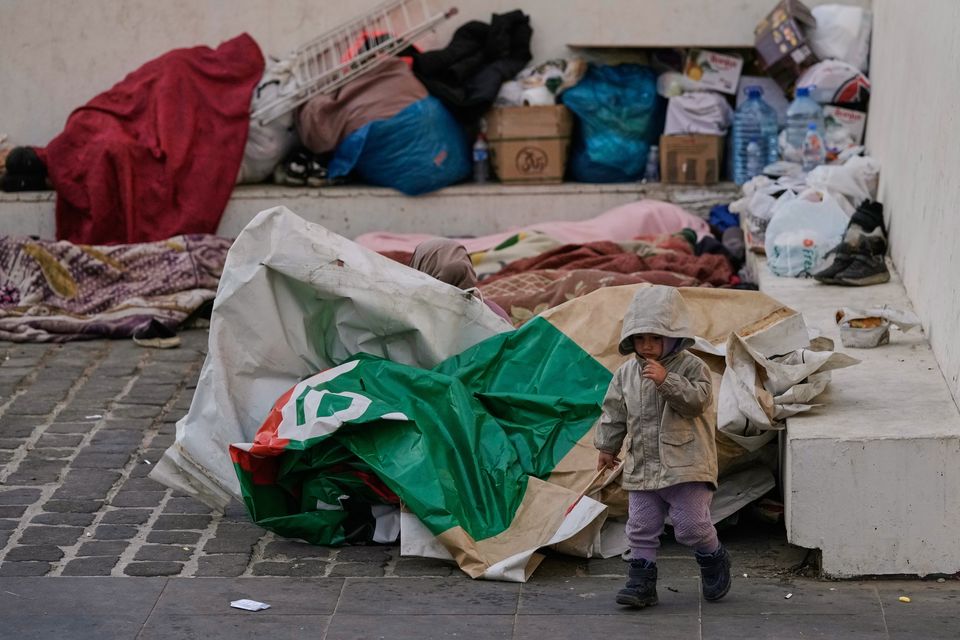
Displaced people are fleeing Israeli air strikes in Dahiyeh, Beirut (AP)
Israel warns Lebanon to rein in Hezbollah
With the conflict spreading, Israel warned Lebanon of a “very heavy price” if it did not rein in Hezbollah, as it pounded the group’s strongholds with airstrikes and mounted a deadly airborne raid in the east.
On Saturday morning, more buildings in the Hezbollah-controlled southern suburbs of Beirut had been reduced to mounds of smoking rubble, dust and tangled wires, Reuters video showed, with a toddler’s toy car lying on its side.
Heavy Israeli bombardment had followed an evacuation order for civilians. The total death toll from Israel’s attacks on Lebanon since Monday has risen to 294, the health ministry said.
The U.S.-Israeli attacks have killed at least 1,332 Iranian civilians and wounded thousands, according to Iran’s U.N. ambassador, Amir Saeid Iravani.
Iranian attacks have killed 10 people in Israel, and at least six U.S. service members have been killed.
Iran rejects Trump call for say in choosing new leader
Iran’s apparent strategy of maximum chaos has driven up the costs of the conflict by raising energy prices, hurting global business and logistics links and shaking trust in the stability of a critical region for the world’s economy.
Early on Saturday, the Iranian army said its navy had carried out drone strikes against targets in Israel as well as U.S. gathering points and bases in Abu Dhabi and Kuwait.
Speaking at an event hosting Latin American leaders in Miami, Florida, Trump said on Saturday the U.S. had knocked out 42 Iranian navy ships in three days.
Israel launched what its military described as a new wave of strikes on Tehran and Isfahan, while overnight, the Israeli military said it had carried out strikes on neighbouring Lebanon that it said were aimed at Hezbollah military sites.
The Israeli military reported identifying missiles fired from Iran at Israel on eight different occasions on Saturday, setting off air raid sirens in parts of the country and prompting Israeli air defences to intercept incoming fire.
The war has roiled global markets and oil prices have hit multi-year highs with the Strait of Hormuz effectively shut. About one-fifth of global oil moves daily through the strait.
Iran’s Revolutionary Guards hit a Marshall Islands-flagged tanker in Hormuz, Iranian state media reported on Saturday.
Trump has said the U.S. Navy could escort ships in the Gulf. But Iran’s Revolutionary Guards challenged him to do so, with spokesperson Alimohammad Naini saying Iran “welcomes” and is “awaiting” any U.S. presence in the strait, state media said.
Trump also reiterated his demand to have a say in selecting Iran’s new supreme leader, a notion rejected by Iravani.
The ambassador said new leadership would be selected “without any foreign interference.”

Families take a stroll along Dubai Creek Harbour on Friday. Photo: Reuters
Investigation ‘points to probable US responsibility’ in Iran school bombing
US military investigators believe it is likely that US forces were responsible for an apparent strike on an Iranian girls’ school that killed scores of children last Saturday, but have not yet reached a final conclusion or completed their investigation, two US officials said.
Reuters was unable to determine more details about the investigation, including what evidence contributed to the tentative assessment, what type of munition was used, who was responsible or why the US might have struck the school.
US defence secretary Pete Hegseth acknowledged on Wednesday that the US military was investigating the incident.
The officials, who spoke on condition of anonymity to discuss sensitive military matters, did not rule out the possibility that new evidence could emerge that absolves the US of responsibility and points to another responsible party in the incident.
.jpg)
Dozens of graves are prepared following an Israeli strike on a school in Iran that is reported to have killed at least 150, including many children. Photo: Reuters
It is not known how much longer the investigation would last or what evidence US investigators are seeking before the assessment can be completed.
The girls’ school in Minab, in southern Iran, was hit during the first day of US and Israeli attacks on the country.
Iran’s ambassador to the UN in Geneva, Ali Bahreini, said the strike killed 150 students.
It could not be independently confirmed how high the death toll was.
According to archived copies of the school’s official website, the school is next to a compound operated by the Islamic Revolutionary Guard Corps (IRGC), the military force that reports to Iran’s supreme leader.
The Pentagon referred questions to the US military’s Central Command, whose spokesperson, Captain Timothy Hawkins, said: “It would be inappropriate to comment given the incident is under investigation.”
The White House did not directly comment on the investigation, but press secretary Karoline Leavitt said in a statement: “While the Department of War is currently investigating this matter, the Iranian regime targets civilians and children, not the United States of America.”
Asked about the incident during a news briefing on Wednesday, Mr Hegseth said: “We’re investigating that. We, of course, never target civilian targets. But we’re taking a look and investigating that.”
The school and compound were hit by multiple simultaneous or near-simultaneous strikes, most likely air-delivered types
US secretary of state Marco Rubio told reporters on Monday that the United States would not deliberately target a school.
“The Department of War would be investigating that if that was our strike, and I would refer your question to them,” Mr Rubio said.
.jpg)
Coffins holding the bodies of mostly children are prepared for the funeral of those killed in what Iranian officials said was an Israeli-U.S. strike Feb. 28 at a girls’ elementary school in Minab, Iran, Tuesday, March 3, 2026. (Amirhossein Khorgooei/ISNA via AP)
Israeli and US forces have until now divided their attacks in Iran both geographically and by target type, a senior Israeli official and a source with direct knowledge of the joint planning said. While Israel was striking missile launch sites in western Iran, the United States was attacking such targets, as well as naval ones, in the south.
Reuters shared satellite imagery and visuals of the aftermath of the Minab attack with NR Jenzen-Jones, director of Armament Research Services, a munitions research consultancy.
“Taken together, the satellite imagery and available videos suggest the school and adjacent IRGC compound were hit by multiple simultaneous or near-simultaneous strikes with explosive munitions, most likely air-delivered types,” Mr Jenzen-Jones wrote in an email.
He cautioned that it is difficult to be definitive about the type of munitions used in the ongoing conflict and said that to determine responsibility investigators would generally attempt to review munition remnants.
The UN human rights office, without saying who it believed was responsible, called on Tuesday for an investigation.
“The onus is on the forces that carried out the attack to investigate it,” UN human rights office spokesperson Ravina Shamdasani told a press briefing in Geneva.
Images of the girls’ funeral on Tuesday were shown on Iranian state television. Their small coffins were draped with Iranian flags and passed from a truck across a large crowd towards the grave site.
Deliberately attacking a school or hospital or any other civilian structure would most likely be a war crime under international humanitarian law.
If a US role were to be confirmed, the strike would rank among the worst cases of civilian casualties in decades of US conflicts in the Middle East.