
A fragment of a centuries-old meteorite has revealed a form of solid silica that carries heat at nearly the same rate across a wide span of temperatures.
That stability challenges one of the simplest assumptions about how solids behave, blurring the long-standing divide between crystals and glass.
Evidence in the meteorite

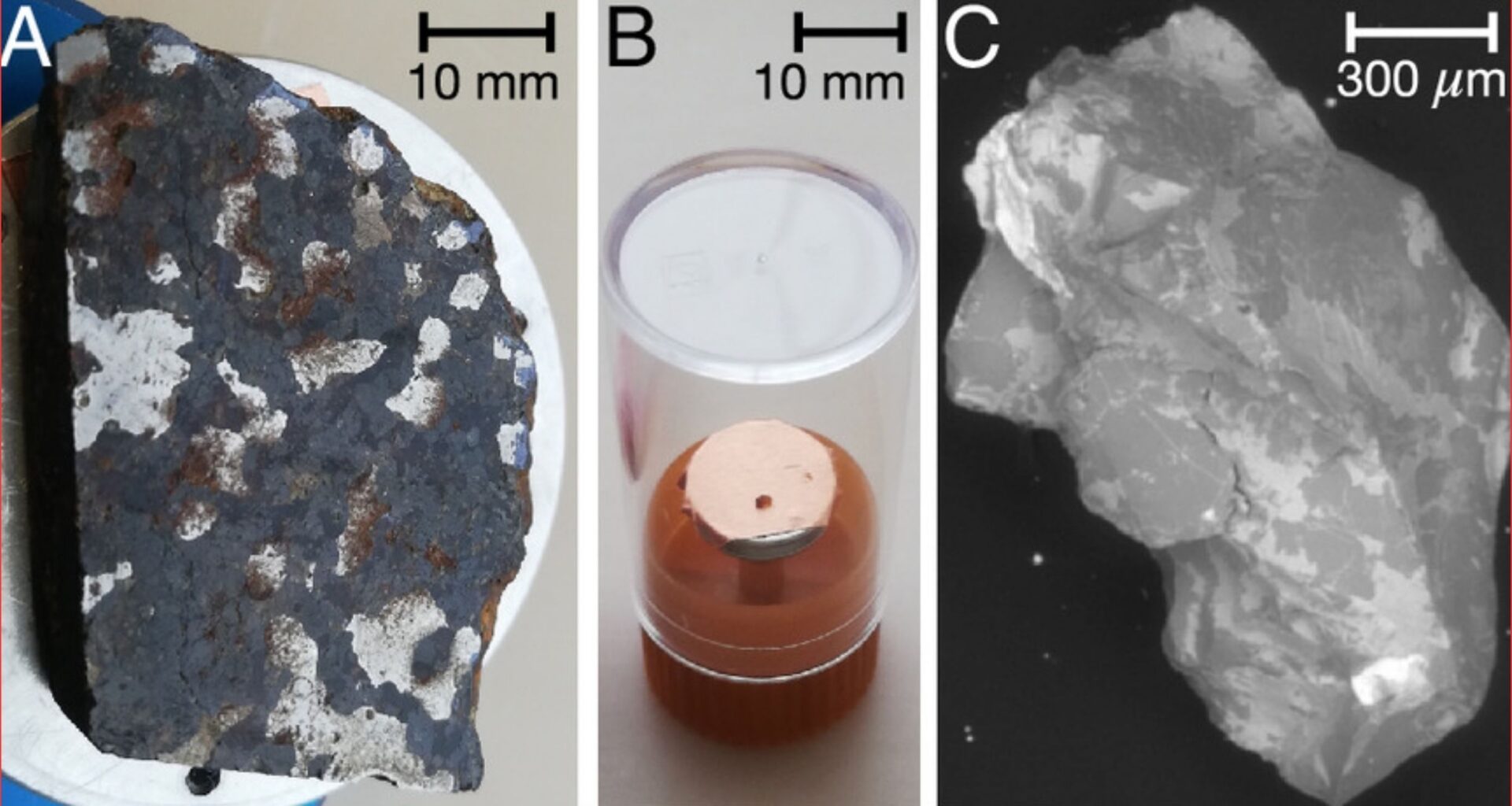
A silica grain preserved inside the Steinbach meteorite, an iron-rich space rock that fell in Germany in 1724, exhibits the unusual behavior.
Examining that fragment, Dr. Michele Simoncelli at Columbia University documented heat flow that barely changed across large temperature swings.
Measurements from the mineral showed that its heat conductivity stayed almost constant from deep cold to well above room temperature.
Such steadiness is rare among solids and signals that the familiar categories used to classify them may be incomplete.
Heat usually stays steady
Heat usually spreads faster or slower as a solid warms, and that change helps engineers predict performance.
Engineers call that thermal conductivity – how easily a solid lets heat pass. In terms of this characteristic, crystals and glass swing opposite ways.
Across about -316 to 224 degrees Fahrenheit (-193 to 107 degrees Celsius) the meteorite sample kept its heat flow almost flat.
A flat curve showed one solid could dodge the usual tradeoff between rigid atomic order and loose atomic disorder.
A strange silica in the meteorite
Mineralogists call the meteorite phase tridymite, a form of silica that is made from linked silicon and oxygen atoms.
Instead of lining up like a tidy crystal, its atomic network kept a repeating pattern but held distorted angles.
Repeated rings of atoms provided order, yet small twists and bends made each ring slightly different from its neighbors.
That mixture set up two competing ways to carry heat, and the measurements showed how they balanced.
Two pathways compete within silica
In a clean crystal, heat traveled through coordinated vibrations, and higher temperatures usually scattered those vibrations and reduced flow.
Inside glass, disorder blocked long-range travel, so heat jumped between local vibrations and rose as more motion filled in.
For the meteorite form of silica, one pathway weakened with warming while the other strengthened, leaving the total almost unchanged.
That cancellation held from deep cold to above room temperature, which made the material valuable for places with wild heating cycles.
A prediction tested
Back in 2019, Simoncelli built a single equation that treated crystals and glasses with the same math.
From that framework, the model predicted a middle class of solids where crystal-like and glass-like heat transport could cancel.
Meteorite tridymite became the cleanest test, since nature had already made the odd structure that the equation required.
By matching prediction to measurement, the work turned an abstract idea into a guide that engineers can actually use.
Born under extremes
Violent heating and fast cooling can freeze atoms into patterns that never form in a quiet lab melt.
Alongside the meteorite sample, the team studied a tridymite phase inside the refractory, heat-resistant lining used in industrial furnaces.
In steel plants, those bricks faced long burns and sudden cool-downs, so steady heat flow could cut wasted fuel.
Finding the same behavior in space rock and factory bricks hinted that the key lay in structure, not origin.
Mars adds context
On Mars, Curiosity found tridymite in Gale crater, a large impact basin near the planet’s equator. Because tridymite normally forms at very high heat, its presence pushed researchers to rethink Mars as mostly made of basalt, a common, dark volcanic rock.
Simoncelli’s team argued that these hybrid heat traits could also influence how planets cool, not just how they erupt.
If geologists can spot more of these phases, cooling models may need new assumptions about how heat escapes rocky worlds.
Furnaces need control
In 2023, the steel industry averaged 1.92 tons of CO2 per ton of crude steel cast globally. Inside a furnace, refractory bricks controlled how heat reached the steel, so their conductivity helped set fuel demand.
“Our findings shed light on how to increase the conductivity of refractories, reducing furnaces’ burn time and consequently lowering carbon emissions,” wrote Dr. Simoncelli.
Making that sort of brick on purpose would demand tight control over structure, and it may not survive every furnace chemistry.
Designing the middle
Materials designers rarely get a tool that keeps heat flow steady, since most solids speed up or slow down.
By tweaking atomic order without turning the structure into full glass, researchers can aim for a custom balance.
Large-scale production still needs recipes that repeat the same internal structure, and industry will test whether it stays stable for years.
Even if the category stays fuzzy, the finding offers a practical target: to keep heat predictable when temperatures swing hard.
Silica in a new heat class
From a centuries-old meteorite to modern furnace bricks, the same hybrid structure kept heat behavior steady across conditions.
Future work will need lab-made samples and real furnace trials before anyone can rely on this middle ground.
The study is published in Proceedings of the National Academy of Sciences.
—–
Like what you read? Subscribe to our newsletter for engaging articles, exclusive content, and the latest updates.
Check us out on EarthSnap, a free app brought to you by Eric Ralls and Earth.com.
—–