
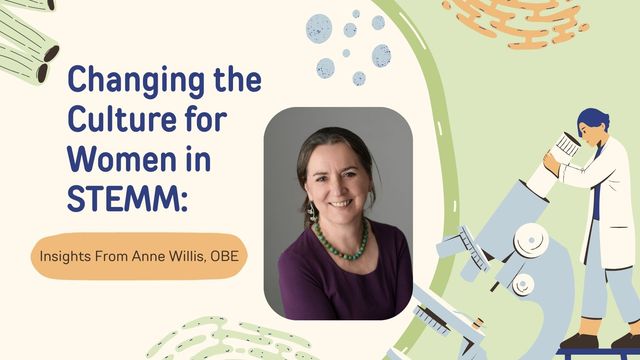
Professor Anne Willis is director of the Medical Research Council Toxicology Unit and professor of Toxicology at the University of Cambridge. She obtained her PhD from Imperial College, London, working with Tomas Lindahl at the ICRF Clare Hall Laboratories. She then did post-doctoral work with Professor Richard Perham at the University of Cambridge, where she also held a junior research fellowship at Churchill College. After holding positions in Leicester and then Nottingham in 2010, Anne became director of the Medical Research Council (MRC) Toxicology Unit. In 2017, she was awarded an OBE for services to biomedical sciences and supporting the careers of women scientists.
In this interview, Willis discusses her research on posttranscriptional control of gene expression and disruptions in RNA regulation. She also shares insights into the challenges faced by women in science, technology, engineering, mathematics, and medicine (STEMM) and highlights her proudest achievements.
Kate Robinson (KR):

Science Editor
Technology Networks
Kate Robinson is a science editor at Technology Networks. She joined the team in 2021 after obtaining a bachelor’s degree in biomedical sciences.
Was there a particular person or experience that motivated you to choose a career in science?
Anne Willis, OBE, PhD (AW):

Director of the MRC Toxicology Unit
University of Cambridge
Anne Willis is Director of the MRC Toxicology Unit at the University of Cambridge. She obtained a PhD in Biochemistry from the University of London while working in the Imperial Cancer Research Fund laboratories (now CRUK) on DNA repair with Dr. Tomas Lindahl. Her research is directed towards understanding the role of post-transcriptional control in response to toxic injury with a focus on RNA-binding proteins, regulatory RNA motifs and tRNAs.
My mother, who gave me my first microscope for my 8th birthday, which sparked my interest in science and biology.
KR:
Science Editor
Technology Networks
Kate Robinson is a science editor at Technology Networks. She joined the team in 2021 after obtaining a bachelor’s degree in biomedical sciences.
Can you tell us a bit about your career to date and your current research?
AW:
Director of the MRC Toxicology Unit
University of Cambridge
Anne Willis is Director of the MRC Toxicology Unit at the University of Cambridge. She obtained a PhD in Biochemistry from the University of London while working in the Imperial Cancer Research Fund laboratories (now CRUK) on DNA repair with Dr. Tomas Lindahl. Her research is directed towards understanding the role of post-transcriptional control in response to toxic injury with a focus on RNA-binding proteins, regulatory RNA motifs and tRNAs.
I completed my PhD at ICRF (now Cancer Research UK) on DNA damage before my postdoctoral work and junior research fellowship in the Department of Biochemistry at the University of Cambridge. I was then appointed as a lecturer at the University of Leicester, progressing to professor in 2004. I then moved to Nottingham University where I held the position of professor of cancer cell biology, and I was director of Cancer Research Nottingham. In 2010, I became the director of the MRC Toxicology Unit, first at Leicester and then the whole Unit relocated to Cambridge.
I work on the posttranscriptional control of gene expression, with a focus the RNA binding proteins and cognate RNAs that regulate mRNA translation/protein synthesis and the associated pathways including the integrated stress response (ISR), the ribotoxic stress response (RSR), and ribosome-associated quality control (RQC). We research dysregulation of these pathways in disease and how they control the response to toxic injury from medicine-related or environmental exposure. Currently, I am applying my expertise to understand the safety liabilities associated with new medicine platforms (including RNA-based medicines used in COVID vaccines, and antisense oligo-nucleotides used to treat rare diseases) and to improve their efficacy, using this information to ensure that nucleic-acid based therapeutics are “safe-by-design”.
KR:
Science Editor
Technology Networks
Kate Robinson is a science editor at Technology Networks. She joined the team in 2021 after obtaining a bachelor’s degree in biomedical sciences.
What barriers exist for women in STEMM, and what could be done to better support them?
AW:
Director of the MRC Toxicology Unit
University of Cambridge
Anne Willis is Director of the MRC Toxicology Unit at the University of Cambridge. She obtained a PhD in Biochemistry from the University of London while working in the Imperial Cancer Research Fund laboratories (now CRUK) on DNA repair with Dr. Tomas Lindahl. Her research is directed towards understanding the role of post-transcriptional control in response to toxic injury with a focus on RNA-binding proteins, regulatory RNA motifs and tRNAs.
While the situation has improved overall for women since I started my career, being an academic scientist in STEMM is still a challenge for women with small children (and sometimes older children) and those with other caring responsibilities.
For postdocs: A major issue is that while maternity leave is paid for around 9-12 months (at least in the UK), none of the funders will extend the grant funding by the same period time. This means that a third or more of project time can be lost. It is hard to get back into the lab after ~1 year out as projects will have moved on, and the large reduction in time strongly affects productivity and output of papers. What is needed is for grant awarding bodies to pay for an additional year on top of maternity pay to ensure that female postdocs are truly competitive at this vital career stage. Some institutions (including School of Biology in Cambridge) have research support schemes where “floating” postdocs can carry out key experiments for those on maternity leave (or off with other caring responsibilities or long-term illness), and more of these types of schemes would definitely be useful.
At senior level or on tenure track routes: More career flexibility is required to allow women to carry on with their research after having children. Shared senior appointments at this career stage could be considered e.g., co-running a laboratory (with two people working 60%). Indeed, some very successful women scientists have partners who are their lab managers. Moreover, far greater allowances need be made in terms of assessing the outputs of women with small children (or men for that matter if they are the major carer). The impact on scientific outputs of having a child doesn’t stop when maternity leave ends! It is particularly hard when both partners have “big” jobs, the demands of science and a family are difficult to manage when both parents are working 200%. Perhaps that is the same for all professions, but as scientists we are constantly judged on our outputs, whether it is papers or grants awarded.
KR:
Science Editor
Technology Networks
Kate Robinson is a science editor at Technology Networks. She joined the team in 2021 after obtaining a bachelor’s degree in biomedical sciences.
What do you enjoy most about your work, and what would you say are your proudest achievements?
AW:
Director of the MRC Toxicology Unit
University of Cambridge
Anne Willis is Director of the MRC Toxicology Unit at the University of Cambridge. She obtained a PhD in Biochemistry from the University of London while working in the Imperial Cancer Research Fund laboratories (now CRUK) on DNA repair with Dr. Tomas Lindahl. Her research is directed towards understanding the role of post-transcriptional control in response to toxic injury with a focus on RNA-binding proteins, regulatory RNA motifs and tRNAs.
Directing the overall science of the Unit, exploring strategic options, and identifying new opportunities. Excitement of discovery, contribution to knowledge, and collaboration with others.
The research from my team has led to new therapeutic directions and drug discovery programmes in industry for disease treatment (e.g., cancers and neurodegeneration), we have improved the safety profile of new medicines e.g., mRNA vaccines, with some high-profile work in this area, all of which have made a real-world difference. However, I am proudest of the fact that I have trained a large number of people who are now successful scientists with their own labs or work in scientific-related areas. The combined work that ex-lab members do to expand this important area of science is a legacy.
KR:
Science Editor
Technology Networks
Kate Robinson is a science editor at Technology Networks. She joined the team in 2021 after obtaining a bachelor’s degree in biomedical sciences.
If you could give one piece of advice to a woman considering a career in science, what would you say?
AW:
Director of the MRC Toxicology Unit
University of Cambridge
Anne Willis is Director of the MRC Toxicology Unit at the University of Cambridge. She obtained a PhD in Biochemistry from the University of London while working in the Imperial Cancer Research Fund laboratories (now CRUK) on DNA repair with Dr. Tomas Lindahl. Her research is directed towards understanding the role of post-transcriptional control in response to toxic injury with a focus on RNA-binding proteins, regulatory RNA motifs and tRNAs.
Focus on your research whatever career stage you are at. If you have children, do not allow yourself to be persuaded to go down the “teaching only” route as it is “easier.” It is hard work, but you can do both and it is a very rewarding and exciting career.