
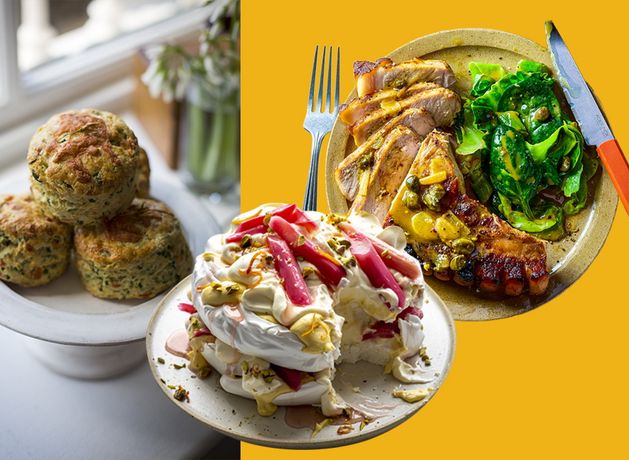
There’s something very satisfying about coming home from the shop, butchers or local market with bags full of ingredients you can put straight to work, or a stroll in the forest for some wild garlic.
Wild garlic doesn’t hang around long in our house. As soon as it’s been picked and washed, make it into flavoured oils, punchy sauces or use it in these wild garlic and cheddar scones, which are one of those things that make people think you’ve made a big effort when actually you’ve just chopped, mixed and baked.
The trick is to handle the dough lightly and get it into a hot oven fast – that will give you height and that soft, fluffy middle. Also, don’t skip the mustard powder. You won’t taste mustard, but everything tastes more like itself.
There are only a few forced rhubarb growers left in Ireland, as once the rhubarb has been forced, the plant no longer provides further yield. But if you do track some down, its dramatic, tart stems are magic with anything sweet you pair it with.
For this rhubarb and custard pavlova, I warm it gently rather than boiling it, using just enough heat to soften it without causing a complete collapse. The custard brings nostalgia, the cream softens the edges, and the meringue is crisp-shelled with a marshmallow interior. A proper show-stopper!
And then, a Sunday dinner contender. Hasselback pork chops with soft greens is exactly the sort of dinner that makes a random market shop feel intentional. Track down really good, thick-cut pork chops. Slice through the fat before cooking skin side down to start, so it crisps instead of curling – a small detail that makes a big difference to how it cooks. Then use the pan juices for a quick sauce.
Really simple weekend cooking that might help you, like me, slow down.
Wild Garlic & Cheddar Scones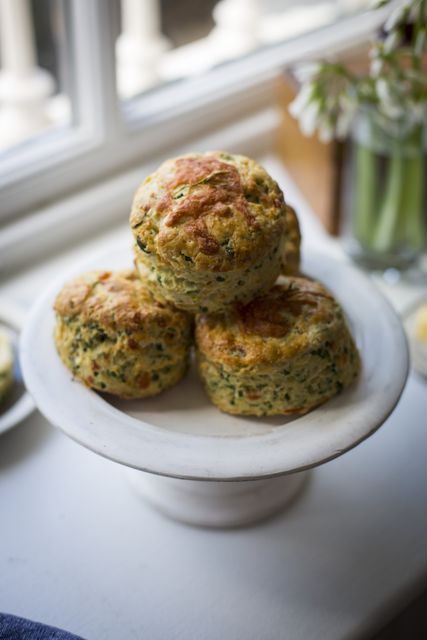
Wild Garlic & Cheddar Scones. Photo: Donal Skehan & Tara Fisher; Food styling: Charlotte O’Connell
Time: 30 minutes
Makes: 6-8 scones
Ingredients
500g self-raising flour, plus extra for dusting1 tsp baking powder120g butter, chilled125g Irish cheddar cheese, grated50g wild garlic leaves, finely chopped1 tsp English mustard powder250ml milk, plus extra for brushing2 large free-range eggsWild garlic flowers, to garnish
Method
1. Preheat the oven to 220C/425F/Gas Mark 7 and dust a large baking sheet with flour.
2. Combine the flour and baking powder in a large mixing bowl and, using your fingertips, rub in the butter until the mixture resembles rough breadcrumbs.
3. Add 100g of the cheese, wild garlic leaves and English mustard to the bowl and mix it through the crumbs.
4. In a measuring jug, whisk together the milk and egg until combined. Pour this into the crumb mixture (leaving about 1 tbsp of the mix in the jug) and mix through with a butter knife until a rough dough forms. Use your hands to push the dough together, making sure to include any mixture that’s stuck on the sides of the bowl.
5. Dust a clean work surface with a little flour, turn the dough out of the bowl and press into a round shape. With a rolling pin, roll the dough out to a thickness of 2½cm.
6. Using a 7½cm circular pastry cutter, cut out the scones and place on the baking sheet. Press the trimmings together, roll out and repeat the process until you have used all the dough. Place the scones on the prepared baking sheet.
7. Brush each scone with the reserved egg and milk mix, sprinkle with 25g of cheese and press wild garlic flowers in the centre to garnish.
8. Place in the oven on the middle shelf and bake for 12-14 minutes until they have risen and turned a lovely golden-brown colour on top. Transfer to a wire rack to cool slightly before serving warm with butter.
Rhubarb & Custard Pavlova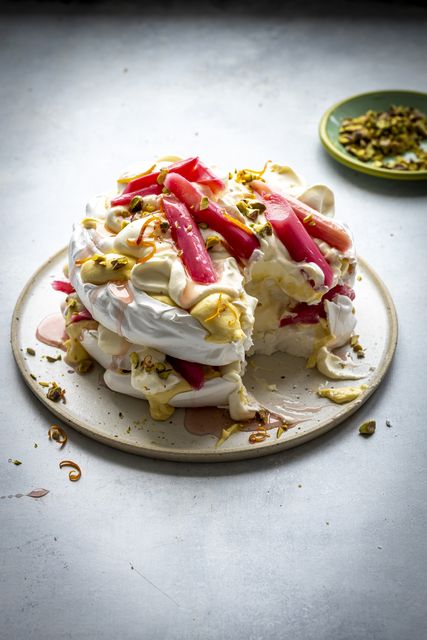
Rhubarb & Custard Pavlova. Photo: Donal Skehan & Tara Fisher; Food styling: Charlotte O’Connell
Time: 1 hour 20 minutes + cooling
Serves: 10
Ingredients
250g icing sugar4 egg whites2 tsp cornflour1 tsp white wine vinegar
For the custard:
3 egg yolks50g caster sugar10g plain flour10g cornflour250ml whole milk1 tsp vanilla paste
For the rhubarb:
250g forced rhubarb35g caster sugar125ml water
To serve:
500ml double cream, whipped50g pistachios, roughly choppedZest of 1 orange
Method
1. Preheat the oven to 150C/130C fan/300F/Gas Mark 2. Line two baking trays with baking parchment.
2. To make the meringue mixture, place the icing sugar and egg whites in a standing food mixer and whisk on high for 10 minutes until glossy white peaks form. Using a spatula, gently fold in the cornflour and the white wine vinegar until incorporated. Divide the mixture between the two baking trays and, using a tablespoon, form two large meringue discs, creating soft peaks and swirls.
3. Transfer to bake for 45 minutes. Then allow to cool completely with the door slightly ajar.
4. While the pavlova cools, make the custard. Whisk the egg yolks, sugar, flour and cornflour together in a mixing bowl. Heat the milk and vanilla paste in a small saucepan until almost boiling and slowly pour the milk over the egg yolk mixture, whisking constantly. Clean the pan and pour in the mixture, then cook over a low heat, stirring constantly until the mixture thickens. The mixture will go very lumpy as it cooks, but don’t worry, this is meant to happen – just keep whisking and the mixture will eventually become smooth and glossy. Cook for a further two minutes, then remove from the heat. Cover the surface of the custard with clingfilm to prevent a skin from forming and to allow to cool.
5. For the rhubarb, cut the stalks into 5cm pieces and place in a large glass bowl. Add the sugar and mix, then leave for 20 minutes. Add the water, and transfer to a large, flat-bottomed pan, ensuring the rhubarb lies in a single layer (if your pan isn’t big enough, cook in batches). Place the pan over a very low heat and warm very gently for about 4-6 minutes at barely a simmer. Now, remove the pan from the heat and place the lid on for 2-3 minutes. Remove the lid and leave to cool completely. To store, transfer the rhubarb and its syrup to a container so that the syrup covers the fruit
6. Once the pavlovas have cooled completely, whip the cream to very soft peaks – making sure not to over-whip it.
7. Remove the clingfilm from the custard and use a whisk to bring it back to a lovely smooth consistency.
8. To assemble the pavlova, place a layer of meringue on a cake stand and top with half of the custard and rhubarb and about a third of the cream. Add the next layer of meringue and then top with the remaining custard, cream and rhubarb. Decorate with the chopped pistachios and some orange zest.
Hasselback Pork Chops with Pan Greens & Savoy Cabbage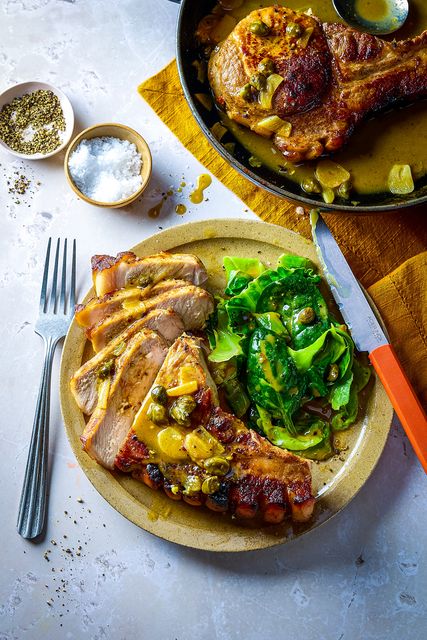
Hasselback Pork Chops with Pan Greens & Savoy Cabbage. Photo: Donal Skehan & Tara Fisher; Food styling: Charlotte O’Connell
Serves: 2
Time: 30 minutes
Ingredients
2 large, thick-cut pork chops2 tbsp olive oil100g butter, divided2 spring onions, thinly sliced4 garlic cloves, 1 grated, 3 thinly sliced½ Savoy cabbage, tough stalks removed and leaves shredded into thin piecesLarge handful baby spinach100ml white wine1 tbsp Dijon mustard1 tsp honey1 tbsp capersHandful fresh parsley, choppedSea salt and freshly ground black pepper
Method
1. Slice through the fat on the pork chops at thin intervals until you reach the meat – think hasselback potatoes. This will help the chops not to curl up when frying and will help the fat to crisp up as it cooks. Rub the chops with a little olive oil and season well with salt and some black pepper.
2. Place a large, heavy-bottomed frying pan over a medium heat and add a drizzle of olive oil. Once hot, add the pork chops, fat side down, and cook for about 3-4 minutes until the fat has crisped up and turned lovely and golden. Now, cook the chops on each side for about 4-5 minutes. When the chops are nearly done, add in 50g of the butter and begin to baste the chops in the melting butter for a further few minutes until cooked through – the pork should read 63C on a meat thermometer.
3. While the pork is cooking, get a second frying pan and place over a medium heat. Add the remaining 50g of butter along with the spring onions, 1 grated garlic clove and a pinch of salt and cook for a minute before adding the Savoy cabbage. Cook for 7-8 minutes, stirring occasionally and adding a splash of water (or wine!) if necessary. Add the spinach to the pan and cook for a further 2-3 minutes until the spinach has wilted, then keep warm.
4. Remove the pork from the pan and allow to rest.
5. Add the garlic to the pan you cooked the pork in and place it back over a medium heat. Cook for a minute, until fragrant, then add the wine, mustard, honey, capers and parsley. Stir and let it reduce to a thickened sauce, for about 2-3 minutes, then season with salt and pepper to taste.
6. Slice the pork thinly and divide between 2 plates, then add the veg and finally drizzle with the pan sauce.