
A small iron meteorite found in Finland has become the most phosphorus-rich iron meteorite ever identified.
Its extreme chemistry preserves a rare record of how metal once separated and reorganized inside a shattered asteroid core.
Inside the cut face

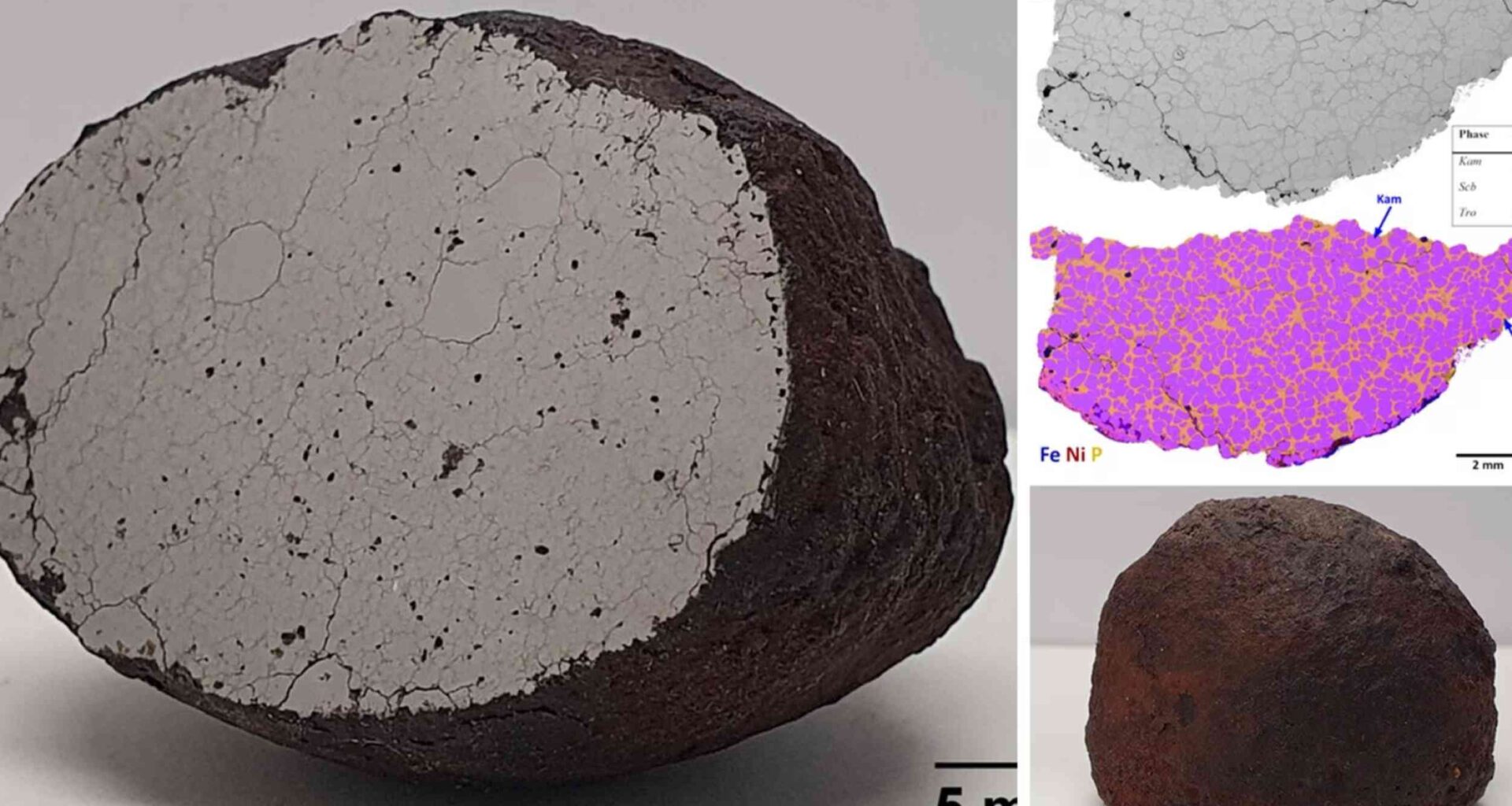
A polished slice of the Finnish meteorite exposed rounded metal grains locked within a thin, web-like matrix unlike typical iron meteorites.
Examining that structure, Laura Kotomaa at Åbo Akademi University documented phosphorus concentrated within the network that surrounds the metal grains.
Those phosphorus-rich regions form one of the meteorite’s dominant mineral components and account for its unusually high phosphorus content.
Understanding how such an extreme composition formed requires looking more closely at the minerals that build the meteorite’s internal structure.
Two minerals dominate
Most of the meteorite consisted of kamasite, an iron-nickel alloy common in iron meteorites, packed into rounded chunks.
Between those chunks sat schreibersite, a phosphorus-rich mineral made of iron and nickel, and it held most of the meteorite’s phosphorus in a brittle, net-like matrix.
Cutting and grinding split shiny granules from the schreibersite because the fragile matrix snapped easily.
Such a high share of schreibersite left the rock chemically extreme, and it narrowed the list of possible parent bodies.
Phosphorus breaks the mold
At the whole-rock level, the team’s analysis of the 2017 Finland find put phosphorus near 4.3% by weight, far above most irons.
Only seven other phosphorus-rich irons are known, and trace elements, tiny amounts of other elements in a rock, highlighted Löpönvaara’s odd fingerprint.
“In addition, Löpönvaara’s unique structure and trace element composition make it a particularly intriguing discovery,” said Kotomaa.
Because classification relies on shared chemistry, scientists labeled Löpönvaara ungrouped, not matching any established meteorite chemical family.
A core split
In the parent asteroid, molten metal likely separated as it cooled, leaving one layer far richer in phosphorus than another.
Geologists call that split liquid immiscibility, when one molten mix splits into two liquids, each holding different elements.
Phosphorus favored the denser melt and later crystallized as schreibersite, while nickel stayed moderate and sulfur remained unusually low.
That kind of chemical sorting suggests a core that cooled in stages, rather than freezing into a single, uniform metal.
Scars from impact
Cracks and crushed zones in the phosphorus-rich matrix showed that the meteorite did not cool gently inside a quiet core.
A collision could have reheated parts of the metal, then rapid cooling locked small grains in place before they grew larger.
Tiny patches of troilite, an iron sulfide mineral common in meteorites, sat at boundaries where shock can focus heat.
Because those scars come from later violence, they complicate efforts to read the meteorite as a simple snapshot of formation.
How rare types form
From the cores of small asteroids came iron meteorites, and they record how metal melted and separated early on.
A pallasite, a stony-iron meteorite with metal and olivine, forms near a core-mantle boundary in its parent body.
“Iron meteorites and pallasites are among the rarest types found on Earth, and they provide crucial insights into the composition and evolution of early planetary bodies,” said Kotomaa.
Löpönvaara fit that rare category, yet its phosphorus load pushed it into a part of space history scientists barely see.
Lieksa keeps producing
Searchers pulled Löpönvaara from eastern Finland near a place called Lieksa, about 400 yards from where the Lieksa pallasite was found.
Weeks earlier, the ungrouped Lieksa pallasite turned up in the same area, and it carried metal mixed with olivine.
Since then, many more metal-rich fragments have turned up, raising the chance that one body broke up overhead.
Without a confirmed link between the pieces, scientists must treat the cluster as a lead, not a solved case.
Why phosphorus stands out
On Earth, phosphorus usually sits inside phosphate, a phosphorus-oxygen form common in rocks, which dissolves slowly and limits chemistry.
In a lab experiment, schreibersite reacted with water-based liquids and produced reduced phosphorus that dissolves more easily.
With schreibersite making up a big share of Löpönvaara, the meteorite offered a test case for that kind of reaction.
Still, no one can assume this rock changed Earth life, because a rare find in Finland does not prove common delivery.
Next tests and searches
Linking Löpönvaara to the other metal fragments will require more than proximity, because similar-looking irons can come from different bodies.
Researchers will compare isotopes, atoms of an element with different weights, to see whether the Finnish pieces share one signature.
Careful sampling also matters, since weathering on the surface can smear chemical signals and hide the original metal pattern.
If the pieces truly match, scientists may be looking at a rare asteroid lineage, and Löpönvaara becomes its clearest witness.
What happens next
Löpönvaara showed how one small rock can hold layered-core chemistry, mineral fingerprints, and impact scars in a single slice.
Future matches to the Lieksa fragments could pin down the parent body, but the search depends on more finds and samples.
The study is published in Meteoritics & Planetary Science.
—–
Like what you read? Subscribe to our newsletter for engaging articles, exclusive content, and the latest updates.
Check us out on EarthSnap, a free app brought to you by Eric Ralls and Earth.com.
—–