
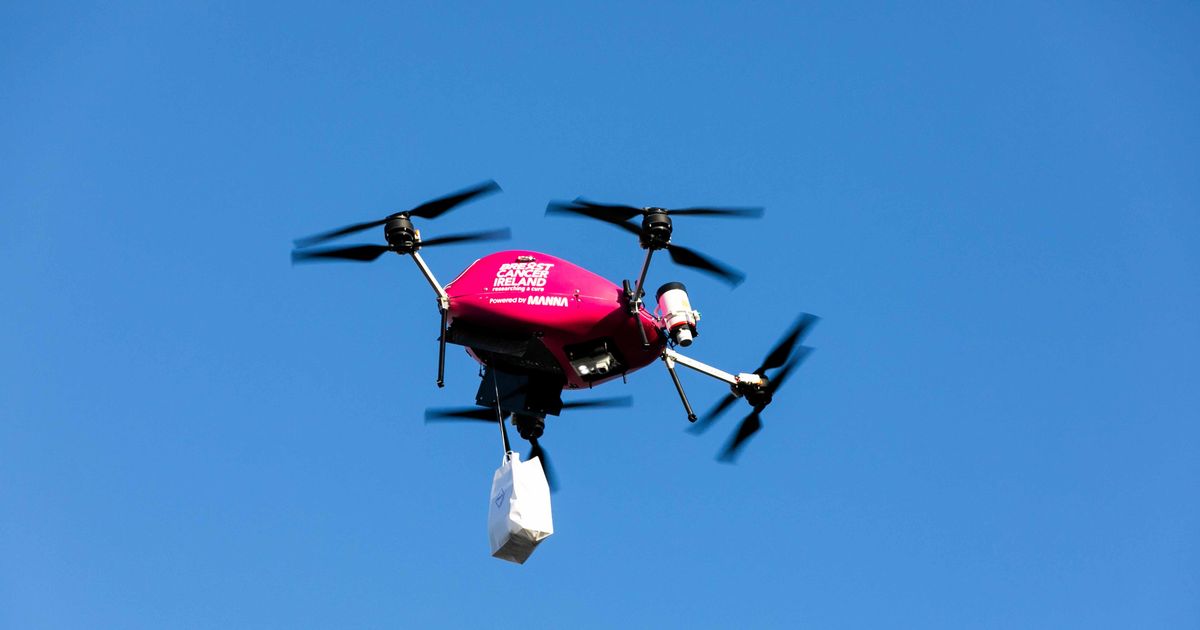
Since Manna confirmed they would be bringing their drone delivery service to the Rebel County, there has been a mix of excitement and trepidation here on Leeside. While many residents are keen to try out the novel service, concerns have been raised about noise levels and the restrictions placed on Cork’s airspace that allow these drones to operate safely.
The service has been up and running in Dublin since 2022, and they’re currently running tests here in Cork, with the service expected to open to the public by the end of the year. In Dublin, the group has faced criticism from local resident groups, who have lodged numerous complaints about the company’s operations over the years.
CorkBeo recently spoke with both Seamus Doyle, Chairman of Drone Action D15 and Bobby Healy, the Founder and CEO of Manna Air Delivery, to get an insight into the concerns raised by residents before the drone delivery service gets up and running here in Cork – as well as the company’s response.
Resident’s concerns
Seamus and Drone. Action D15 have been campaigning against Manna’s operations for several years. The group has repeatedly raised concerns about the noise levels emitted by the drones, with Seamus comparing them to a ‘higher-pitched petrol lawn mower’ flying overhead.
The group says the drones have impacted their quality of life, as with an average of 100 to 200 deliveries per day, those living along common flight paths hear dozens of drones overhead each day. The group says that on particularly busy summer days, they estimate up to 300 deliveries, which compounds the issue.
The campaigners say they are sceptical about Manna’s assessment of the noise levels, with a report commissioned by the company estimating that the drones can be heard for about 10 seconds while flying overhead in an urban area. The group contends that each flyover is audible for between 45 seconds and a minute.
The group also took issue with Manna’s noise measurements: while the company estimates that a flyover generates about 59dB, the group claimed to have measured noise levels of 64-66dB, dropping to 62-60dB after Manna installed quieter rotors.
While the differences seem minor, the decibel scale increases logarithmically, which means each point on the scale represents a notable jump. For example, a noise level of 59dB is equivalent to a normal conversation, while 66dB is about the noise level emitted by moderate traffic. Manna has strongly disputed the group’s claims about noise levels, as they were not conducted by independent professionals in a controlled environment.
Drone Action D15 also took issue with the fact that each delivery can involve a drone flying over hundreds of homes or provide a single food order or other small package to one household. Finally, the group has also called for greater engagement with the Government’s national drone strategy, which was published last year
Manna’s Response
Much of the criticism surrounding Manna’s operations in Dublin has focused on noise levels and disturbances to local residents along the flight path. While some level of noise is inevitable, Manna contends that the drone flyovers are brief and that the noise is not beyond what one would expect in a typical urban or suburban environment.
Manna provided CorkBeo with a report from Trinity College Dublin, which showed a single 65m flyover generated around 59 dBA and the final drop off – the noisiest phase of delivery – generates 66–68 dBA, although only for a brief period.
Manna has also sought to dispel any notion of them being a ‘coffee and takeaway’ delivery company, with CEO Bobby Healy describing the company simply as: a delivery service for all local businesses. The founder pointed to Manna’s success among Dublin butchers, who have used the service to send groceries directly to their customers, as well as the range of products available for delivery in the capital.
The company estimates that half its deliveries are food-related, with the rest a mixed bag of pharmaceuticals, books and other items.
The company is currently running test flights in Cork, and it’s estimated that the service will be up and running for up to 25,000 households within 3-6 months. It’s important to note that this is the best estimate the company can provide, rather than a definitive date.
In Dublin, Manna faced scrutiny from local authorities on planning grounds, with an enforcement order served over a drone hub the company had set up near the M50. Fingal County Council alleged that the hub had been erected in breach of the planning code and subsequently denied an application for retention of the site, forcing the company to remove the hub.
We asked the CEO if the people of Cork could be assured that Manna would fully comply with local planning laws as it expands into the Rebel County.
Bobby answered in the affirmative, commenting: “Everywhere we go, we’ve engaged with local councils, and we’ve had that discussion. The truth is – and this is where it gets very grey – there are no planning regulations that relate to drone delivery hubs, they simply don’t exist. Where we believe we’re doing something that requires planning permission, that is regulated, we get it.”
While no specific planning legislation exists to cover drone hubs because they are an emerging technology, Bobby said that Manna is committed to working with the cities they operate in, and that, until specific legislation covering drone delivery hubs is in place, they will work with local councils to regulate their operations.
Criticism has also been levelled at Manna following the implementation of new airspace regulations over Cork. Manna was mentioned by name in the Irish Aviation Authority’s press release announcing these restrictions, which are necessary for beyond-line-of-sight drone operations.
The restrictions are under the control of the IAA, not Manna, but local councillors have accused the company of ‘monopolising the airspace’ following the announcement.
Bobby described the restrictions as ‘traffic lights for drones’ and said that the rules are simple regulations that all operators should have no trouble following. He also disputed claims that securing permission to fly in the airspace is too onerous for everyday drone users and noted that several other companies have since applied and been granted permission to use the airspace.
In response to recent criticisms from hobbyist drone users and Drone Professionals Ireland, a spokesperson for Manna said: “Manna believes that regulated drone technology and aviation innovation should benefit all licensed and safety-approved operators and as Europe’s first holders of a Light UAS Operator Certificate (LUC), supports a coordinated national approach that enables sustainable growth for all licence holders.
“The company believes Ireland has the opportunity to position itself as a centre of excellence in advanced aviation. Manna supports the IAA in its full and consistent implementation of the European Union’s U-space regulatory framework, which formally commenced in January 2023, as the appropriate long-term structure for managing shared airspace.
“Manna is committed to working closely with all industry bodies which we are members of and independent operators to develop coordinated, practical solutions, and to collectively engage with the Irish Aviation Authority and AirNav Ireland to support fair, safe and efficient access to shared airspace while maintaining the highest safety standards.
“The company met with industry representatives earlier this week to progress this work. It also notes the IAA’s confirmation that emergency services retain absolute priority and that, across seven years of regulated operations in multiple locations, no licensed operator has been refused permission to fly in an area in which Manna was operating.”
Want to see more of the biggest and breaking stories from Cork Beo? Making us your preferred source on Google means you’ll get more of our exclusives, top stories and must-read content straight away. To add Cork Beo as a preferred source, simply click here.