
THIS CONTENT IS ONLY AVAILABLE TO INC42 PLUS MEMBERS
×

Become A Startup Insider With Inc42 Plus
Join our exclusive community of business leaders
&makers
for in-depth tech stories and intelligence on India’s tech economy you won’t
find
elsewhere.

Unlimited Access
Unlock unlimited access to 500+ monthly new stories and Inc42’s complete archive of 40,000+ stories.

Inc42 Academy
Exclusive, in-depth and actionable sessions from 300+ industry leaders, founders & operators to help you level up.

Startup Deals
Over $250,000 worth deals on software & tools to help your business scale up.

Member-Only Events
Connect with editors and industry peers through our members-only community

Clutter-Free Experience
Enjoy an ad-free and clutter-free
experience as a member, focus on
what really matters to you

Support Independent Journalism
Your contribution will go on to
support and empower our unbiased
& data-driven journalism
THIS CONTENT IS ONLY AVAILABLE TO INC42 PLUS MEMBERS
×
Become A Startup Insider With Inc42 Plus
Join our exclusive community of business leaders
&makers
for in-depth tech stories and intelligence on India’s tech economy you won’t
find
elsewhere.
Choose Your Plan
3 YEAR PLAN
₹222/Month
Cancel Anytime
2 YEAR PLAN
₹249/Month
Cancel Anytime
1 YEAR PLAN
₹291/Month
Cancel Anytime
Inc42 Academy Is Exclusive For Inc42 Plus Members
×
Join Us In Celebrating 5 Years Of Inc42 Plus!
Unlock special offers and join 10,000+ founders, investors & operators staying ahead in India’s startup economy.
3 YEAR PLAN
₹222/Month
Cancel Anytime
2 YEAR PLAN
₹249/Month
Cancel Anytime
1 YEAR PLAN
₹291/Month
Cancel Anytime
Back in the 2000s, India’s startup ecosystem was far from attracting global attention. Venture capital was poorly understood, exits were rarely heard, and setting up a startup often triggered frowns of disbelief. Risk capital was scarce, networks fragmented, and institutional support was abysmal. Angel investing was a niche pursuit then.
Cut to the present day. India is today home to more than 2 Lakh DPIIT-recognised startups, employing over 20 Lakh people. The ecosystem has expanded over 404 times since 2016, propelled by policy tailwinds, deeper pools of capital, and a steady cultural shift that has made entrepreneurship a legitimate career path.
This scale wasn’t pulled off overnight. It was built patiently, often quietly, by early believers who brought up what was once a wobbly industry into the world’s third-largest startup economy, mobilising more than $11 Bn of investor wealth in 2025 alone.
Much of this infrastructure did not appear overnight. It emerged gradually through incubators, accelerators and early networks that attempted to formalise what had previously been fragmented. Dr Apoorva Ranjan Sharma was part of that early wave of ecosystem builders.
In 2002, Sharma set up one of India’s first formal incubation initiatives, JSS Technology Business Incubator, in Noida. A decade later, in 2012, he launched Venture Nursery, widely regarded as India’s first structured accelerator. Three years later, he cofounded Venture Catalysts, a distributed angel network that pooled capital, standardised diligence and brought mentorship on a shared platform.
When 100Unicorns came up in 2019, it was a $70 Mn early stage accelerator fund aimed at institutionalising seed capital at scale. Now the managing director of 100Unicorns, Sharma heads India’s largest accelerator VC fund and mentors very early stage startups. His company has so far funded 145 startups and helped unfurl category leaders like Shiprocket, VideoVerse, Zypp Electric, Renee Cosmetics, Assiduus, Homeville, TruNativ, Rezolv.AI, OTO Capital, Klub, Wiom, DrinkPrime, LeverageEdu, Prescinto and Rooter.
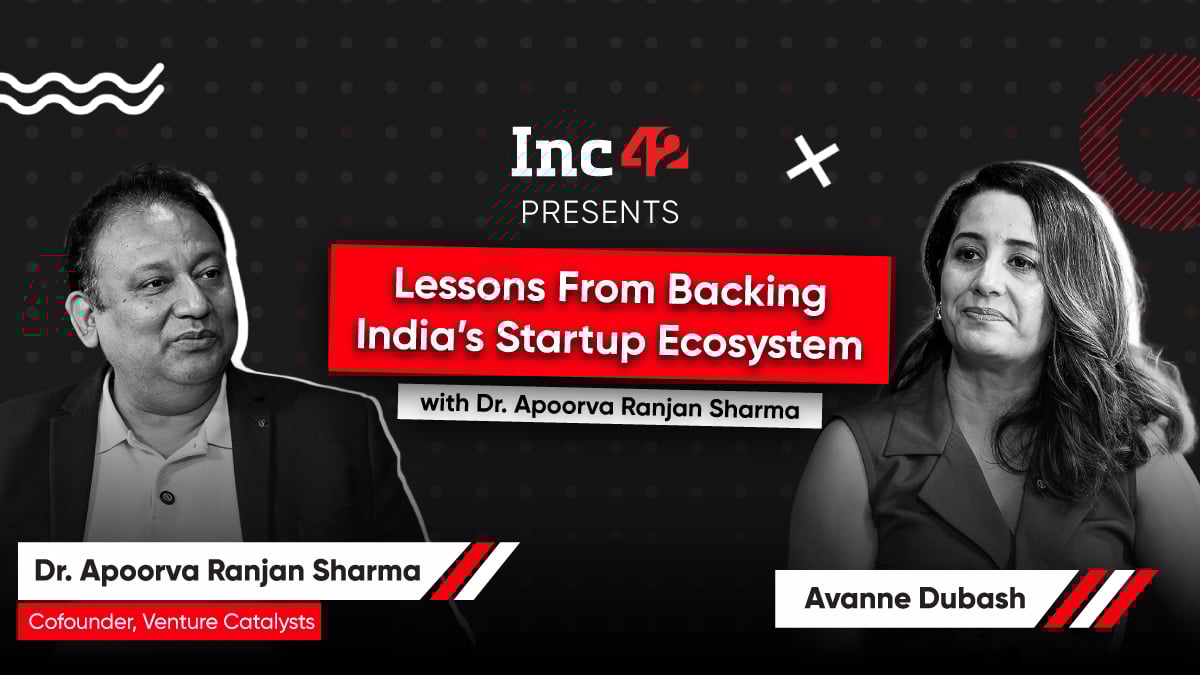
Inc42 recently caught up with Sharma to find out whether there was anything he would have done differently. Sharma was emphatic: “I wouldn’t do anything else. I love backing entrepreneurs. I have no regrets.”
In a candid conversation, he talked of his journey from setting up one of India’s earliest incubators to building one of the country’s largest early stage investment platforms. He shared how he would convince professionals to take the startup plunge when few understood the term.
span {
margin: 0;
padding: 3px 8px !important;
font-size: 10px !important;
line-height: 20px !important;
border-radius: 4px !important;
font-weight: 400 !important;
font-style: normal;
font-family: noto sans, sans-serif;
color: #fff;
letter-spacing: 0 !important;
}
.code-block.code-block-55 .tagged {
margin: -4px 0 1px;
padding: 0;
line-height: normal;
}
@media only screen and (max-width: 767px){
.code-block.code-block-55 {
padding:20px 10px;
}
.code-block.code-block-55 .recomended-title {
font-size: 16px;
line-height: 20px;
margin-bottom: 10px;
}
.code-block.code-block-55 .card-content {
padding: 10px !important;
}
.code-block.code-block-55 {
border-radius: 12px;
padding-bottom: 0;
}
.large-4.medium-4.small-6.column {
padding: 3px;
}
.code-block.code-block-55 .card-wrapper.common-card figure img {
width: 100%;
min-height: 120px !important;
max-height: 120px !important;
object-fit: cover;
}
.code-block.code-block-55 .card-wrapper .taxonomy-wrap .post-category {
padding: 0px 5px !important;
font-size: 8px !important;
height: auto !important;
line-height:15px;
}
.single .code-block.code-block-55 .entry-title.recommended-block-head a {
font-size: 10px !important;
line-height: 12px !important;
}
.code-block.code-block-55 .card-wrapper.common-card .meta-wrapper .meta .author a, .card-wrapper.common-card .meta-wrapper span {
font-size: 8px;
}
.code-block.code-block-55 .row.recomended-slider {
overflow-x: auto;
flex-wrap: nowrap;
padding-bottom: 20px
}
.code-block.code-block-55 .type-post .card-wrapper .card-content .entry-title.recommended-block-head {
line-height: 14px !important;
margin: 5px 0 10px !important;
}
.code-block.code-block-55 .card-wrapper.common-card .meta-wrapper span {
font-size: 6px;
margin: 0;
}
.code-block.code-block-55 .large-4.medium-4.small-6.column {
max-width: 48%;
}
.code-block.code-block-55 .sponsor-tag-v2>span {
padding: 2px 5px !important;
font-size: 8px !important;
font-weight: 400;
border-radius: 4px;
font-weight: 400;
font-style: normal;
font-family: noto sans, sans-serif;
color: #fff;
letter-spacing: 0;
height: auto !important;
}
.code-block.code-block-55 .tagged {
margin: 0 0 -4px;
line-height: 22px;
padding: 0;
}
.code-block.code-block-55 a.sponsor-tag-v2 {
margin: 0;
}
}
]]>
Building The Rails Of Early Stage Startups
After working in Europe, Sharma returned to India in 2002 without a ready blueprint. What he found was an absence of institutional support for founders. “We had to convince professionals that it was okay to do a startup. The word itself was not glamorous,” shared Sharma.
He set up the JSS Technology Business Incubator the same year, with backing from the Department of Science and Technology. Spread across 20,000 Sq Ft, the incubator initially struggled to attract founders, but within a year, the centre became a reference model for similar facilities across emerging markets and received the National Award for Best Technology Incubator from the President of India in 2005.
“Incubator was also a new concept in India then. A lot of people started reaching out to me, saying they also wanted to set one up. Many large university owners approached us. Amity, for instance, came to us after that, and that became my second incubator, which later led to the making of Amity University.”
By 2012, Sharma launched Venture Nursery, one of India’s first structured accelerators. During that time, one of the earliest cohorts included a teenage founder pitching an Airbnb-like platform for India. That was Ritesh Agarwal of OYO. “He was highly passionate and highly mentorable,” Sharma said.
“OYO became one of the largest travel tech companies within three years. SoftBank invested in it and that paved the way for a 250 times exit for the angels who had backed the company at an early stage. That’s when we realised that, yes, you could actually make money from backing startups.”
Sharma set up Venture Catalyst in 2015 as a distributed angel network that today stands as one of India’s largest angel growth funds. Across funds and networks, more than ₹2,000 Cr has been deployed into startups, backing 11 unicorns and over 50 soonicorns. The combined portfolio valuation exceeds $15 Bn.
There are three non-negotiables that Sharma looks for in a founder. These are hunger, scale and integrity. He looks for founders who are driven to build very large companies, not lifestyle businesses, and who show a deep hunger for success. Just as important, he said, is integrity.
“I invested in a company called Beardo. The founder’s integrity was so strong that we invested just half a million dollars and gave him a term sheet, introducing him to many angels and large family offices in our network. Suddenly, one large family office offered them $1 Mn. At that time, the market was not very structured and legal agreements were not always binding in spirit. But he refused and informed us. That’s when we realised his integrity was very, very high. So we decided we should back him multiple times, and in his next venture, Rene Cosmetics, I put in the first cheque,” he recalled.
Red flags, he said, are often visible early. Founders juggling multiple ventures without clear focus, impressive pitch decks with weak execution plans, and poor chemistry within founding teams are among the biggest concerns. “Most companies die because of founder conflicts,” Sharma noted.
India Needs Capital, Risk Appetite, And Systems
When it comes to risk capital, Sharma believes the country is still under-allocated globally. Of the roughly 22,000 VC funds worldwide, the bulk of capital remains concentrated in the US, with China coming close. Asia, and India within it, receives a fraction of that allocation. “You cannot build $100 Bn companies without $1-$3 Bn of capital behind them,” Sharma said, citing the examples of Chinese tech giant ByteDance and America’s SpaceX.
For India to produce more decacorns and global technology leaders, he said, the capital base needs to expand at least 10 times. That means attracting more global funds, encouraging domestic capital to participate and building confidence through predictable exit pathways.
“Billions of dollars have been returned to global investors through companies like Paytm and Zomato. They are seeing, every quarter, a growing number of startups going for IPOs. The exit corridor created allows global investors to enter, invest in Indian startups, and then exit through public markets. That is boosting their confidence. In my view, this is one of the biggest developments in the Indian startup ecosystem over the last five years,” Sharma noted.
But capital alone is not enough. Governance, Sharma insists, is the other missing pillar. Recent high-profile startup controversies have dented trust between founders and investors. While commercial losses are part of venture investing, breaches of governance erode the ecosystem’s credibility.
“Individuals fail. The system makes it successful. Have systems in place,” he said, advocating mandatory governance workshops for founders once they reach meaningful scale. Many compliance lapses, he believes, stem from ignorance rather than intent, but that does not diminish their impact.
The final shift India needs, according to him, is cultural. Entrepreneurship is now celebrated in middle-class households in a way unimaginable two decades ago. The next step is to normalise failure. In mature ecosystems, founders fail, regroup and build again. In India, failure still carries the stigma. “If we want a thousand-unicorn economy,” Sharma said, “we have to build the systems that allow people to fail, learn and scale again.”