
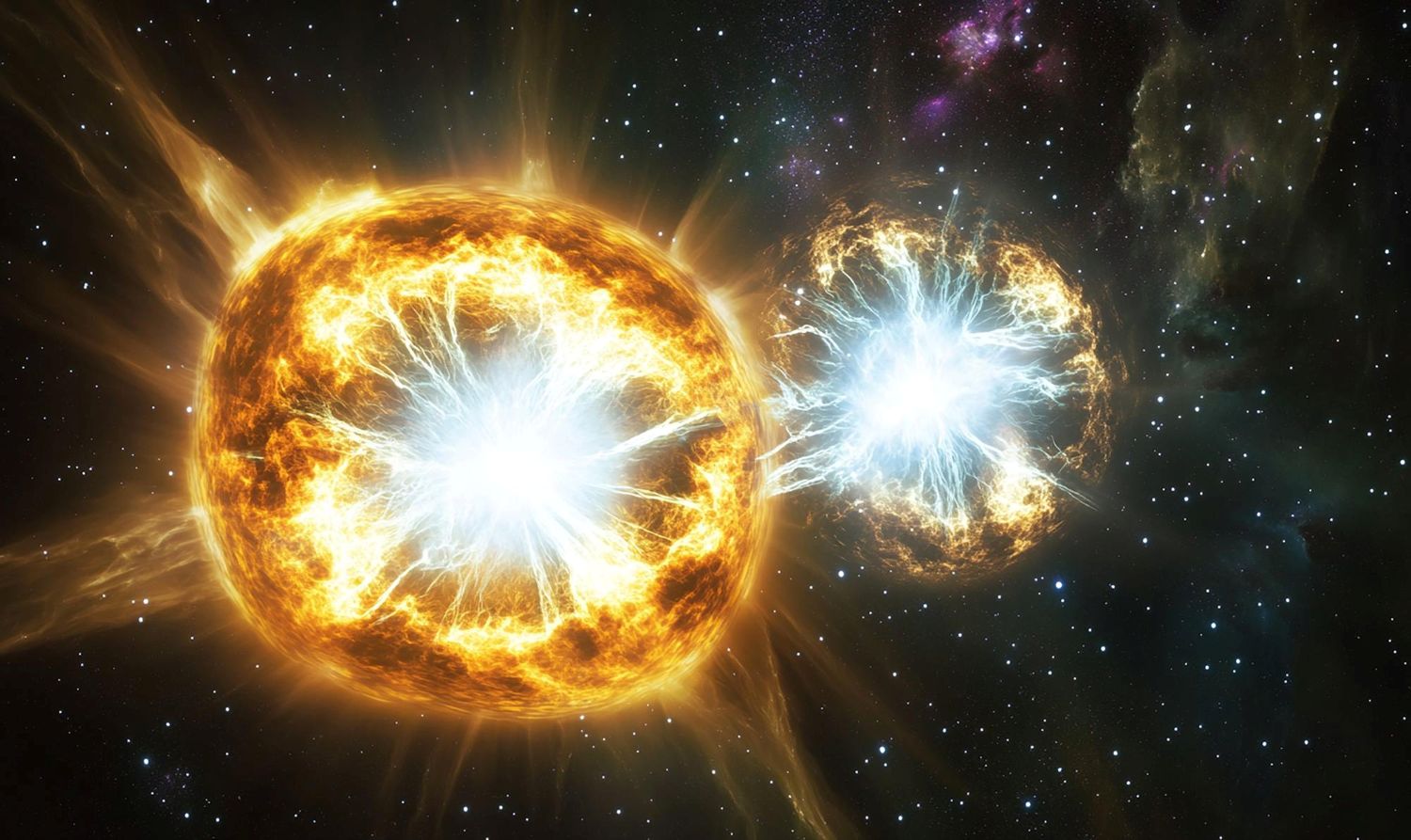
Neutron stars are like cosmic laboratories. Born from collapsed stars, they’re packed so tightly that a teaspoon of their material would weigh billions of tons. They’re so heavy, gravity is unmatched only by black holes.
But what’s inside them is still a mystery. To glimpse the hidden cores of these stellar corpses, scientists are now listening to the faint ripples they send sweeping across space: gravitational waves, created when two neutron stars in close orbit spiral into one another.
Some theorists believe these stars may hold a rare state of matter called quark-gluon plasma, a super-dense soup of the particles that make up protons and neutrons. It’s the same kind of matter that existed for a fleeting moment after the Big Bang.
On Earth, the only way to create quark-gluon plasma is by smashing particles together at incredible speeds inside giant colliders. These experiments reach extreme temperatures, but they can’t explore what happens at lower temperatures.
That’s where neutron stars come in. We can’t bring them into a lab, so physicists have to study them from afar. For a long time, the only clues came from light, electromagnetic signals. But now, with the rise of gravitational-wave astronomy, scientists have a new tool. By listening to the ripples in spacetime made when two neutron stars spiral together, they may finally be able to peer into the mysterious heart of these cosmic giants.
Physicists from the University of Illinois Urbana-Champaign, working with colleagues in California, Montana, and India, have made a big breakthrough in understanding neutron stars. They studied what happens when two of these stars spiral toward each other and tug on each other with tidal forces.
The team showed that the way neutron stars respond to these tidal pulls can be explained by their natural vibrations, or ‘modes.’ This extends a result known in simple Newtonian gravity to the more complex world of relativity. In other words, they’ve found a new way to describe how neutron stars behave under extreme conditions, bringing us closer to uncovering what they’re really made of.
Neutron stars tend to make binary pairs, existing in a slow spiral dance as they edge closer to each other. As they expend energy through gravitational waves, each star tugs on the other with immense tidal forces.
Abhishek Hegade, a physicist now at Princeton, explains: “As they get closer, tidal forces from one star begin to deform the other and vice versa. The amount of deformation depends on what’s inside the stars.”
These deformations produce vibrations, like striking a bell and listening to it ring. The stars pulsate, and this has an effect on the gravitational waves they radiate. With sensitive detectors on Earth, scientists can “listen” to those patterns and start to uncover the secret makeup of neutron stars.
In order to fully decode the signals hidden in gravitational waves, scientists must understand how neutron stars behave when they spiral together and feel tidal forces. The hitch is that these forces evolve quickly over time, particularly during the last moments before the stars collide.
In the simpler world of Newtonian physics, the answer is neat: the tidal response can be described entirely in terms of oscillations, or ‘modes,’ which behave like damped springs. This forms a complete set; nothing more is needed.
Physicists have long hoped the same would hold for neutron stars in Einstein’s theory of relativity. But neutron stars are extreme: incredibly dense, moving at nearly 40% the speed of light, and warping spacetime around them. The complexity of Einstein’s equations has made it very difficult to prove whether a complete set of modes can also capture their tidal responses.
Studying neutron stars in pairs is tricky. Because two stars are tugging on each other, it’s hard to separate the effects of one from the other. That makes the math messy; the equations don’t line up neatly with the boundary conditions needed for a complete set of modes to appear.
Massive neutron stars likely to have a strange quark matter core
Lead author Abhishek Hegade explains: “A star’s own gravity changes the equations inside and outside of itself. This doesn’t happen in Newtonian gravity, where everything is treated like a vacuum. To understand the tidal response, you need to know the tidal field both inside and outside the star.”
On top of that, neutron stars lose energy through gravitational radiation, something Newtonian theory doesn’t account for. If energy is leaking away, the modes can’t be complete, which means you can’t fully describe the star’s behavior just in terms of those oscillations.
To tackle these hurdles, the team broke the problem into simpler pieces. They focused on one star at a time, treating its partner as the source of tidal forces. Using a set of linearized Einstein-Euler equations, they divided the star’s environment into two regions: a strong-gravity zone deep inside, and a weaker-gravity zone outside. This clever approach provided them with a way to apply the appropriate boundary conditions and search for a complete set of modes.
Hegade elaborated, “Physically, it’s a very intuitive way to conceptualize the system. Inside the star as well as near its surface, gravity is strong. But far away, gravity is weak.
“This process is called a matched-asymptotic expansion, where you zoom in at different scales and then find approximate solutions. Finally, you stitch the solutions together to get something uniform across all scales.”
By breaking the system down this way, the researchers could apply the right boundary conditions step by step. Importantly, including the weak-gravity zone allowed them to subtract out radiation effects, treating them as small corrections.
“Our near-zone decomposition ensured that we accounted for the tidal field,” Hegade said. “By restricting to the near zone, we took care of radiation by subtracting it out. This gave us a complete set of modes.”
The researchers also figured out how to describe the tidal field inside a neutron star. By carefully working with the Einstein-Euler equations, they realized the internal tidal field could be treated as the driver of the star’s vibrations. As long as the tidal field changes smoothly, without sharp jumps, the math produces harmonic-oscillator modes, just like in Newtonian physics.
With this, they achieved their goal: a complete set of modes for neutron stars.
Hegade summed it up: “We showed two major things. First, we were able to subtract off radiation, proving that a neutron star’s modes do form a complete set. Second, we found that if you solve the equations consistently with a smooth tidal field, you can describe the star’s interior in general relativity just as you can in Newtonian gravity.”
The researchers are now eager to see what their new framework might unearth.
Yunes explained that one of the big hopes is to uncover what neutron stars are made of finally. Do they hide a quark core deep inside? Are there strange phase transitions happening in their dense interiors that we haven’t discovered yet?
But for the moment, those answers elude. The two gravitational-wave signals detected by LIGO in 2017 weren’t strong enough to expose the fine details that the group’s model predicted. And current detectors also miss out on the higher frequencies, where much of the information about neutron-star vibrations exists.
The positive sign is that next-generation detectors are coming online. As they switch on over the next few years, and with some luck in detecting close encounters of neutron stars that then collide, scientists hope to finally snag the sharper signals needed to investigate the murky interiors of these enigmatic stars. For now, physicists have time to get ready for the next generation of detectors.
Yunes’s team already has its sights set: their existing model simply deals only with non-rotating stars, but most neutron stars spin at a breakneck pace, so they hope to extend their approach to take rotation into account. They also plan to test their framework against more challenging tidal forces, and add other fields, animal or magnetic.
The hardest part, though, is already solved. As Hegade put it: “The nice thing about our new framework is that we’ve figured out the hard part, gravity. Now it’s just a matter of applying our models to more realistic configurations.”
Journal Reference:
Abhishek Hegade K. R. et al, Relativistic and Dynamical Love Numbers, Physical Review Letters (2026). DOI: 10.1103/1wdp-6×27