
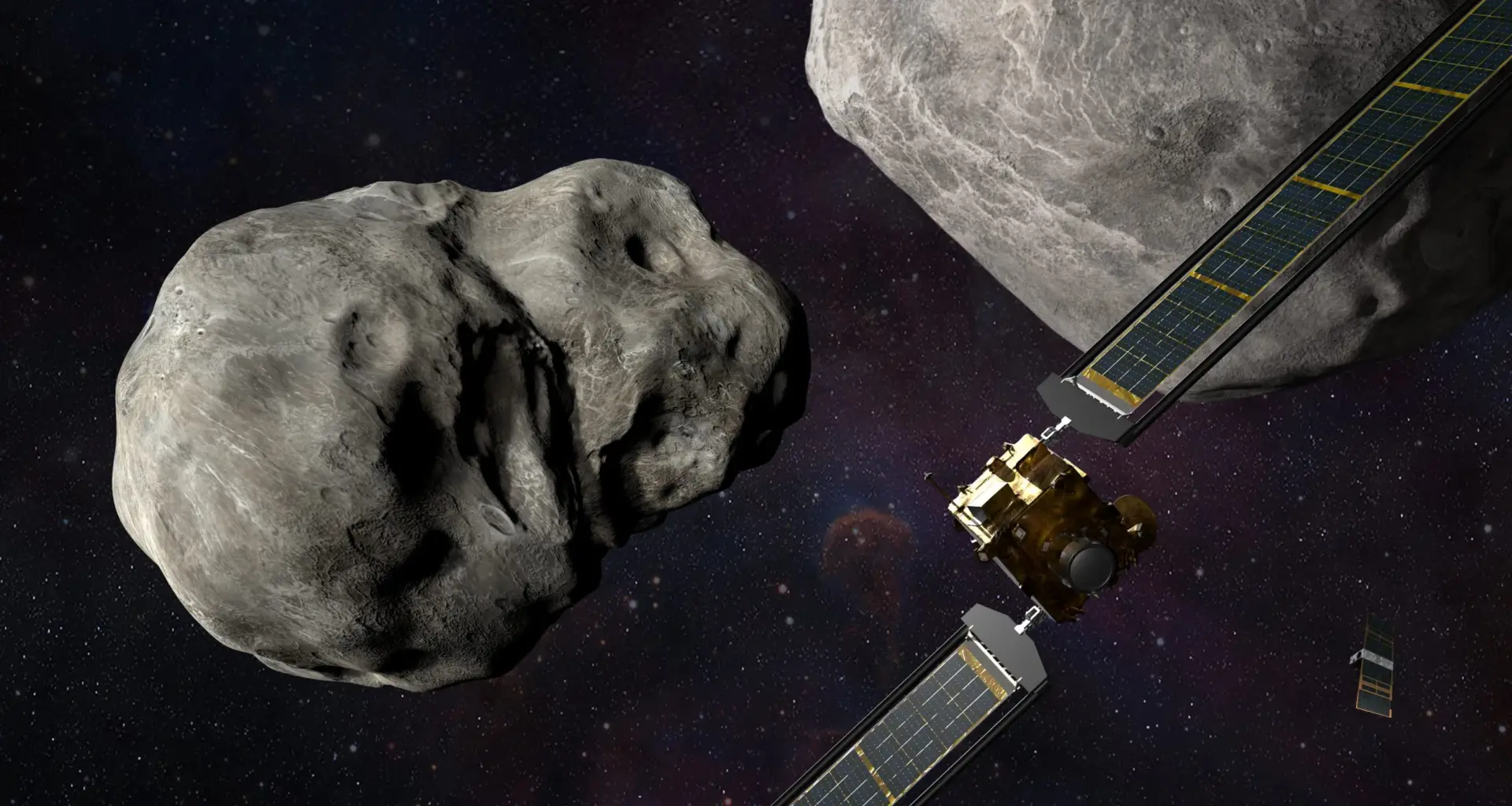
Around 15 percent of near-Earth asteroids have small moons, which suggests binary systems are fairly common. Many of the larger asteroid pairs have likely formed via collisions in the main belt; however, smaller ones, such as near-Earth binaries and the asteroid Dinkinesh, originated through a different process: YORP.
This gradual change in the rotation of the object, impacted mainly by sunlight, is known as the YORP effect. Over eons, this can ramp up the asteroid’s spin rate so high that it sheds material, sometimes giving rise to a moon. These spin alterations have been observed directly from the ground and from spacecraft.
Evidence for this process includes radar measurements of asteroid shapes, the ridges observed on Ryugu and Bennu by Hayabusa2 and OSIRIS-REx, and, most recently, material transfer between Didymos and Dimorphos. Taken together, these findings highlight the effect sunlight has as a sly yet influential sculptor of small asteroids.
A team led by the University of Maryland has found that binary asteroid systems are much more active than previously realized. Instead of staying still, these paired asteroids slowly trade rocks and dust in gentle collisions that reform them over millions of years.
NASA’s DART mission, which intentionally collided with Dimorphos in 2022, provided the first close-up views of such a system. When scientists looked at the images, they saw bright, fan-shaped streaks covering Dimorphos’ surface, providing the first direct evidence of material moving naturally from one asteroid to another.
Not only does this discovery change the way we think about binary asteroids, but it’s also an important factor to consider when thinking about potentially hazardous asteroids and how best to prepare for them running amok in our neighborhood of space.
Lead author Jessica Sunshine explained, “At first, we thought something was wrong with the camera, or maybe with our image processing. But once we cleaned things up, the patterns looked exactly like low‑velocity impacts, like tossing ‘cosmic snowballs.’ It was the first direct proof of material moving between asteroids in a binary system.”
DART was the NASA spacecraft that smashed into Dimorphos, Didymos’s smaller moon, to see whether its orbit could be changed. The strike had the intended effect, shortening Dimorphos’ orbital period by about 33 minutes, a change confirmed by telescopes on Earth.
The spacecraft’s targeting camera, DRACO, took its highest-resolution images ever of Dimorphos before impact. Those images unexpectedly revealed faint, discontinuous rays across the surface and offered new insights into how binary asteroids exchange material.
The primary asteroid, Didymos, has features indicating the YORP effect spun it up, and its equatorial bulge and landslide evidence indicate sunlight is very slowly increasing its rotational velocity.
Jessica Sunshine said this spin-up likely resulted in the formation of Dimorphos, its smaller moon, and traces of “cosmic snowballs” seen on Dimorphos’ surface, similar to giant hailstones left behind when a thunderstorm dissipates, which lends support to that hypothesis.
Identifying those traces proved challenging. The original images taken by the DART spacecraft did not reveal them. It took months of painstaking work by UMD scientist Tony Farnham and former postdoc Juan Rizos, who devised new methods for removing shadows and lighting artifacts. When they did, the pale fan-shaped streaks appeared as a visual signature of the unexpected debris trails left behind as it tracked from Didymos to Dimorphos.
“We ended up seeing these rays that wrapped around Dimorphos, something nobody’s ever seen before,” Farnham said. “We couldn’t believe it at first because it was subtle and unique.”
As the spacecraft moved closer and kept a constant light and perspective on Dimorphos, it remained to be determined whether those streaks were true features or optical illusions. To confirm this hypothesis, the team tracked the marks to a particular area at the edge of that asteroid moon, out of alignment with where sunlight would register at its zenith overhead. This confirmed the streaks were real, not just artifacts.
“As we refined our 3D model of the moon, the fan-shaped streaks became clearer, not fainter,” said Tony Farnham. “It confirmed to us that we were working with something real.”
Until now, scientists had indirect evidence that sunlight might spin small asteroids up to the point where they would steam off material. The University of Maryland, the same team that produced the refined models for Dimorphos, actually offered the first visual confirmation of this process, including pinpointing where the sprinkled material from Didymos had settled.
The debris drifted at only 30.7 centimeters per second, slower than walking speed, a primary reason for the characteristic fan-shaped deposits observed (calculations conducted by UMD alumnus Harrison Agrusa).
“That would explain the distinctive fan-shaped marks,” Sunshine said. “Instead of even spreading, these slow-moving impacts would create a deposit rather than a crater. And they are centered on the equator as predicted from modeling material spun off the primary.”
Their theories were supported by a series of experiments, the researchers report. To bring their ideas to life, the researchers conducted laboratory simulations of asteroid impacts. They dropped marbles into sand mixed with painted gravel to simulate the boulders on Dimorphos.
High-speed cameras tracked how the boulders obstructed some particles and let others through, creating ray patterns similar to those seen on the asteroid’s surface.
Computer simulations at Lawrence Livermore National Laboratory confirmed the experiments. Whether the body that hit us was a solid rock or a loose pile of dust, the boulders inevitably molded the debris into streaks like fans.
“We could see these marks on Dimorphos from the DART spacecraft footage right before the collision,” said Jessica Sunshine. “It was proof of material exchange between Dimorphos and Didymos. The deposits should extend to the side of the moon we didn’t hit, and there’s a chance they survived the impact.”
Journal Reference:
J. M. Sunshine, J. L. Rizos, O. S. Barnouin, R. T. Daly, C. M. Ernst, T. L. Farnham, H. F. Agrusa, E. Wright, S. E. Wiggins, M. Bruck Syal, A. M. Stickle, J. M. Pearl, C. D. Raskin, and K. M. Kumamoto. Evidence of Recent Material Transport within a Binary Asteroid System. The Planetary Science Journal. DOI 10.3847/PSJ/ae3f27