

Here at Top Comments we strive to nourish community by rounding up some of the site’s best, funniest, most mojo’d & most informative commentary, and we depend on your help!! If you see a comment by another Kossack that deserves wider recognition, please send it either to topcomments at gmail or to the Top Comments group mailbox by 9:30pm Eastern. Please please please include a few words about why you sent it in as well as your user name (even if you think we know it already :-)), so we can credit you with the find!
Tonight’s report is interesting both because of the method used to perform measurements and for the explanation used to interpret the results.
First, the measurements. The measurement of gravitational waves made a big splash in 2016 when the LIGO detectors in Louisiana and Washington State, just days after they went on line, detected the gravitational wave from the merger of two black holes. However, the sophisticated strategy used by the LIGO detectors is not the only was to detect the presence of gravitational waves, and further, while the LIGOs are good at detecting high frequency gravitational waves (like those produced as two closely spaced black holes spiral toward each other), they’re no good at detecting low frequency gravitational waves of the sort that are emitted from a black hole binary pair that are much further apart.
So how can one detect gravitational waves? By closely monitoring and comparing the periods of a large array of pulsars spread around our galaxy and others nearby, and look for variations in their periods. A pulsar is a rapidly spinning neutron star, which acts like a lighthouse in that pulses with an extremely constant period, on the order of milliseconds, is observed. However, very small variations in these periods are observable, and the cause of these variations is the stretching and squeezing of spacetime as a gravitational wave passes between the pulsar and the Earth. This is called a pulsar timing array (PTA), and astronomers pursuing this technique have acquired 15 years-worth of data. By continuous precise observation of these variations over the entire array of pulsars, it is possible to deconvolute the data into gravitational wave frequencies that are due to the orbital dynamics of supermassive black holes in the centers of galaxies (which are the only sorts of systems that would produce gravitational waves of sufficient amplitude to be observable).
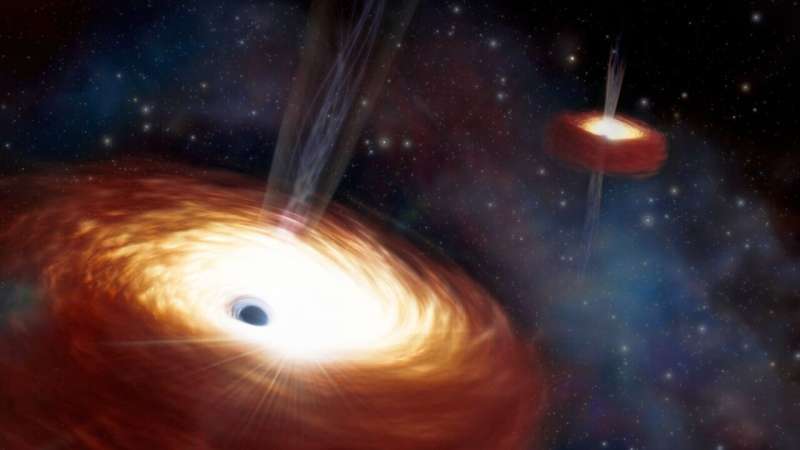
So what did they find? Theoretical simulations of orbiting binary supermassive black holes have been performed, and the data from this study match quite well except in the low-frequency region, that is, when the black holes are fairly far apart. The data suggest that the actual binary pairs are losing energy and merging faster at these greater distances than theory predicts. Why? In the theoretical study, it is assumed that the only mechanism for the binary pair to lose energy is by radiation of gravitational waves. But in galactic centers, there’s a whole lot of other stuff going on, as galactic centers tend to be quite dense, relative to the rest of outer space. By their nature, black holes capture into orbit lots of passing objects, such as stars and roaming planets. However, in the many-body dynamics that occur under these circumstances, such objects can be passed between the two black holes, and ultimately be shot out of the system in what is called a slingshot effect. Simulations of binary supermassive black holes with additional bodies orbiting them show that those those slingshot bodies carry away enough energy to account for the low-frequency discrepancy.
Comments are below the fold.
Top Comments (March 5-6, 2026):
From zenbassoon:
In DRo’s diary about the firing of Kristi Noem, kamachanda makes a comment that is Colbert or Weekend Update worthy.
Highlighted by peregrine kate:
This comment by Soaked Ferret in jwpeace’s recommended post on 911 calls in rural parts of the country.
Top Mojo (March 4, 2026):
Top Mojo is courtesy of mik! Click here for more on how Top Mojo works.
Top Mojo (March 5, 2026):