
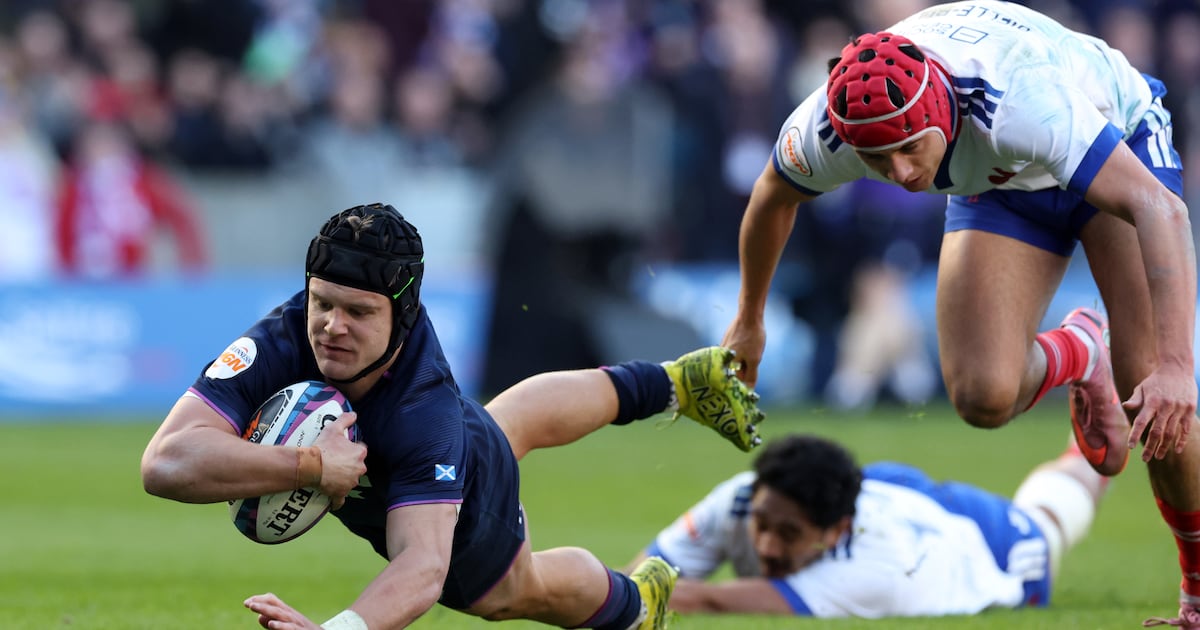
When will we ever learn? As in learn not to rush to judgment after just one round. Recall way back in time – well, a mere four weeks ago – when all three Celtic nations lost on the opening day for the first time since 2000. Warnings followed about the championship being on the road to perdition. It was becoming a two-tier affair, with France and England a cut above the rest.
After Ireland had been beaten 36-14 in the Thursday night opener at the Stade de France and Scotland lost 18-15 to Italy in the Stadio Olimpico, what were the odds, one wonders, of the two Celtic rivals being in the title picture when kicking off at the Aviva Stadium next Saturday (kick-off 2.10pm)?
Most likely, no one even considered it a possibility. Coupled with heavy defeats for the Ireland Under-20s against their French counterparts and an even more chastening defeat for an Ireland XV team against England A, the country’s entire rugby system and pathway was being called into question, along with dire warnings of impending doom and gloom.
Meanwhile, the clamour for Gregor Townsend’s head on a stick was growing louder in Scotland after the defeat in a sodden Rome compounded an anti-climactic autumnal campaign.
Fast-forward a month and both Ireland and Scotland have won three games on the spin to set up the opening game of Super Saturday. The winner of that game will lift the Triple Crown trophy and become clubhouse leader of the Six Nations while then requiring some kind of favour from England.
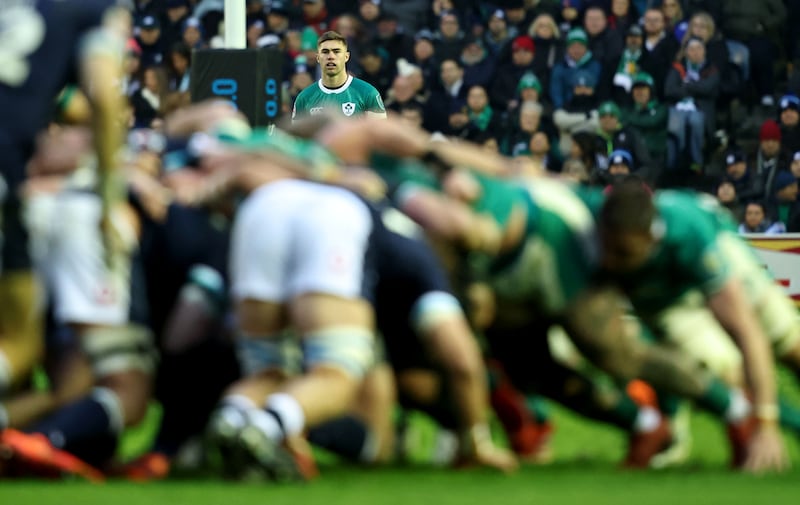 Ireland’s Jack Crowley looks on as both teams slog it out in the scrum during last year’s Six Nations match between Scotland and Ireland at Murrayfield. Photograph: Dan Sheridan/Inpho
While there will be a third successive World Cup pool meeting between Ireland and Scotland next year, never has there been so much at stake for both teams in a championship clash since the Six Nations came into being. The organisers are fortunate that a trophy presentation is guaranteed after the full-time whistle at the Aviva Stadium.
Presumably, the championship trophy will be in Paris. Table-toppers France have the same points tally as Scotland, with 16 each, but Fabien Galthié’s team have a vastly superior points difference. Ireland are third in the standings, two points farther back.
 Are Scotland primed to finally beat Ireland?
France have a significant advantage in kicking off last against England (8.10 Irish time) and thus knowing exactly what will be required of them. Despite last Saturday’s remarkable 50-40 loss in Murrayfield, they remain 2/9 favourites to win the title. Ireland’s odds have shortened to 7/1 and Scotland are 15/2.
Either way, it makes for a long, logistically challenging day, not least for the winning team at the Aviva Stadium. The tournament organisers, sponsors and TV rights holders will want some kind of presentation at the conclusion of business in the Stade de France – whether there or at the Aviva.
There is a certain schadenfreude in knowing the only team unable to win a trophy across both games in Dublin and Paris is England. When they beat Wales 48-7 on the opening Saturday of the championship, to register their 12th win in succession, it was seen almost as a fait accompli that this Saturday’s final game would be a Grand Slam shootout, never mind a title decider.
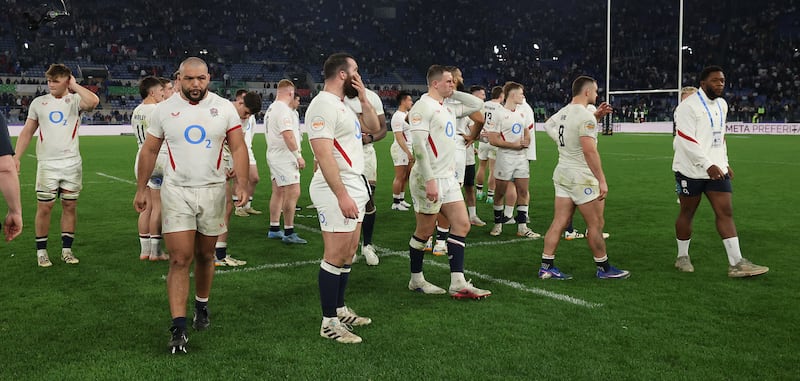 Shocked England players after last Saturday’s Six Nations defeat to Italy in Rome. Photograph: David Rogers/Getty Images
Of course, in all of this, England are being hoisted by their own petard, for even when announcing his Six Nations squad in January, their head coach Steve Borthwick was eyeing up the finale in such a manner.
“On March 14th in Paris, we want to be in a position entering that game where we can achieve what we’re all aiming to achieve. We want England fans flooding across the Channel to watch the team in a massive encounter in the final round with the opportunity to achieve what we want.”
Perhaps the idea was for his England players to embrace the expectations on their shoulders, but it was a very un-Borthwick thing to say and looks all the more ill-advised after three successive defeats that leave them on the brink of their worst championship in half a century.
If England lose to France it will be the first time they’ll have lost four games in the same championship since they were whitewashed in 1976 in the old Five Nations. Despite the qualified backing for Borthwick from the RFU, it would be hard to envisage him surviving until the World Cup, especially after rolling the dice when making nine changes to the starting XV against Italy.
The Six Nations is rarely linear, but even so, this year’s edition has been an extraordinary rollercoaster. Almost nothing is as it seemed after that first round.
For starters, England are evidently nowhere near as good as they were perceived to be after beating Wales, who themselves are nowhere near as bad as they looked then. Wales have improved significantly, especially with their physicality, aggression and accuracy in defence, while Rhys Carre’s try against Ireland has underlined his status as one of the stars of the tournament.
Italy, it transpires, are perhaps even better than they looked after their opening win whereas Scotland are not the side they were being portrayed as after that initial loss in Rome.
France are still a fine side and will most likely win the championship, but last Saturday exposed a soft underbelly, or brittleness, which even affected the great Antoine Dupont and certainly proved they are beatable.
As for Ireland, the end is not nigh after all. But not only are they a much better side than thought after Paris, perhaps the record win at Twickenham was not quite as good as it looked at the time either. Against that, beating Italy and a rejuvenated Wales may have been better achievements than first thought.
The net effect is that never before has an Ireland-Scotland game been set up more intriguingly. And if we’ve learned one thing from this Six Nations that keeps on giving, it’s that every round has had at least one surprise.