

Your support helps us to tell the story
From reproductive rights to climate change to Big Tech, The Independent is on the ground when the story is developing. Whether it’s investigating the financials of Elon Musk’s pro-Trump PAC or producing our latest documentary, ‘The A Word’, which shines a light on the American women fighting for reproductive rights, we know how important it is to parse out the facts from the messaging.
At such a critical moment in US history, we need reporters on the ground. Your donation allows us to keep sending journalists to speak to both sides of the story.
The Independent is trusted by Americans across the entire political spectrum. And unlike many other quality news outlets, we choose not to lock Americans out of our reporting and analysis with paywalls. We believe quality journalism should be available to everyone, paid for by those who can afford it.
Your support makes all the difference.Read more
An entrepreneur who secured a £50,000 investment on Dragon’s Den for her innovative indoor dog toilet has won a High Court battle against a rival businesswoman over her “Piddle Patch” product.
Rebecca Sloan, 39, first trademarked her product – real turf in a biodegradable litter tray for housetraining dogs – in 2016.
Her idea was a hit on the BBC show in 2022, securing offers from four Dragons, with Ms Sloan eventually accepting Steven Bartlett’s £50,000 investment.
However, Ms Sloan, through her company Makeality Ltd, ended up in a High Court trademark dispute with rival indoor dog toilet-maker Laurencia Walker-Fooks, 34, and her company City Doggo Ltd.
Ms Sloan alleged that Ms Walker-Fooks – also chief operating officer for the Anahata Capital Management LLC hedge fund – had deliberately infringed her trademark in online marketing materials to capitalise on Piddle Patch’s fame.
After a trial at the High Court in Manchester, a judge has now found the infringement was “deliberate”, meaning that Ms Sloan’s company will receive a compensation payout, yet to be assessed.

open image in gallery
Rebecca Sloan presenting her Piddle Patch product on ‘Dragons’ Den’ (Supplied by Champion News)
District Judge Araba Obodai said that Ms Walker-Fooks “knew exactly what she was doing” when she started what Ms Sloan had claimed was a “campaign of infringement”.
She said that using the phrase “piddle patch” in website domain names and embedded in webpages was a “deliberate attempt … to benefit commercially from the use of the trademark” by driving traffic to her own company’s site.
“It had the desired effect because, as the claimant pleaded, the result was that City Doggo’s website was ranked alongside the claimant’s when consumers searched for Piddle Patch,” the judge said.
She found that Ms Walker-Fooks and City Doggo were guilty of “passing off” by “misrepresenting to the public that the defendants’ product was that of the claimant or was otherwise associated commercially with the claimant.”
“Further, I find, based on the answers Ms Walker-Fooks gave during cross examination, that passing off is exactly what she intended when she began her campaign of infringement.”

open image in gallery
The Piddle Patch indoor dog toilet designed by Rebecca Sloane (Supplied by Champion News)
The court heard that Ms Sloan has been marketing her product – “a patch of grass in a biodegradable box for toilet training pets” – under the Piddle Patch trademark since September 2016, and claimed that she had generated “substantial goodwill” in connection with it.
According to online marketing materials, the inspiration for the Piddle Patch product came during a visit to the park.
“The dogs were happy to be in their natural environment and the stress associated with toilet time melted away because the dogs knew instinctively where to do their business,” Ms Sloan claimed.
“Wouldn’t it be great if we could replicate the outdoor experience indoors? Piddle Patch was born from that desire to bring a natural dog toilet solution into the home.”
Piddle Patch is a biodegradable litter tray with real grass, which allows pooches to urinate indoors without making a mess while being housetrained.
Ms Walker-Fooks said she also came up with her own “real grass” indoor dog toilet – known as “Oui Oui Patch” – after experiencing the “stress and anxiety” of housetraining her dog, Tinkerbell.

open image in gallery
Laurencia Walker-Fooks, director of indoor dog toilet makers City Doggo Ltd (Supplied by Champion News)
“With our real grass pet potties, toilet training my second pup, Bambi, took half the time and half the effort,” she says in her own marketing materials.
“She knew the only place she was supposed to relieve herself was on grass from the day I got her.”
The two women ended up going head to head after Ms Sloan, through her company Makeality Limited, accused Ms Walker-Fooks and City Doggo of infringing on the Piddle Patch trademark.
The words had been used on online marketing materials for the Oui Oui Patch, while domain names using the words had been bought and directed traffic to Ms Walker-Fooks’ site.
The words appeared in website source code, landing page titles and blog posts, while two of the Piddle Patch domain names were purchased by City Doggo within three days of Ms Sloan’s Dragons’ Den appearance.
In court, Ms Walker-Fooks admitted using the words, but said it was only for search engine optimisation and also so minor that it was “not actionable” in trademark law.
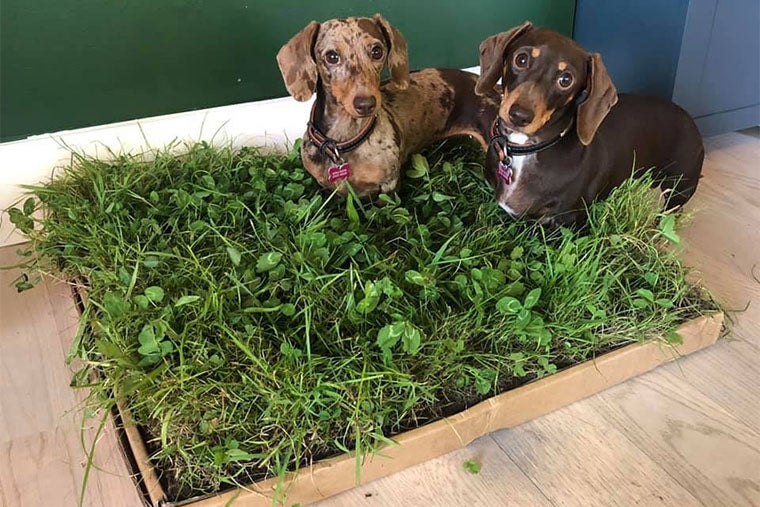
open image in gallery
The Oui Oui Patch indoor dog toilet, designed by Walker-Fooks (Supplied by Champion News)
But giving judgment, District Judge Obodai said of Ms Walker-Fooks: “When I listened to her give evidence, I gained the distinct impression that she was seeking to persuade the court that she was naive in relation to matters of business and intellectual property. I was not persuaded by her portrayal.
“In my opinion, she knew exactly what she was doing when she started City Doggo and started what [Ms Sloan’s barrister] Ms Rogers described as, ‘a campaign of infringement beginning in May 2022.’
“I am satisfied from Ms Sloan’s evidence, and I prefer her evidence to that of Ms Walker-Fooks, that the number of infringements, their content and significance and the likely individual and cumulative impact on the trademarks’ function means that the infringements themselves cannot properly be described as negligible or insignificant.
“I also find that they were not isolated or accidental incidents, but were a deliberate policy to promote the sign in the relevant market.
“The defendants clearly and deliberately intended to use Piddle Patch – and its variations – to promote their product because of the goodwill associated with the trade mark.
“I have considered them and I am satisfied and agree that each constituted a misrepresentation to the public that the defendants’ product was that of the claimant or was otherwise associated commercially with the claimant.
“Further, I find, based on the answers Ms Walker-Fooks gave during cross examination, that passing off is exactly what she intended when she began her campaign of infringement.”
The case will now return to court for an assessment of the compensation due to Ms Sloan’s company, although it has already been limited to a maximum of £10,000 by a previous judge.