

A year ago, in the shadow of a new round of redundancies but also an encouraging home draw with Arsenal, Manchester United announced plans for a new, 100,000-capacity stadium, replacing the club’s famed Old Trafford home.
The blueprints were ambitious, though one rather key question was without an answer. At a purported cost of £2billion ($2.7bn), building the new ground represented a massive outlay for any club, never mind one in the midst of huge cost-cutting after five straight years of loss-making. How, exactly, were United going to pay for it?
Several suggestions were mooted — and Sir Jim Ratcliffe, United’s part-owner, declared the build “eminently financeable” — yet 365 days on that question remains shrouded in uncertainty.
Overall progress on the stadium project has been glacial.
Freightliner, owner of a rail freight terminal to Old Trafford’s west, wants £400million from United for the land there, eight times what the club initially projected. The Old Trafford Regeneration Mayoral Development Corporation (MDC), tasked with overseeing the wider regeneration project within which a new stadium would sit, has, at least, held an opening meeting last Friday. The MDC could force through a compulsory land deal if it chose to, though Greater Manchester mayor Andy Burnham has previously played down that prospect in the immediate term.
Such slow movement does little to clear up the many questions surrounding the mooted move out of Old Trafford. One thing is certain: it will not be paid for out of United’s existing resources.
That is a bit of a given, really. No football club on the planet has £2billion (in itself now looking a low estimate) to spare. And that’s without mentioning how financially inefficient it would be to use up such a cash pile in one fell swoop; debt and borrowings are dirty words in football, but they have their uses, particularly when deployed for long-term projects.
Even so, funding a new home at United looked tricky a year ago and remains so now. Paying for it via Ratcliffe or his fellow owners, the Glazer family, is a remote possibility.
Ratcliffe’s INEOS business has financial concerns of its own, and has halted dividends for five years to try to tackle those, limiting his scope to add more to the £238.5million he has already injected into United coffers since February 2024 (notwithstanding the slim likelihood of him being allowed to dilute his fellow owners’ shareholdings any further). As for the Glazers, they’ve spent 20 years taking money out of the club rather than propping it up.
Debt, then, is the likeliest path forward for the bulk of the financing, as it has been for some of the largest recent stadium projects in football. Barcelona, Real Madrid, Everton and Tottenham Hotspur have all built up huge debt while building or renovating state-of-the-art home grounds.
Funding big infrastructure without big bank borrowings is rare for football clubs; Paris Saint-Germain’s investment in a new training centre and Manchester City’s developments at the Etihad Stadium, each of which will top £300million in total outlay, are recent outliers. Even in the latter’s case, around a third of the expected overall build cost has been funded through external lending.
A key difference between United and those other stadium builders is where each started from. None of those were already carrying large external debts on their balance sheets (Everton owed significant sums to owner Farhad Moshiri, but they were interest-free). For United, that couldn’t be further from the truth: outside those clubs mentioned, they are already the most indebted club in world football.
When Ratcliffe arrived two years ago, some fans hoped that his investment would see United’s debts fall. The opposite has happened. As of the end of December 2025, United’s borrowings had marginally increased on 24 months earlier, from £773.3million to £777m.
Yet the change would be greater (see: worse) were it not for favourable exchange-rate movements in that time. Had the USD:GBP rate remained unchanged from the end of 2023, United’s debt would have topped £800m in December, even after that £238.5m of funding from Ratcliffe in 2024.
United’s long-term, United States-dollar-denominated debt has not shifted in years, but the club has become more active in short-term borrowings. At the end of 2025, United had drawn down £290million under their revolving credit facility (RCF), their highest-ever level of short-term lending.
If cost-cutting has been the headline financial story since Ratcliffe’s arrival, something else has gone under the radar: debt manoeuvring. United have utilised the RCF with much greater frequency since their ownership rejig, drawing down, repaying and upsizing borrowing facilities with a frequency not seen before at Old Trafford.
The latest upsize came just last month. On 10 February, United increased their RCF by £50million, taking the overall facility (ie, the maximum United can borrow from it) to £400m. That followed a previous £50m upsize in July, a move that consolidated three RCFs into one that at least came with slightly lower borrowing rates. United have held RCFs for a long while but did not dip into them until the Covid-19 pandemic hit. Such short-term funding is now a regular part of club business.
Even with quarterly financial reporting, a luxury no other English club offers analysts, United’s debt position is now swiftly out of date. Since the end of December, the most recent reporting date, United have repaid £75million on the RCF.
Such flexibility with borrowings shouldn’t be a surprise now that Ratcliffe’s hand is at the tiller. INEOS, the company he made his fortune through, has, since its formation, been highly leveraged and reliant on careful debt management. Refinancing activities speckle the company’s 28-year history.
Where Ratcliffe has yet to make a dent or a difference is in the long-term debts, those which can be traced back to the Glazers’ leveraged buyout in May 2005. But that may soon change.
Those long-term borrowings remain at $650million, but are split into two tranches. The largest tranche comprises $425m in senior secured notes, incurring a fixed 3.79 per cent rate of interest (costing the club $16m, or around £12m currently, per year) and, crucially, is due to mature in June 2027.
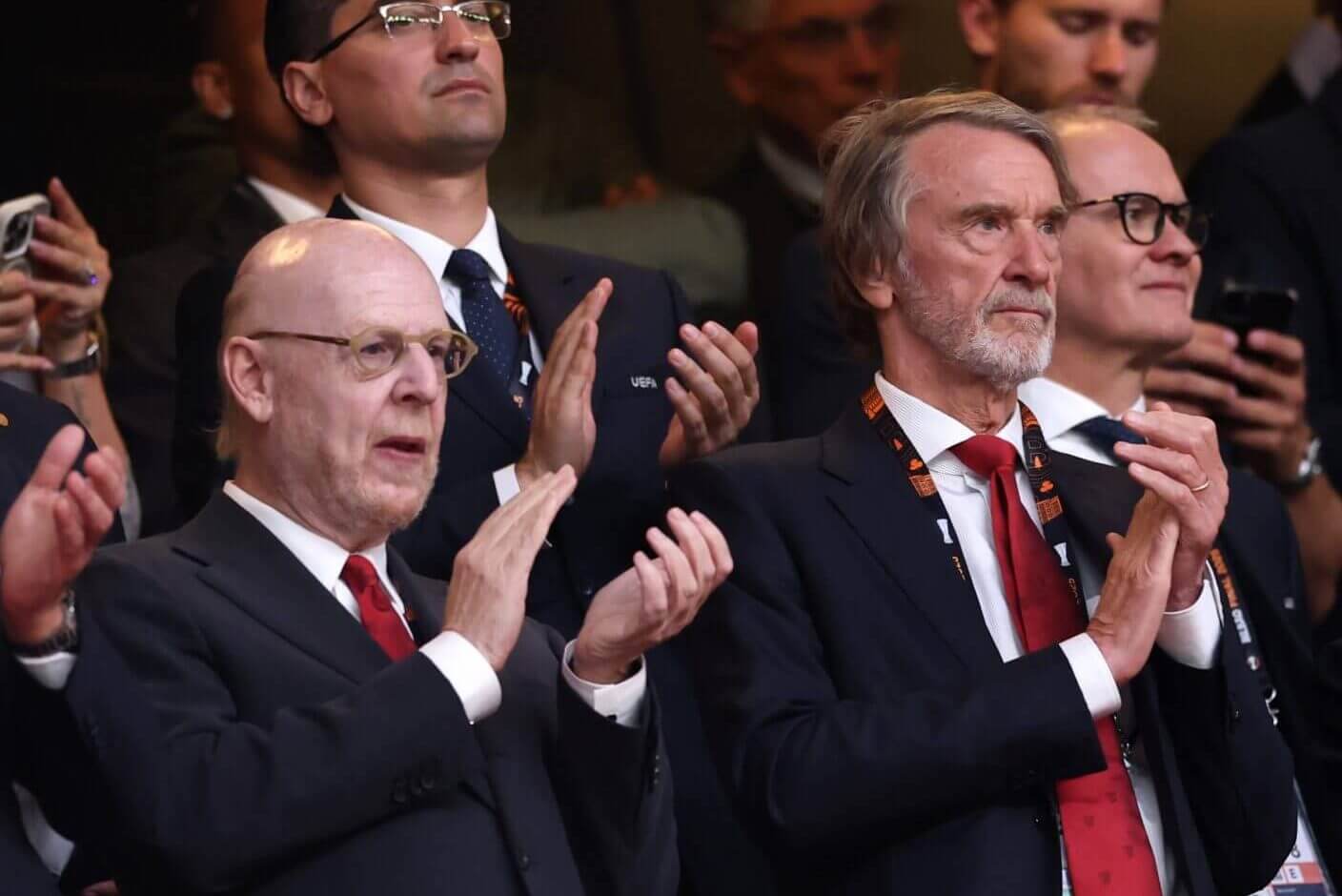
The Glazers and Ratcliffe are no strangers to utilising debt in their businesses (Getty Images)
The chances of United redeeming that in full are minute. People with knowledge of United’s debt structure, speaking anonymously to discuss sensitive matters, expect the club will seek to refinance the senior notes between now and this summer. United declined to comment when contacted by The Athletic.
The chances of securing favourable lending winnow as existing maturity dates loom, and refinancing a year in advance is commonplace.
An issue for United here is that worldwide interest rates have jumped since those senior notes were first secured on the club. There’s little chance they’ll be able to refinance at 3.79 per cent.
Instead, new borrowings will be taken out at higher rates. What any new agreement will look like is unknown but even at a not-unreasonable two percentage-point increase, assuming no reduction in the size of the loan, United’s annual interest costs would climb by more than £6million.
Like at any club, United’s cash balance is subject to seasonal swings. Their Q2 (July through to the end of December) free cash flow is always negative, reflecting those uneven cash flows, though, like the full-year picture, it has dipped deep into the red in recent seasons. If a business has negative free cash flow, it needs to dip into either existing reserves or find funding from elsewhere.
That was the case for United through the first six months of this season, where negative free cash of £170million was plugged via £130m in new borrowings under the RCF, alongside putting a £40m dent in the club’s existing cash balance.
This season’s Q2 report detailed a £60million improvement on 2024-25, even without European football, as cuts to spending and improved player sales make their impact. That shows things moving in the right direction yet United remain reliant on sourcing extra funding, and certainly until they make a Champions League return. Free cash flow was more than £200m in the red last season; recovering to a positive position in 2025-26 looks highly unlikely, even as works at the new Carrington training centre were completed earlier this season and reduced that particular resource drain.
Even with those improvements, to the end of February, United had borrowed a further £55million this season, and that’s after taking into account £75m of repayments since the beginning of 2026. The club continues to reach further into debt to fund the day-to-day, even before we consider the long-term liabilities a stadium build would require.
Most prominent in driving United’s cash down has been continued heavy investment in the playing squad, principally in the form of transfer fees.
Since Ratcliffe’s arrival, United have spent £369million cash on player transfers. Some of that relates to deals done before he bought shares in the club, but it also reflects huge transfer spending under him; in two years of him being on the scene, United have committed a gross £518m in transfer, agent and other fees relating to signing or retaining players (not including wages).
One interesting point, relative to future debt considerations, is the makeup of the transfer debt: £192million, or 61 per cent, of United’s £314m net transfer debt falls due for payment in 2026. That can be viewed both as a concern — it is a big sum to service in a short time, especially if Champions League football goes begging again next season — and an opportunity — once paid off, it will reduce United’s repayment burdens.
Of course, the latter only holds true if they slow their transfer spending. Wiping out over half of their transfer debts and then sitting tight in the transfer market would give United greater room to work in financially but might also damage their reputation as, still, one of the world’s most attractive clubs to play for. An amnesty on transfer spending looks unlikely.
Not that it wouldn’t be useful in slowing a worrying trend. United’s ‘football net debt’, an industry-specific measure that combines financial and transfer debt before deducting a club’s cash balance, continues to march steadily upward, and at the end of December 2025 totalled £1.047billion ($1.41bn). That is a new high at Old Trafford and a £49m increase on where the sum sat just before Ratcliffe joined the club.
A notable caveat, too, is something United did in late January. United’s net transfer debt of £314million at the end of December comprised £422.1m in total transfer debts, less £108.1m receivable on players sold. A month later, United pulled forward, or ‘factored’ £39.4m of the latter balance. In simple terms, United sold that receivable to a lender, receiving cash up front.
Transfer factoring is common in football, but this is the first (known) instance of United doing it. Clubs generally do it to aid cash flow, and a note in United’s Q2 financials links the factoring agreement to those RCF repayments. ‘In conjunction with’ the transfer fees being pulled forward, it says, United repaid £50m of their short-term borrowings.
Naturally, no lender is giving United free money in advance. Doing so costs money, though the interest rate on the factoring agreement is undisclosed. United may have reasoned they could project for cheaper than keeping that £50million chunk of the RCF borrowings would cost. But using that transfer fee money now means it can’t be used in the future, even as United’s transfer payables remain hefty. What’s more, if nothing else, entering into such agreements for the first time points to a club in need of cash.
At the end of February, United had £185million in borrowing headroom under the RCF. That could be drawn upon to help pay down 2026’s transfer debts. But doing so would not reduce United’s overall liabilities.
Of clear relevance to any discussion around financing at Old Trafford, as it has been for more than 20 years, is the cost of servicing United’s debts. Factoring nearly £40m in transfer fees this season has added an unknown sum to an interest burden that is once again lurching upwards.
Last season, United’s net interest payments topped £30million for the third year running, reflecting enhanced short-term borrowing and increased interest rates worldwide.
Alongside the $425million, 3.79 per cent fixed debt expected to be refinanced soon, United’s other long-term debt is a $225m term loan, bearing interest at the benchmark Secured Overnight Financing Rate (SOFR) plus a margin of between 1.25 and 1.75 per cent. SOFR sits around 3.65 per cent (and has dropped recently); the added margin depends on United’s level of debt relative to earnings, with recent figures pointing at the higher end of the range being used.
Interest on the $225million debt has generally topped five per cent in recent times and, even with the lowered borrowing rates on the now-syndicated RCF, the same rates apply there too. In all, United have now leaked over £30million in annual interest payments in each of the past three seasons, and are on course to do so again in 2025-26. To the end of December, they had paid a net £18.9m in cash relating to finance costs.
Loading further debt onto United — and potential multi-billion-pound debt at that — looks a difficult sell, and would cause repercussions with existing agreements and covenants.
A more likely scenario is United seeking to employ a separate, ring-fenced financing structure, akin to Real Madrid’s refurbishment of the Bernabeu. There, the Spanish giants have racked up around €1.2billion (£1bn; $1.4bn today) in stadium-related debt, yet they routinely avoid highlighting it, instead showing it as project debt separate to the club’s (much lower) day-to-day borrowings.
That’s both a bit sneaky and a justifiable way of separating distinct areas of the business. Madrid’s Bernabeu debt is tethered to the performance of the revamped asset. All three tranches of the overall stadium debt included grace periods, whereby repayments wouldn’t need to be paid until the works were sufficiently completed to start generating revenue. Madrid then repay the loans using those same, newly generated revenues.
A replacement for Old Trafford could feasibly be funded in the same way, though United already have significant debts to service. Once all three tranches start to be repaid in 2027, Madrid will spend €66million (£57m, $76.7m) annually until 2049.
United are already shelling out over £30m in annual interest payments alone, before the likely uptick in rates on the senior debt once that is refinanced, at a time when they’re dipping more regularly and deeper into relatively expensive short-term facilities.
Still, securing funding for a new stadium is far from unimaginable and, while it may be jarring, some would say intolerable, to see it happening at a football club, leveraging assets as much as possible is hardly new. Indeed, INEOS and Ratcliffe have been doing it for decades. There’s a reason he was bullish about financing a new stadium when those plans were first announced, 12 months ago.
United’s finances remain far from fixed, and footballing performance will dictate how quickly they can reach that destination. Cuts have been made but one of the consequences of actions taken in the past two years is a realigning of club finances with sporting results. Without Champions League football and the riches it brings, it is hard to see how United’s financial picture improves to the extent both owners and fans wish to see.
Yet they are also still one of the world’s premier football, and sporting, establishments. Revenue dwarfs most. The club’s allure remains, to both players and fans. Old Trafford sells out routinely, even as it falls further behind more modern stadiums.
Building a new home would cost a lot, but events of recent years show both a club able to withstand more than many and, when the crunch comes, willing benefactors such as Ratcliffe. Whether he was sensible to jump into the fray is up for debate, but there’s a reason he and others look upon Manchester United as a worthwhile venture, even as trophies wane and debts weigh as heavily as ever.
That quality, almost intrinsic, is, after all, why the Glazers came here in the first place.
Additional reporting: Mark Critchley and Laurie Whitwell.