
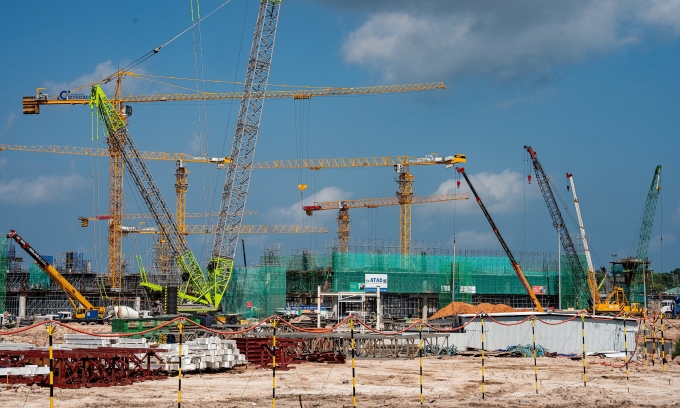
The island in southern Vietnam is the site of 21 major infrastructure projects being fast-tracked ahead of the summit, which will bring leaders from 21 Asia-Pacific economies to the island.
The projects include a massive expansion of Phu Quoc International Airport, the APEC Convention Center, Provincial Road 975, and thousands of hotel rooms. Nearly all are in their most intensive construction phase ahead of the rainy season, and nearly all depend on diesel-powered heavy equipment.
Contractors say they have only days of fuel left.
Since early March, diesel deliveries to the island have slowed to a fraction of what contractors need. The disruption traces back to a U.S.-Israeli military strike on Iran on Feb. 28 and Iran’s subsequent blockade of the Strait of Hormuz, a chokepoint for roughly 31% of the world’s seaborne crude oil.
The crisis sent global oil prices surging past $90 a barrel and forced shipping routes to divert around the Cape of Good Hope, adding cost and time.
Vietnam’s regulated diesel ceiling price has been raised twice in a week, hitting VND30,717 ($1.17) per liter on March 10, the highest since 2019. But on Phu Quoc, where fuel must arrive by tanker from the mainland, distributors have largely stopped accepting new orders, and contractors report paying up to VND36,000 ($1.37) per liter through secondary channels when they can find supply at all.
The airport expansion is one of the hardest-hit projects. Invested by Sun Group at a cost of nearly VND22 trillion ($840 million), the project aims to boost the airport’s capacity from 4 million to 18-20 million passengers a year, with a new terminal, a second runway, and an expanded apron system. The runway is being built by the Airport Construction Corporation (ACC), one of Vietnam’s major aviation contractors.
Le Vu Minh Quang, site commander for ACC’s runway 2 work, said his team needs about 10,000 liters of diesel a day to run 160-180 pieces of heavy equipment. Since March 2, suppliers have delivered only 2,000-3,000 liters. With just 6,000 liters left in reserve, the contractor has been borrowing fuel from other companies and buying it liter by liter from gas stations across the island. Over the past two days, 60% of equipment has been shut down and 70 vehicle and machine operators have been temporarily laid off.
“It will be very difficult for us to meet the April 30 deadline if diesel supply to Phu Quoc remains this restricted,” Quang said.
Another contractor on the airport project, Duc Chinh Investment and Construction JSC, faces the same squeeze on a larger scale. The company is handling earthworks across 270 hectares of the runway area, running 130 pieces of equipment in three shifts around the clock and consuming about 27,000 liters of diesel a day. The company built two fuel depots on site and contracted five suppliers. Before the crisis, tanker shipments of 200,000 liters arrived from the mainland every seven to 10 days. Since March 2, the supplier has fulfilled only pre-existing orders and stopped taking new ones.
Phung Manh Tuan, the company’s site commander, said the on-site depots hold 70,000 liters, supplemented by 50,000 liters sourced elsewhere on the island, enough for about a week.
“We don’t know how we’ll keep working next week if we run out. We may have to shut down entirely,” Tuan said.
The fuel crisis compounds the financial pressure on contractors. Duc Chinh said fuel costs typically account for 17-20% of a construction package’s total expenditure. With diesel prices roughly doubling, the company faces deepening losses unless the investor adjusts the contract price.
On Provincial Road 975, a vital artery connecting APEC infrastructure zones across the island, the situation is similarly dire. An Phat, the contractor, needs about 25,000 liters of diesel a day but has been receiving only 2,000-4,000 liters.
“The three-shift, four-team schedule has collapsed,” said Hoang Huong Son, the site commander. Multiple components are now behind schedule.
A typical large-scale infrastructure project on the island, worth VND5-6 trillion ($191-229 million) and built over roughly three years, requires 100-200 pieces of heavy equipment running continuously, consuming 10,000-20,000 liters of diesel a day. On-site reserves typically last only three to five days. When supply is cut, equipment stops, shifts break down, and hundreds of workers are left idle.
Contractors say the labor risk is as serious as the fuel shortage itself. Workers stranded without tasks will leave the island for the mainland or transfer to other projects, and recruiting replacements is extremely difficult.
“We’re very worried that if workers have nothing to do for even a few days, we won’t be able to keep them,” Quang said.
Construction firms have petitioned the investor for fuel cost support and called on authorities to establish a priority fuel allocation mechanism for APEC projects at controlled prices. If the shortage extends into April or May, when the dry-season construction window begins to close, the risk of widespread work stoppages grows significantly.