

“Hippie” bonobos are just as aggressive as “warrior” chimpanzees, according to a new study. However, the findings also reveal some key details about which sex is instigating the aggression. Bonobo females were more likely to attack males, while male chimps were more aggressive towards females. Female-on-female aggression in both species, they found, was significantly lower.
The work was in captive animals in zoos, so it may not apply to wild bonobos and chimps — but it adds to a growing body of recent research suggesting bonobos aren’t as peace-loving as once described.
Article continues below
You may like
Bonobos (Pan paniscus) and chimpanzees (Pan troglodytes) are our closest living relatives. The two species are geographically separated by the Congo River in Africa and evolved from a common ancestor between 1.5 million and 2 million years ago.
Although they are closely related, chimps and bonobos look and behave differently. Bonobos are smaller, with a more slender build, and the differences between the sexes are less pronounced than in chimpanzees. Bonobo communities are led by female coalitions; this is seen as a strategy for females to gain power over the larger males. Chimpanzees, on the other hand, have males at the top of their hierarchies.
Aggression is an important social behavior in apes, as it helps them protect territory, identify mates, assert dominance and secure resources. This aggression can range from vocal expressions of anger to physical attacks.
In the past, bonobos were seen as chimps’ peace-loving “hippie” cousins because they were thought to be less warlike and more likely to use sex to resolve conflict. But recent studies have started to upend that idea. In one recently reported incident, five wild female bonobos viciously attacked a male in the Democratic Republic of Congo.
In the new research, published Wednesday (March 11) in the journal Science Advances, researchers show that bonobos are just as aggressive as chimps — but they target males and females differently.
Little difference in overall aggression
The team analyzed how 22 zoo-based groups of chimps and bonobos in Europe interacted. A researcher sat in front of the enclosure and noted each act of aggression, which ranged from shouting to physical violence, that occurred throughout the day. The team spent two to three months at each zoo, recording a total of 3,243 instances of aggression from all of the apes older than 7 years. Seven is the youngest age at which researchers have recorded a bonobo male reproducing, Staes said.
They found that there were 1,368 instances of directed aggression from bonobos and 1,875 from chimpanzees. About a third (1,193) of the instances were “contact” aggression, meaning there was physical violence between the individuals rather than just shouting or other less-violent forms of aggression. Once the data were controlled for sex, relationship and context, there was little difference in overall aggression between chimps and bonobos.
What to read next
“You don’t find that chimpanzees are more aggressive,” Staes said. “Bonobos are equally aggressive.” Among chimpanzees, males were mostly responsible for the conflicts. Male and female bonobos, on the other hand, were equally likely to pick a fight. “There’s no difference between the sexes in bonobos, which was a bit surprising to us,” Staes said.
However, there were differences in which sex got targeted. Male chimps were aggressive toward both females and other males, and they were also more likely to get physically violent. Female bonobos were more likely to be aggressive toward bonobo males. While there is male-male aggression in bonobos, there is seldom female-female aggression, Staes said.
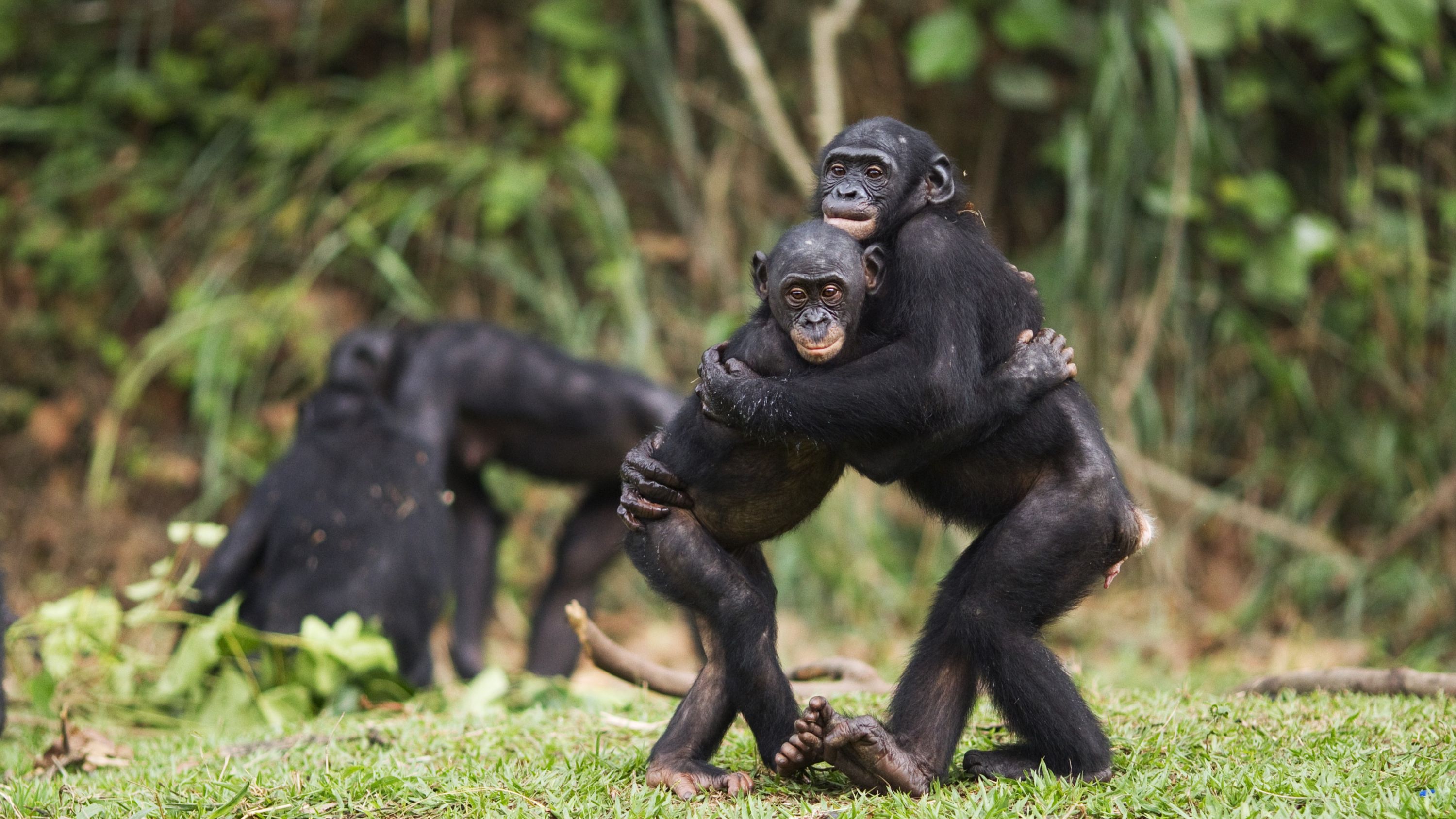
Bonobos, the researchers found, were better than chimps at conflict resolution. (Image credit: Anup Shah/Getty Images)
But bonobos are better at making up, she said, adding that in an upcoming study, the team plans to describe how the different groups resolved conflicts.
There were also stark differences between the levels of aggression among the bonobo groups in different zoos — more so than in chimps. “Our findings contribute to a growing body of evidence suggesting that behavioral patterns in Pan, including aggression, may be more influenced by group identity than by species-wide traits,” the authors wrote.
Zoos offer an interesting perspective on ape behavior. Some researchers argue that chimpanzees are more warlike because food was less available on their side on the Congo River and they had to compete with gorillas for resources. Conversely, bonobos had more food and fewer predators.
In zoos, these environmental factors are no longer at play. “The main benefit is that you take the two species out of their ecology and you really get the behavioral differences that are due to, for example, genetic changes that have occurred since the split from each other,” Staes said.
Sonya Pashchevskaya, a behavioral ecologist at the Max Planck Institute of Animal Behavior in Germany who was not involved in the research, said she welcomed the new insights. “This study is particularly important in light of the ‘hippie’ bonobos notion famously originating in the captive setting,” she told Live Science. “It is great to see the myth methodologically challenged in such a setting and with multiple groups involved.”
“Aggression, as a means to navigate conflict, is a normal part of life,” Pashchevskaya said. While chimpanzees are more prone to taking it to violent extremes, bonobos may “reserve real violence for the worst dangers.”
The new insight into bonobo aggression could provide more clues about conflict among our closest relatives. “While conflict is inevitable,” Pashchevskaya said, “there exist varying aggressive expressions, and from both sexes.”
Roth, T., Edwin, V. L., & Bryon, E. (2025). Replication Data for: Chimpanzees are not more aggressive than bonobos, but target sexes differently [Dataset]. In DataverseNL. https://doi.org/10.34894/c7vbhl