
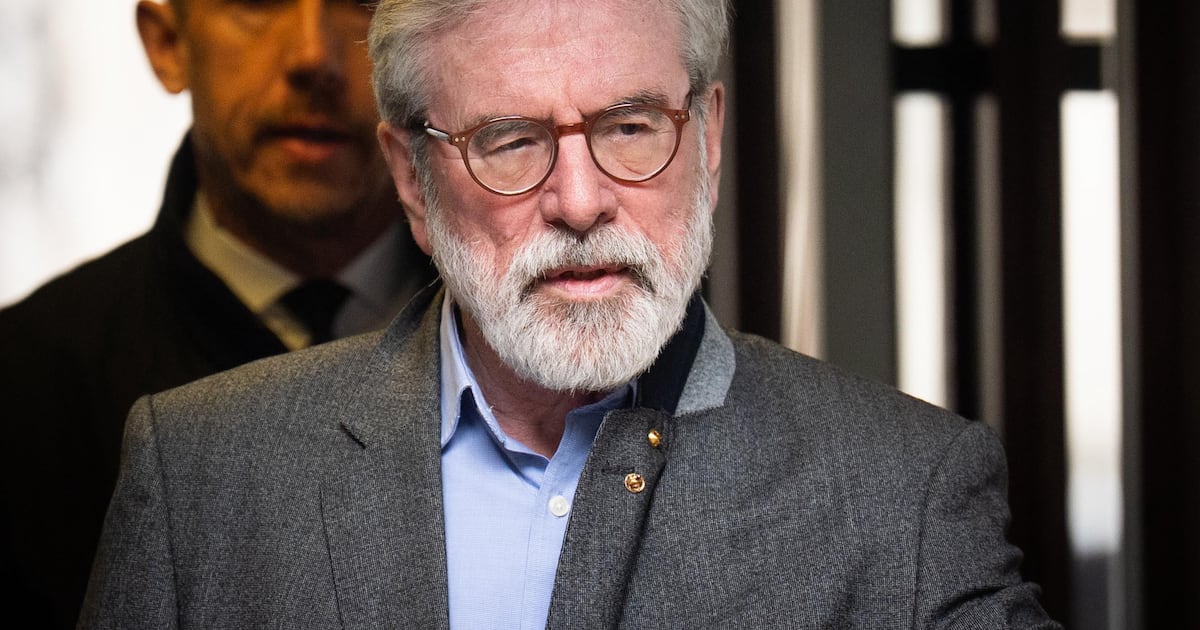
Former Sinn Féin leader Gerry Adams was the leader of the IRA until “the mid-2000s, and it was only then that he took a backwards step”, a senior former Police Service of Northern Ireland officer has told the High Court in London.
Former detective superintendent Timothy Hanley, who headed the PSNI’s serious crime squad until his retirement in 2016, was the officer who arrested Adams in 2014 in connection with the kidnapping and killing of Jean McConville in the 1970s.
He said he had been “intimately involved” with intelligence linking Adams to the IRA since he joined the Royal Ulster Constabulary in 1969, and from 2009 read “intelligence reports that came from everywhere”.
Adams is facing a civil suit for £1 in damages by three victims of IRA bombings in England, who argue that he was “directly responsible” for IRA bombs between 1973 and 1996.
Edward Craven, Adams’ barrister, was sharply criticised by Judge Jonathan Swift for questioning Hanley about a prosecution he faced in 1991 for shooting a Catholic youth he believed to have been armed.
Hanley had then made “a very significant error and had jumped to the wrong conclusion”, said Craven, who asked the former officer if he was now making the same mistake again in his allegations against Adams.
Interrupting, the judge halted the line of questioning, saying Craven had gone “wide of the mark” and was making “light of a tragedy” in the life of Hanley.
Hanley, clearly upset by the issue being raised in the Royal Courts of Justice, was acquitted of the killing, where the court found he had wrongly, but honestly, believed the youth was armed.
In his witness statement, Hanley said: “There is no question in my mind that Adams was the leader of the IRA.
“I know Adams was the leader until the mid-2000s, and it was only then that he took a backwards step. The IRA is like the Mafia; you never really leave it.
“He led the IRA throughout the whole of the Troubles from the early 1970s. I don’t dismiss that Adams took the IRA towards a peaceful resolution, but he also directed IRA terrorism which resulted in the deaths of many people.”
Craven questioned the accuracy of intelligence documents, since some other papers claimed that Adams had been a member of the Army Council, but had left in the early 1980s.
Earlier on Thursday, the court heard senior Garda intelligence officers repeatedly placed Adams and Martin McGuinness at IRA army council meetings that were always held in the Republic of Ireland.
Praising the quality of Garda intelligence, a former member of the Royal Ulster Constabulary’s Special Branch – testifying behind a screen and identified in court only as Witness B – said the Garda had even better insight into the IRA in the 1970s and 1980s than the RUC.
Up to then, the RUC had believed that the seven-strong army council met on their own, but the Garda were able to tell them confidently that other senior figures in the organisation were able to attend.
The meeting were always held in the Republic because it was “too dangerous” for the IRA to hold such meetings in Northern Ireland, Witness B told Adams’s lawyer James Robottom.
Rejecting questions over his memory, the 71-year-old former officer said he could not only remember what senior gardaí had told him, but he could also remember where the meeting happened too.
Denying any personal enmity towards Adams, the retired officer said he had spent the majority of his police career stopping members of loyalist paramilitary organisations from “killing totally innocent Catholics”, not pursuing the IRA.
However, he said it was “unthinkable” that bombs could have been set off outside of Northern Ireland, in England or elsewhere, without “the sanction, or explicit instructions” of the IRA army council.
“You would not have had a situation where somebody would say, ‘Wouldn’t it be a good idea to bomb London?’ They were a very disciplined organisation. There was a strategic element to them,” he said.
He was questioned about a letter unearthed in last year’s National Archives in Dublin from then Garda assistant commissioner Noel Conroy in May 1996 to the then secretary general of the Department of Justice, Tim Dalton.
The letter listed the leading figures in the IRA at that time, including Martin McGuinness, but it did not mention the name of Adams just weeks before the Arndale Centre bomb exploded Adams’s barrister told the former officer.
The former officer sharply disagreed with the Conroy letter’s judgment that senior Sinn Féin figure Gerry Kelly was emerging as the dominant figure in the organisation, saying that “was not the view of the RUC. I would doubt that very much”.
He said he believed Adams’s name had been deliberately kept out of the letter because his inclusion would have made it more difficult for the Irish and British governments to “do business with him”.
The witness said that had Adams not been a senior IRA figure there would been “absolutely no point in the British, Irish and the United States governments dealing with [him] in the way that they did on the road to the Good Friday Agreement”.
Adams “was, by far, the most strategic thinker” in the republican movement, said the former officer, who was previously a member of the British army’s parachute regiment before joining the RUC.
The case continues.