
The Government has signed an updated defence agreement with Britain designed to bolster maritime co-operation in tackling activity by the Russian “shadow fleet”.
The defence memorandum of understanding us due to be announced on the fringes of the United Kingdom-Ireland summit being held in Cork on Friday.
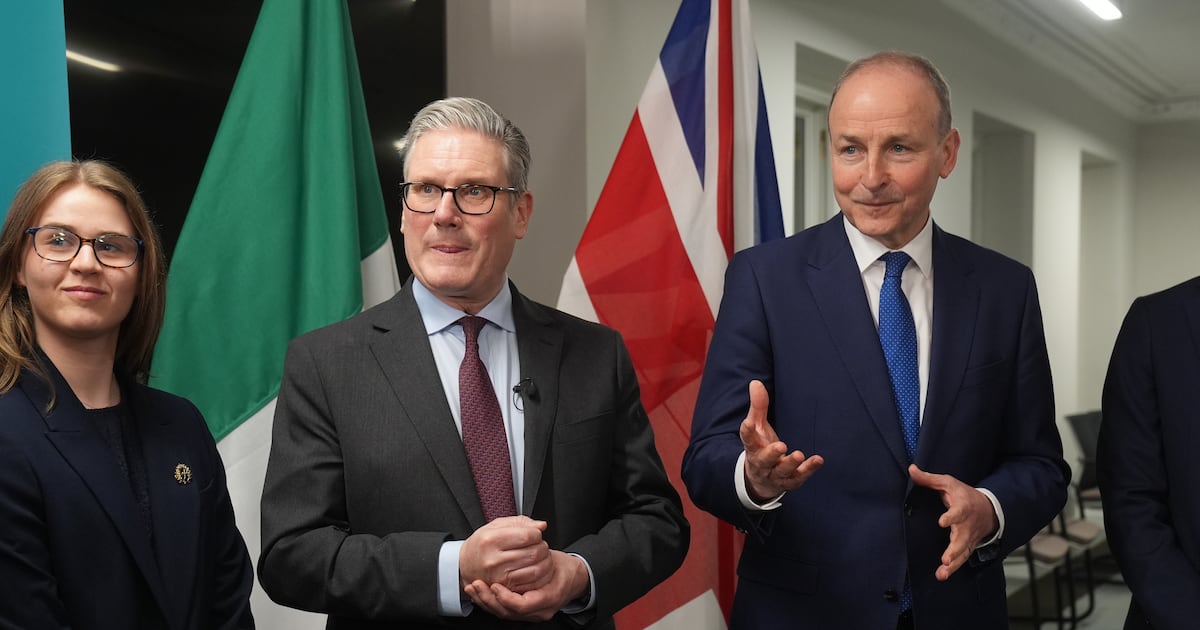
British prime minister Keir Starmer flew to Cork on Thursday where he was met by Taoiseach Micheál Martin, after first visiting Northern Ireland where he met the First and Deputy First Ministers.
It is understood that Minister for Defence Helen McEntee and UK defence secretary John Healey signed the defence memorandum earlier this week, which is an update to a 2015 agreement between the two countries.
The new deal, however, will focus particularly on maritime, cyber defence and security, information sharing and joint procurement initiatives.
The British Embassy in Dublin said the defence agreement would “bolster maritime co-operation in the face of threats from Russian shadow fleet vessels”.
Elements of the original deal which will be continued include staff exchanges, training and education, including civil and military personnel. The deal will be laid before the Houses of the Oireachtas.
McEntee said the agreement “respects fully the differing policy positions and security arrangements of both countries”.
It is understood McEntee and Healey also discussed Ukraine, the Middle East and Cyprus at the signing of the agreement.
It comes after McEntee received Cabinet approval earlier this week to draft laws expanding powers for the Naval Service to board vessels in Ireland’s maritime zones.
The UK-Irish summit is expected to focus on economic ties, as well as inward investment from Irish companies to Britain.
A group of around 250 protesters gathered at Cork City Hall on Thursday evening in advance of a cultural performance attended by Starmer and Martin.
Some protesters flew Palestinian flags and banners bearing the Iranian national colours with “Iran” printed on them. Republican groups were also present.
They accused Starmer and Martin of being complicit in genocide in Gaza and criticised Cork City Council for flying the Union flag over Cork City Hall.
Starmer made the short journey from UCC’s Centre of Executive Education across the river by car and was brought in the main entrance to Cork City Hall on MacSwiney Quay, shielded from the protesters by a line of Garda vans.
One man was arrested over a public order offence, although the protest was largely peaceful.
In a speech at City Hall on Thursday, the Taoiseach committed to “deepen co-operation” with the UK on infrastructure, housing, energy and climate, while “protecting our critical infrastructure, including under our seas”.
At the event Starmer said that in a world that had “more conflict now than at any time most of us can remember, globally” it was important that close allies “work together and stick together”.
He said both governments were focused on “turning the page on the turbulent Brexit years”.
“The relationship was not as good as it should have been in those years,” Starmer said.
“There is a real determination on both our parts that we will improve, reset and take that forward in a materially different way.”
He said the UK and Ireland were focused on “bolstering” shared prosperity and increasing the security of the seas.
Starmer said “this is an age of dramatic uncertainty”, pointing to the events of the last two weeks, saying co-operation was “more important now than it ever has been”.
He acknowledged the cost of living was uppermost in people’s minds and the associated impact of global conflicts on households.
Earlier in Lisburn, Starmer said addressing soaring energy bills was “absolutely on my radar”.
He said money had been set aside in the budget “for energy bills, to take money off those bills” and the UK treasury would “co-ordinate” with the Northern Executive to see how this could be delivered.