
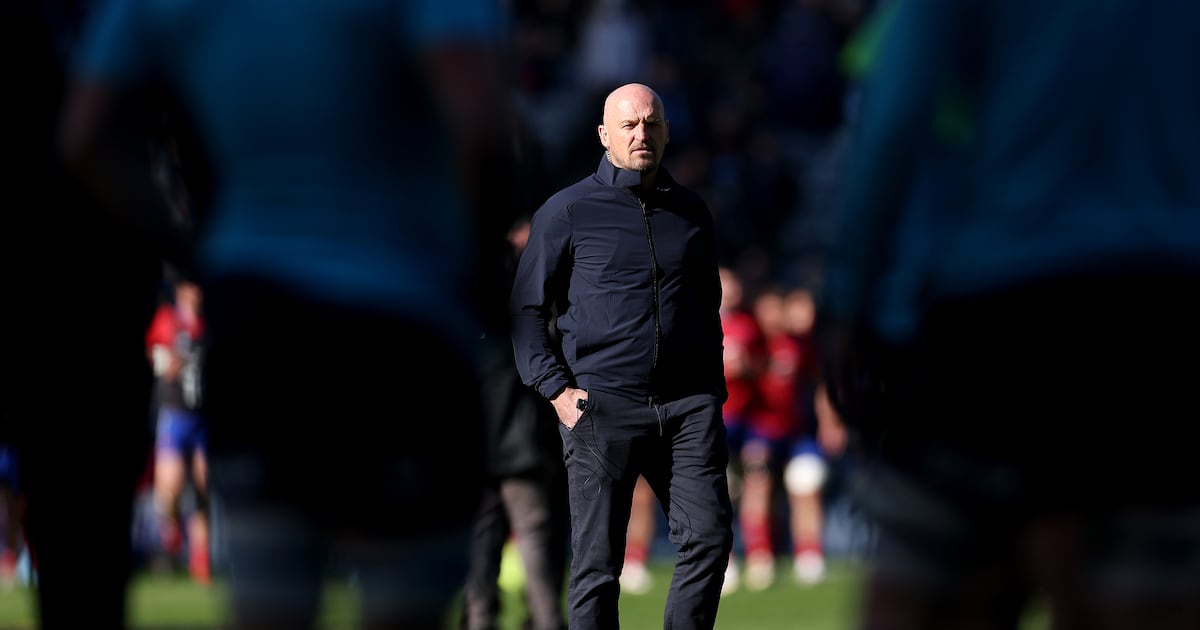
In a time of abject misery for the Scotland rugby team – we probably need to be a bit more specific here, it was 2014 – a fearless radio interviewer stuck a microphone in front of the face of Scott Johnson, the gruff Aussie who was interim coach at the time.
Scotland had just suffered some humiliation or other – another one – and Johnson’s carefree, wisecracking personality wasn’t exactly cutting it with the Scottish rugby public or the increasingly angry media. “Scott,” began the exasperated man on the mic, his face reddening, his trousers threatening to catch fire. “An utterly embarrassing defeat today. How does it feel to know that everybody in Scotland thinks you’re a bit of a clown?”
Ouch. The kind of vitriol dumped on Johnson’s head went away throughout the Vern Cotter years and for much of Gregor Townsend’s record-breaking run in the job from the summer of 2017.
 Do Scotland have a genuine chance at breaking their 11-match losing run to Ireland?
Most lately, there’s been shades of the Johnson treatment, though. Online, mostly, but press conferences became awkward. When Townsend sat down to chat there was an edge.
It’s hard to recall exactly when Scotland’s cyber rugby public turned on him, ditching the affectionate “Toony” moniker and replacing it with “Clownsend”, but when it happened it was unpleasant. For some, with no memory of how inspirational a figure he was as a player and nowhere near enough appreciation of some of the big days he has had as coach, it was just indiscriminate flak.
For others, it was a whole lot more complicated than that. Many, many fans arrived slowly and reluctantly to the conclusion that Townsend had probably been there too long and had to go. The whole Red Bull affair was a problem. Did a 30-day consultancy with the global sporting brand not suggest he was taking his eye off the ball at home? No, he said, and those who know him, believed him, but the optics were not good.
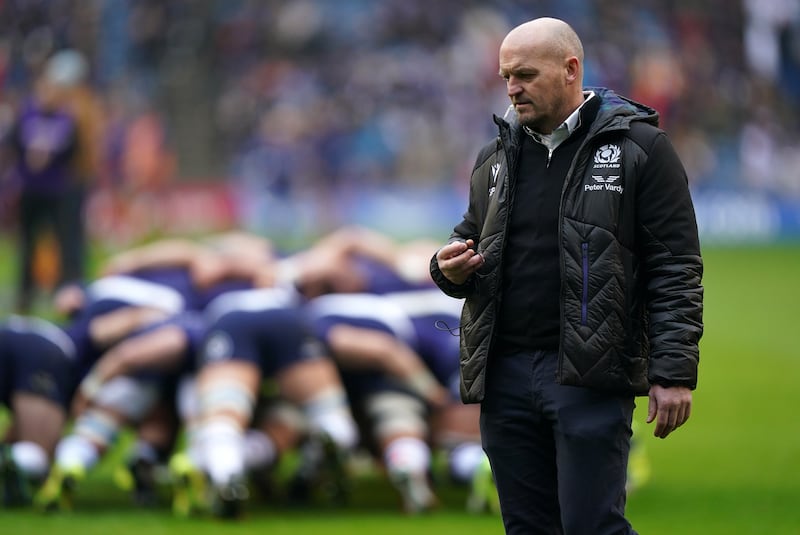 Many critics said the Scotland team would be better off without Gregor Townsend after a bad start to this year’s Six Nations. Photograph: Andrew Milligan/PA Wire
And they got worse when Scottish Rugby denied that he was having anything to do with Newcastle Red Bulls, only for quotes to emerge from Newcastle to the contrary. A conflict of interest? No. Townsend is too professional to allow anything get in the way of his work with Scotland, but it was still a PR mess.
Was he working his ticket with Scotland while preparing a move to Newcastle as director of rugby after his SRU contract ran out after the next World Cup? If so, shouldn’t he just go now?
After a third Six Nations in four years that delivered just two wins, Townsend was getting it in the neck. Then, his team blew a 21-0 lead against Argentina in the autumn. Then, the players came out in the media just before this Six Nations promising to right the wrongs of previous campaigns. They said they were now steelier and more demanding of each other, that they were going to be more ruthless on both sides of the ball and that the yo-yo stuff was going to stop.
A fortnight later they played poorly and lost to Italy. Townsend lost another bunch of supporters after that. This is, unquestionably, the best set of backs that Scotland has ever had and while you couldn’t be so certain about the forwards’ place in the pantheon, they’re still a very strong unit.
So why wasn’t Townsend wasn’t getting the best out of a fine group of players? And wouldn’t Franco Smith, the impressive Glasgow coach, be the man to take them forward?
Nobody could possibly have known what was about to happen. Nobody is talking about Red Bull any more. His critics – one of them right here – have had to backtrack. Gladly, actually.
Three wins in a row is still a small sample size, but if it becomes four at the Aviva then it’s not Townsend getting the sack that people will be calling for, it’ll be Townsend getting a statue. A team that has struggled awfully for years to find consistency and mental strength to go with their undoubted quality has suddenly found something.
They were pilloried after losing to Italy and came back and hammered England. They were in a deep hole in Cardiff – trailing 20-5 in front of a deafeningly loud home crowd – but fought back to win. They conceded two rapid-fire tries to France early on at Murrayfield, normally a cue for implosion. Not this time. They hit France with six tries on the bounce from there.
Ireland is the acid test, though. A Triple Crown on the line, for sure. A championship, possibly. Those are tangible things. The intangible is Scotland once again putting their rugby sanity on the line against a team that has caused them more pain than any other.
Townsend will never let his mask slip – he’s too canny and too classy for that – but if he was to speak openly about what beating Ireland would mean to him, the chances are you would hear a whole lot of angst and frustration, nine years of it, the impact of every one of his 11 consecutive defeats trotted out in microscopic detail.
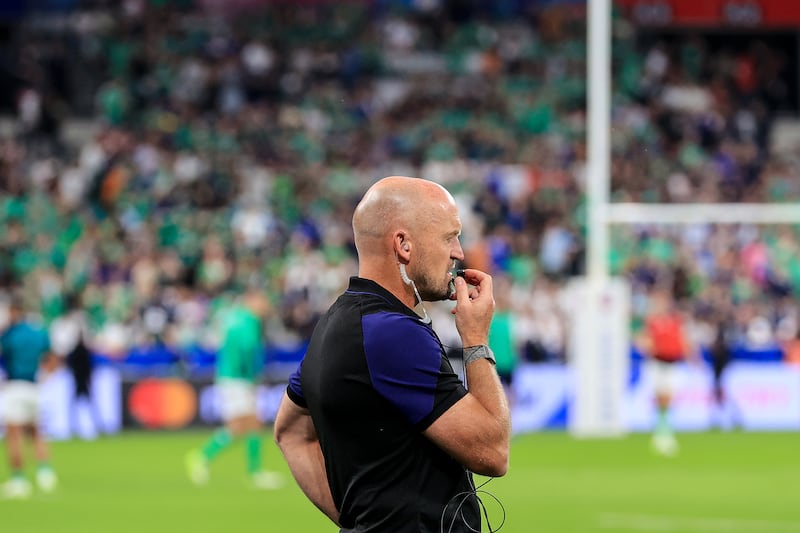 Gregor Townsend watches his Scotland team lose to Ireland at the 2023 World Cup. Photograph: Dan Sheridan/Inpho
Ireland haven’t just beaten Townsend’s team 11 times in a row, they’ve on occasion humiliated them, ripped them apart, left them dazed and confused.
Under Townsend, Scotland have played 880 minutes of Test match rugby against Ireland and they’ve been ahead for only 65 of those.
If you want to know which team in global rugby the Scots want to beat more than any other, then it’s Ireland. For the longest time it was England, but Townsend exorcised those English ghosts years ago.
It’s all Ireland now. How fitting, then, that their biggest game in Six Nations history comes against the nation that’s tormented them more than any other in recent times.
Scotland have lost the try count in 10 of the 11 games with Ireland. Townsend’s team, with tremendous game-breakers throughout the backline and probably their greatest ever player, Finn Russell at 10, have run in tries for fun against most other nations.
Ireland have been their kryptonite. In eight of the 11 games, Scotland have scored one or no tries. The average score is 26-12. Townsend has masterminded six wins over England and six wins over France (in all competitions). He’s brought an end to age-old losing runs against England at Twickenham, France in Paris and Wales in Cardiff. Statistically, he’s Scotland’s most successful ever coach. But this Ireland thing? It’s a curse that will not go away.
As a player, he lorded it over Ireland. The last time Scotland won on the site of the Aviva in 1998 – the rickety, concretey and strangely lovely old Lansdowne Road – Townsend was in the team. Things were simple for Scotland back then. They turned up and they beat Ireland, five times in a row between 1989 and 1993, then a draw, then another six in a row from 1994-1999.
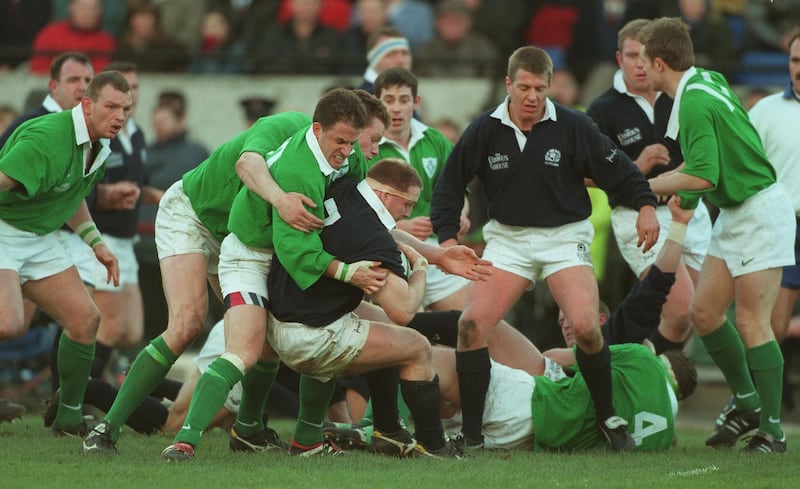 Matthew Stewart is tackled by Ireland’s David Humphreys during a routine win for Scotland in Dublin in 1998. Photograph: Inpho
He was in the last Scotland team that won a championship. He scored in every round of that 1999 Five Nations including the 30-13 win against Warren Gatland’s team in Murrayfield. An eternity ago. How the Scots have suffered in the years since.
Townsend has been through the wringer in recent times. A lot of people lost faith, which was understandable. Most of those same people are back on board now because three wins in a row is uncommon for Scotland and a title tilt of any kind is a first.
In his time as coach he has broken down barriers with wins in places where Scotland had almost forgotten how to win. In the northern hemisphere there is only one city left to conquer, one demon left to banish. This will be Townsend’s 103rd game as coach and, perhaps, the most significant of all.
Tom English is the chief sports writer and a broadcaster at BBC Scotland
Follow our rugby WhatsApp channel
If you want the latest rugby news, analysis and opinion then you should follow our dedicated WhatsApp channel. From Gerry Thornley to Owen Doyle and Gordon D’Arcy, we have every angle covered.
Find the channel here.